Fast path: If you already want to see your Big Five profile, start the FermatMind Big Five Personality Test →. If you want to understand how it differs from MBTI first, keep reading.
The 30-Second Reality Check
The Big Five is not a personality label: it does not sort you into one type;
it shows where you fall on five continuous traits.
It uses continuous trait dimensions: openness, conscientiousness, extraversion, agreeableness, and neuroticism are widely used personality dimensions in research.【1】
It can help explain work style: including how you handle stress, change, teamwork, and long-term goals.
It cannot predict destiny: it cannot decide your career success, income, intelligence, mental health, or life value.
FermatMind’s position: MBTI is closer to self-narrative language, the Big Five is closer to a trait coordinate system, and RIASEC is more useful for career-interest direction.
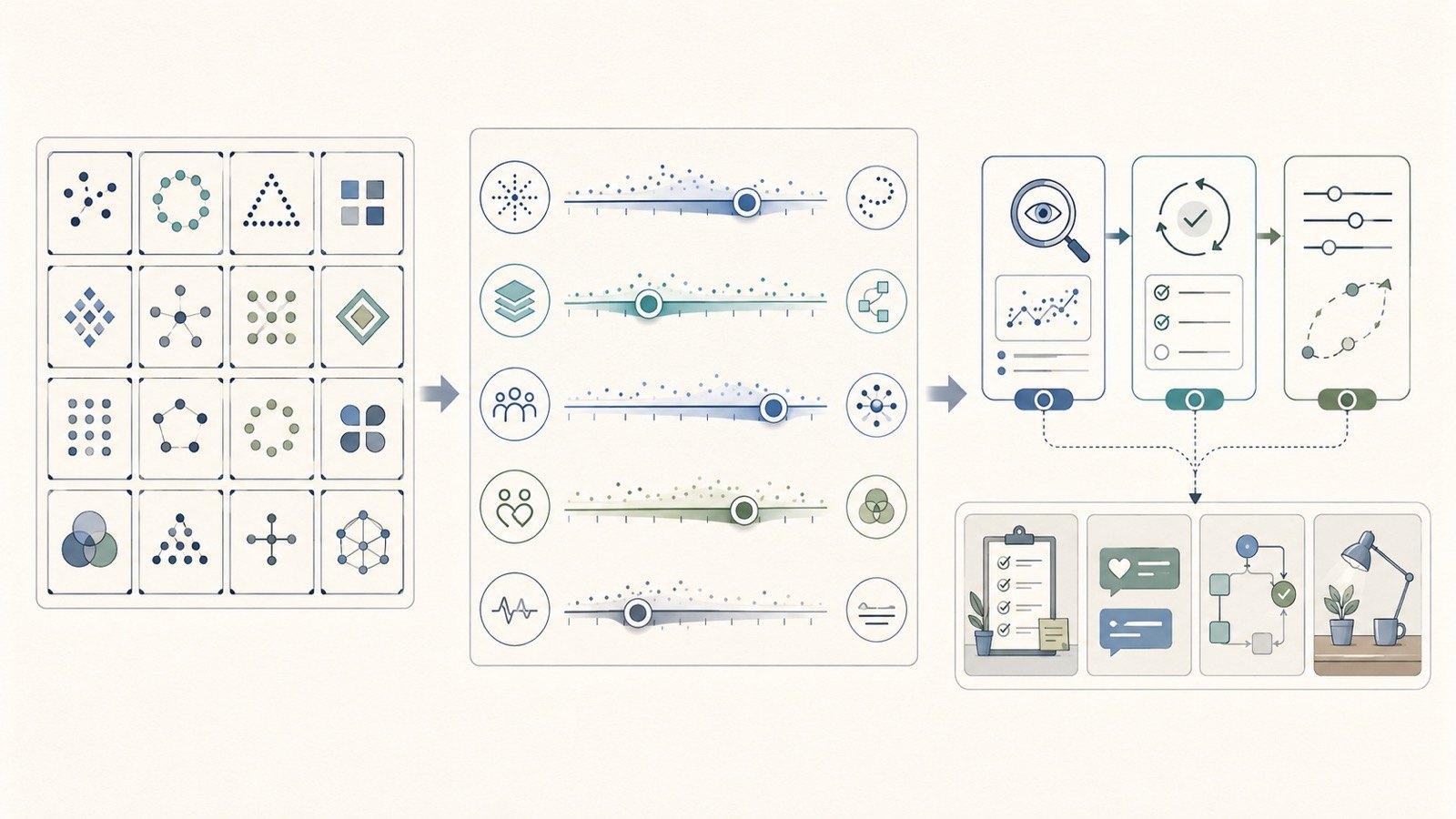
After taking an MBTI test, many people ask a second question: if four-letter type labels feel too rigid, is there a more continuous and research-friendly way to understand personality? That is where the Big Five personality test matters. The Big Five, also known as the OCEAN model, describes personality through five continuous dimensions: openness, conscientiousness, extraversion, agreeableness, and neuroticism. It does not ask which type you belong to. It asks where you tend to fall on each trait. The strength of the Big Five is that it describes stable behavioral tendencies. Its boundary is that it still cannot decide your career, relationships, ability, or life outcome. At FermatMind, we treat MBTI as a language for “how I describe myself,” and the Big Five as a coordinate system for “how I usually behave.”
What does the Big Five personality test measure?
The Big Five model understands personality as five relatively stable, but not completely fixed, trait dimensions. It does not divide people into sixteen types or nine types. It treats personality as a continuous distribution.【1】 That distinction matters. In a type model, you might ask: “Am I INFP or ENFP?” In the Big Five, better questions are:
How high is my openness?
How stable is my conscientiousness?
In what contexts does my extraversion show up?
Does my agreeableness make it hard for me to set boundaries?
Does my neuroticism make me more sensitive to stress?
This is not about which label sounds better. It is about which dimension explains your behavior more clearly.
What do the five OCEAN traits mean?
Action step: Want to see where you fall on openness, conscientiousness, extraversion, agreeableness, and neuroticism? Take the Big Five Personality Test →, then return to this article to understand what the result can and cannot mean.
O: Openness
Openness describes a person’s interest in new ideas, imagination, aesthetics, complexity, and abstract thinking. People high in openness are often drawn to new concepts, art, theory, cross-domain problems, and complex ideas. They may enjoy exploration, creativity, and reinterpretation. Low openness does not mean boring or backward. It may mean a person prefers familiar, stable, concrete, and verifiable things. At work, openness may influence how much you enjoy innovation, ambiguity, abstract problem solving, and creative exploration.
C: Conscientiousness
Conscientiousness describes self-discipline, planning, reliability, goal persistence, and organization. People high in conscientiousness often do well with long-term goals, task execution, rule-following, and detail management. They are more likely to break goals into steps and keep going. Low conscientiousness does not mean laziness. It may mean a person dislikes excessive control and prefers flexibility, improvisation, or exploratory work rhythms. In work settings, conscientiousness is often discussed in relation to task stability, reliability, and long-term goal management. Job performance research has also paid close attention to conscientiousness as a personality dimension.【3】
E: Extraversion
Extraversion describes a person’s preference for social interaction, expression, stimulation, action, and external feedback. People high in extraversion may gain energy from interaction and may be more comfortable expressing, influencing, participating, and acting quickly. Low extraversion does not mean social failure. It may mean a person needs quiet, solitude, depth, and lower-stimulation environments. At work, extraversion may influence communication rhythm, team interaction, and how much external feedback feels energizing.
A: Agreeableness
Agreeableness describes a person’s tendency toward cooperation, trust, empathy, compromise, and relationship maintenance. People high in agreeableness often care about others’ feelings, coordinate conflict, and support team harmony. Low agreeableness does not mean unkindness. It may mean a person is more direct, more boundary-oriented, and more willing to challenge others. In organizations, agreeableness can support cooperation, but it can also lead to over-compromise. The issue is not whether high is always better, but whether the person can balance relationships and boundaries.
N: Neuroticism
Neuroticism describes emotional sensitivity and reactivity to stress, threat, uncertainty, and negative emotion. People high in neuroticism may worry more, scan for risks earlier, and be more affected by pressure. But high neuroticism does not mean a mental health problem. It is not a diagnosis. It is a tendency in emotional reactivity. In real life, high neuroticism can also bring risk sensitivity, early warning, and self-monitoring. The problem begins when sensitivity becomes chronic overload.
Compare Output Structure, Then Check the Specific Instrument
A model’s continuous output is not proof that any particular test, translation, or intended use is valid. Check evidence for the specific version, sample, and purpose. A more accurate statement is:the Big Five fits more naturally with the continuous-trait approach used in modern personality psychology. MBTI divides people into types. The Big Five places people on dimensions. This creates three differences. First, the Big Five expresses degree. You are not simply extraverted or introverted. You fall somewhere on the extraversion dimension. Second, repeated scores require a compatible tool and measurement interpretation. You can observe changes in conscientiousness, neuroticism, or openness without asking whether your entire type has changed. Third, continuous trait scores are used in personality research. Continuous scores allow researchers to study relationships between personality and behavior, work, relationships, and health.【1】【3】【4】 But this does not mean the Big Five can decide your future. It is a tool for trait measurement, not a destiny engine.
Big Five vs MBTI: type labels versus continuous traits
Next layer: If you already know your MBTI type, use the Big Five Personality Test → to look beyond four letters and understand your trait strengths more precisely.
The core difference between MBTI and the Big Five is type versus trait.
Question
MBTI is closer to
Big Five is closer to
Who am I?
A type label
Five continuous trait coordinates
Output
Four letters
Five trait dimensions
User experience
Easy to remember and share
More detailed and analytical
Common strength
Self-narrative and communication
Stable traits and behavioral tendencies
Common risk
Label fixation
Being mistaken for destiny prediction
Best use
Quick expression of preference style
Understanding trait strength
MBTI is valuable because it tells a memorable story. The Big Five is valuable because it shows a more specific trait map. That is why FermatMind does not treat the two as replacements for each other. They answer different questions:
MBTI is better for asking: how do I express myself?
The Big Five is better for asking: where are my stable trait strengths?
RIASEC is better for asking: what kinds of work activities interest me?
What can the Big Five tell you?
1. It can help explain work style
The Big Five can help explain stable differences in work behavior. For example:
people high in conscientiousness may be better at long-term goal pursuit;
people high in openness may enjoy complex, novel, abstract tasks;
people high in extraversion may prefer high-interaction environments;
people high in agreeableness may cooperate well, but may also struggle to say no;
people high in neuroticism may notice risks early, but may also be more affected by stress.
These are not career verdicts. They are work-style signals.
2. It can help identify stress patterns
The Big Five is especially useful for understanding stress responses. People high in neuroticism may be more sensitive to uncertainty, conflict, criticism, and failure. People high in conscientiousness may over-carry responsibility because they care about execution. People high in agreeableness may suppress their own needs to protect relationships. None of these patterns means something is wrong with you. They only show that your stress sources may differ from someone else’s.
3. It can help explain teamwork
Teamwork is not just about whether you are extraverted. In a team:
high extraversion may push discussion forward;
high agreeableness may protect team harmony;
high conscientiousness may focus on delivery quality;
high openness may generate new possibilities;
high neuroticism may notice potential risks earlier.
Understanding these differences can make communication less moralizing. Many conflicts are not simply about who is right. They are about different traits being activated in the same situation.
4. It can reveal growth blind spots
The value of the Big Five is not to give yourself another label. It is to see repeated patterns. For example:
If you are high in openness but low in conscientiousness, you may have many ideas but struggle to execute them consistently.
If you are high in conscientiousness and high in neuroticism, you may be reliable but chronically tense.
If you are high in agreeableness but weak in boundaries, you may cooperate well but become depleted.
If you are low in extraversion but your work demands constant interaction, you may need a better recovery design.
This is where the Big Five becomes more useful than asking “what type am I?” It helps you see structural patterns.
What can the Big Five not tell you?
1. It cannot decide your career success
The Big Five can explain some behavioral tendencies, but it cannot determine whether you will succeed. Career success also depends on:
ability;
training;
education;
industry opportunity;
networks;
local market conditions;
values;
health;
family constraints;
luck.
Personality traits may influence how you work, but they do not do the work for you.
2. It cannot diagnose mental health
High neuroticism is not the same as an anxiety disorder. Low extraversion is not the same as depression. The Big Five is not a clinical diagnostic tool. It can describe emotional sensitivity and stress reactivity, but it cannot replace professional mental health assessment. If a test tells you that high neuroticism means you have a mental health problem, the test is being misused.
3. It cannot measure intelligence or ability
High openness does not mean high intelligence. High conscientiousness does not mean high ability. High extraversion does not mean leadership ability. Personality traits describe tendencies, not skill level. If you want to understand reasoning ability, job skill, learning speed, or task competence, you need different assessments and real-world task evidence.
4. It cannot replace a career-interest test
The Big Five explains “how you tend to act.” RIASEC, or the Holland career interest model, is more focused on “what kinds of work activities attract you.” These are different questions. A person may be high in conscientiousness, but that does not tell us whether they prefer finance, education, research, design, or management. Personality traits cannot replace career interests.
5. It cannot define your worth
There is no morally superior Big Five profile. High openness is not more advanced. Low openness is not backward. High extraversion is not more successful. Low extraversion is not social failure. High conscientiousness is not moral superiority. Low conscientiousness is not a character defect. The meaning of a trait depends on the task, environment, relationship, and goal.
How should you use Big Five, MBTI, and RIASEC together?
FermatMind recommends using these assessments as different signals within the same decision system, not as replacements for one another.
MBTI: identity language and communication entry point
MBTI helps you quickly describe yourself:
How do I gain energy?
How do I process information?
How do I make decisions?
How do I organize life?
Its strength is that it is easy to understand, easy to share, and useful for self-narrative. Its risk is that it can turn into identity attachment.
Big Five: stable trait coordinates
The Big Five helps you understand:
How stable are my behavioral tendencies?
Where do I react to stress?
What patterns show up in my work style?
What growth blind spots might I have?
Its strength is continuity, detail, and analysis. Its risk is being mistaken for destiny prediction.
RIASEC: career-interest direction
RIASEC helps you understand:
What kinds of work activities attract me?
Which work environments may be worth exploring?
What career directions should I validate next?
Its strength is its connection to career exploration. Its risk is being misused as precise career recommendation.
A more mature approach
The more mature question is not “which test is the most accurate?” but:
What did MBTI help me express?
What did the Big Five help me explain?
What did RIASEC help me point toward?
Do these signals hold up in real life?
FAQ
Is the Big Five more scientific than MBTI?
The Big Five is closer to the continuous trait model commonly used in academic personality research, but this does not mean it can predict your life outcomes.
Can the Big Five tell me what career fits me?
It can help explain work style, stress patterns, and behavior, but it cannot decide your career alone. Career decisions also require interests, skills, values, and real opportunities.
Does high neuroticism mean I have a mental health problem?
No. Neuroticism describes emotional sensitivity and stress reactivity. It is not a clinical diagnosis.
Can Big Five traits change?
Personality traits are relatively stable, but they are not frozen. Development, environment, and long-term behavior can influence trait expression.【4】
Should I take the Big Five or MBTI?
Choose according to the question and evidence for the actual instrument. You can compare the descriptions as reflection prompts, without treating one as universally stronger or converting Big Five scores into MBTI types.
Conclusion
The Big Five and MBTI express personality in different forms. That difference alone does not establish which specific test is more accurate or useful for an individual. But that does not mean the Big Five can decide your life. It can tell you where you tend to fall on openness, conscientiousness, extraversion, agreeableness, and neuroticism. It can help explain how you work, handle stress, collaborate, and grow. It cannot tell you your perfect career, predict your success, diagnose your mental health, measure your intelligence, or define your worth. FermatMind’s recommendation is simple: use MBTI to understand expression style, use the Big Five to understand trait strength, use RIASEC to understand career interests, and then test these signals against real life. A valuable assessment does not make the decision for you. It helps you ask the next question more clearly.
References
【1】John, O. P., Naumann, L. P., & Soto, C. J. (2008). Paradigm shift to the integrative Big Five trait taxonomy: History, measurement, and conceptual issues. In O. P. John, R. W. Robins, & L. A. Pervin (Eds.), Handbook of Personality: Theory and Research (3rd ed., pp. 114–158). Guilford Press.
【2】McCrae, R. R., & Costa, P. T., Jr. (1989). Reinterpreting the Myers-Briggs Type Indicator from the perspective of the five-factor model of personality. Journal of Personality, 57(1), 17–40.
【3】Barrick, M. R., & Mount, M. K. (1991). The Big Five personality dimensions and job performance: A meta-analysis. Personnel Psychology, 44(1), 1–26.
【4】Roberts, B. W., Walton, K. E., & Viechtbauer, W. (2006). Patterns of mean-level change in personality traits across the life course: A meta-analysis of longitudinal studies. Psychological Bulletin, 132(1), 1–25.
【5】DeYoung, C. G., Quilty, L. C., & Peterson, J. B. (2007). Between facets and domains: Ten aspects of the Big Five. Journal of Personality and Social Psychology, 93(5), 880–896.
Big Five vs MBTI: Which Personality Test Is More Scientific? | FermatMind