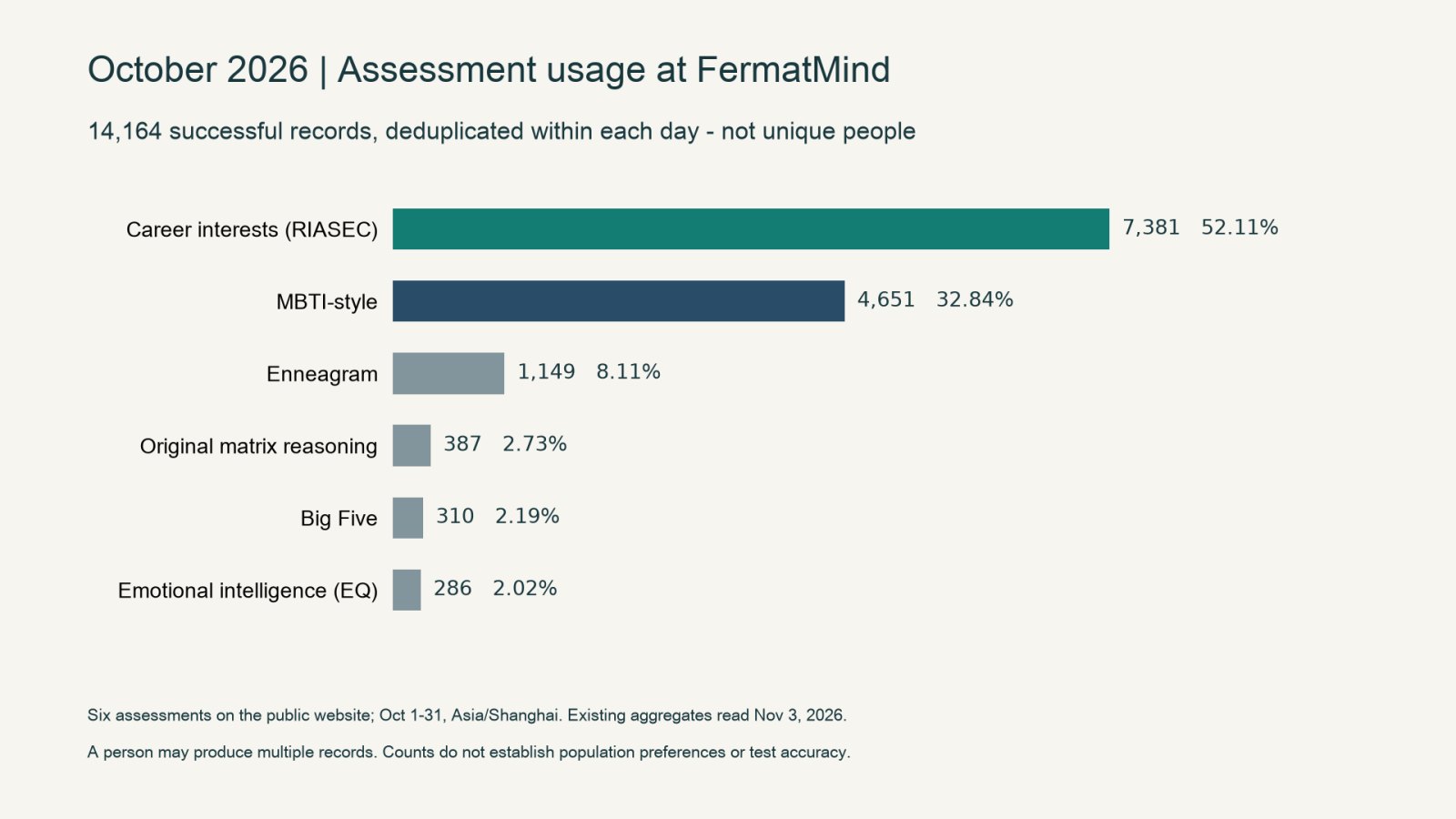
Three findings describe assessment activity on FermatMind’s public website in October 2026:
- Six assessments generated 14,164 successful result records, deduplicated by assessment attempt within each Beijing calendar day.
- Career interests (RIASEC) and MBTI-style accounted for 84.95% of those records: 7,381 and 4,651 respectively. This describes the composition of the recorded activity.
- Longer forms did not consistently account for more records. Longer forms accounted for the majority within MBTI-style and Big Five; shorter forms accounted for the majority within RIASEC and Enneagram.
The reporting window runs from 1 October 2026 at 00:00 to 1 November 2026 at 00:00, Beijing time (UTC+8), excluding the final endpoint. These are records from one platform, not 14,164 unique people or a representative survey of personality and career interests.
This report shows how recorded activity was distributed across assessments and forms. It does not establish why people took them or what happened after they received a result.
Which assessments generated the most records?
Career interests (RIASEC) accounted for 52.11% of the reported records, followed by MBTI-style at 32.84%. The remaining four assessments together accounted for 15.05%.
| Assessment | Successful result records | Share of the report total |
|---|---|---|
| Career interests (RIASEC) | 7,381 | 52.11% |
| MBTI-style | 4,651 | 32.84% |
| Enneagram | 1,149 | 8.11% |
| Original visual matrix reasoning | 387 | 2.73% |
| Big Five | 310 | 2.19% |
| Emotional intelligence (EQ) | 286 | 2.02% |
| Total | 14,164 | 100.00% |
Each percentage uses 14,164 successful result records as its denominator and is rounded to two decimal places. Records are combined across the platform languages represented in the aggregates; this English edition does not describe a separate English-speaking sample.
A successful record means that a result was computed, marked valid by the system and included under the existing analytics eligibility rules. The system’s “valid” flag is a record-status condition, not evidence of psychometric validity. Result generation also does not establish that someone read, accepted or used the report.
The table compares record counts. It does not combine scores from six different tools into a single measure of self-knowledge or rank the tools by accuracy. The visual matrix-reasoning exercise is FermatMind’s original exercise; a historical internal identifier does not make it an official Raven test.
How did longer and shorter forms compare?
The distribution differed across the four assessments with two reported forms. Within MBTI-style, the 144-item form accounted for 74.72% of successful records. Within RIASEC, the 140-item form accounted for 24.22%.
| Assessment | Shorter form: successful records | Longer form: successful records | Total for this assessment | Longer form’s share |
|---|---|---|---|---|
| MBTI-style | 93 items: 1,176 | 144 items: 3,475 | 4,651 | 74.72% |
| Career interests (RIASEC) | 60 items: 5,593 | 140 items: 1,788 | 7,381 | 24.22% |
| Big Five | 90 items: 115 | 120 items: 195 | 310 | 62.90% |
| Enneagram | 105 items: 722 | 144 items: 427 | 1,149 | 37.16% |
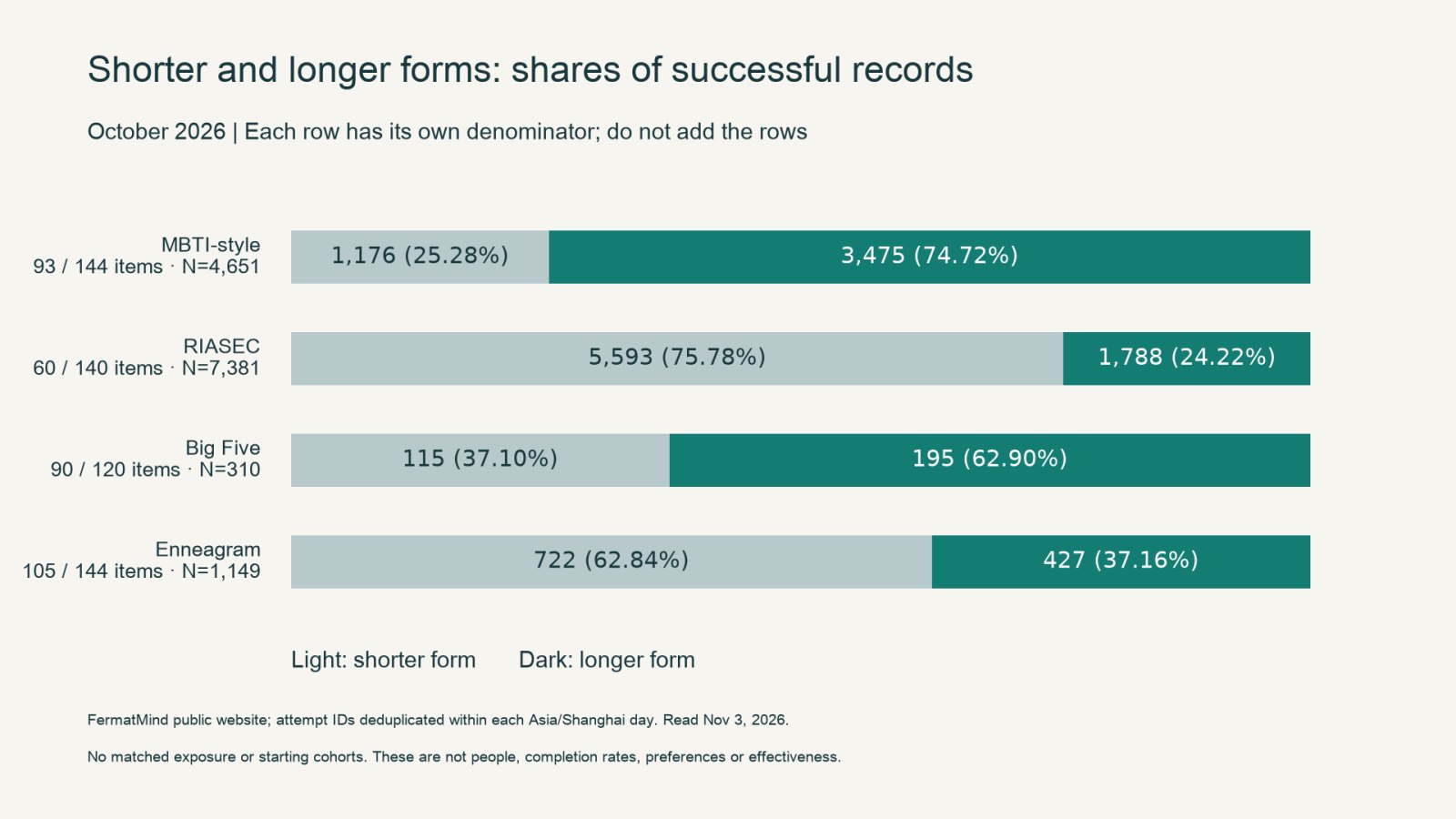
The denominator in each row is that assessment’s own successful-record total. These are the same records grouped by form, not an additional sample to add to the six-assessment total.
The pattern answers a narrow question: how were successful records distributed between the reported forms? It does not show whether people preferred longer or shorter questionnaires. The aggregates do not provide comparable exposure counts or matched groups of people who started each form, and this analysis did not control entry points, recommendations or traffic sources. The percentages are shares of successful records, not completion rates or an experiment on questionnaire length.
All 286 EQ records corresponded to the 60-item form. Of the 387 original matrix-reasoning records, 380 had an explicit 30-item form identifier. The remaining seven were not attributed to a specific form in the form-level aggregate used here; they have not been assigned a version.
These form counts contain no score distributions. They cannot establish which form produced higher scores, measured a construct better or had a greater effect on participants.
What does the concentration in RIASEC and MBTI-style mean?
The supported observation is straightforward: RIASEC and MBTI-style generated most of the successful records in this set of six assessments during this window.
The reason remains unknown. More career-interest records do not establish rising career anxiety. The report contains no measures of participation motives or anxiety, and no suitable information on age, occupation or job-search status. Coursework, curiosity and career exploration are possible reasons someone might take an assessment, but none was established by these counts.
Entry-point placement, search exposure, content recommendations, available forms and repeat attempts could also affect the distribution. Those conditions were not controlled in this analysis. The percentages therefore cannot establish a general population preference for one psychological model, demonstrate that RIASEC is more accurate or show that one assessment is more useful.
Why records cannot be read as people
The daily aggregation counts the same assessment-attempt identifier once within a Beijing calendar day. The monthly total adds those daily counts.
A person can generate multiple records by taking different assessments or making repeat attempts. An existing attempt whose result is computed again on another date can also enter another day’s count. The available aggregates do not deduplicate attempts across the full month or identify unique people.
Accordingly, 7,381 RIASEC records cannot be described as 7,381 job seekers, and the total cannot be presented as 14,164 independent respondents. Daily IP counts were not added together to estimate monthly unique people.
The global aggregate separately recorded 41 completed records excluded under the existing rules. These include marked internal testing, probes, confirmed automated activity and other ineligible traffic; older records may use existing legacy exclusion rules. The exclusion count does not guarantee that every unmarked test or anomalous visit was identified. This report did not reverify participants’ identities.
Questions this edition cannot answer
The available October aggregates do not support analysis of MBTI type proportions, Big Five trait distributions, assessment-quality indicators or differences between demographic groups. Missing type, dimension or quality data mean those analyses are unavailable; they do not mean that a type had no participants or a characteristic was absent.
Entertainment-test completion paths are not fully covered by the result-counting chain used for this report. The table cannot establish that entertainment tests received little use or support a completion-rate comparison between entertainment and the six reported assessments.
No comparable September baseline was established, so this edition reports no month-over-month growth. Search clicks, browser sessions and broader event counts were not substituted for successful assessment results.
How to cite these findings
Keep the platform, month, counting unit and denominator together. For example:
FermatMind’s October 2026 public-site report counted 7,381 career-interest (RIASEC) successful result records, representing 52.11% of 14,164 records across six assessments. Records were deduplicated by assessment attempt within each Beijing calendar day. These single-platform counts do not represent unique people, national preferences or population psychological distributions.
Suggested reference:
FermatMind Editorial. (2026). What October 2026 Records Show About Assessment Use on FermatMind. https://fermatmind.com/en/articles/assessment-usage-october-2026
Data, method and editorial responsibility
Source and scope. The report uses existing daily aggregates for six assessments on FermatMind’s public website. Private organizational projects are outside its scope. Individual answers, scores, private result text, identities and private links were not accessed for this analysis and are not published.
Time and counting rules. Results are assigned to Beijing calendar days using their computation time. Eligible successful records are deduplicated by assessment-attempt identifier within each day, then summed for the reporting window. The six-assessment table uses 14,164 as its denominator; the form comparison uses each assessment’s own total.
Selection and weighting. People chose to enter and use the platform. The records are not a probability sample. No population weighting or missing-value imputation was applied, and no sampling margin of error for national estimates is reported.
Data status. The aggregates were read on 3 November 2026. The historical daily rows used for the report were last refreshed at approximately 02:15 Beijing time that day. All 31 October dates had a global daily row marked complete. That coverage label does not establish that every upstream source is final or cannot be backfilled. Any material revision should identify the version and reason rather than silently change the denominator.
Responsibility and product relationship. FermatMind Editorial is responsible for this report. FermatMind’s developer operates the assessments described, creating a direct product interest in the subject. Codex provided AI assistance with extraction, calculation, editing and checks; WorkBuddy assisted with topic selection and media-direction discussion. AI-assisted checks do not constitute human expert review. This is first-party platform reporting, not an independent third-party survey, peer-reviewed paper or clinical study.
Other platform statistics. These monthly activity counts and historical server statistics use different scopes, units and time windows. They cannot be directly substituted for one another or subtracted to infer changes.
The report draws on the principles of disclosing scope, methods, selection and limitations in AAPOR’s Disclosure Standards. This is a methodological reference, not AAPOR certification or endorsement. FermatMind’s Privacy Policy and data and privacy information describe the platform’s data-use boundaries.