What Are the 30 Big Five Facets? Hierarchical Differences and Equivalence Traps Across NEO-PI-R, BFI-2, and BFAS
The 30 facets come from the NEO-PI-R's 240 items and 6×5 structure. BFI-2 uses 15 facets, while BFAS measures 10 aspects. Identically named facets across instruments cannot be assumed equivalent. This article lists all 30 facet names and descriptive glosses across 5 domains and offers a three-step framework for comparing identically named indicators in two reports.
What Are the 30 Big Five Facets? Hierarchical Differences and Equivalence Traps Across NEO-PI-R, BFI-2, and BFAS
The report scenario and scores of 82 and 58 are fictional editorial illustrations, not real cases or a common scale. Two Big Five reports both show an “assertiveness” score: 82 in one and 58 in the other. Can you compare them directly? The short answer is to check the instruments first. The 30 facets come from the NEO-PI-R’s 240 items and 6×5 structure. BFI-2 uses 15 facets, while BFAS measures 10 aspects. A shared facet name across instruments does not establish equivalence. Check the instrument, definition, and score type before comparing. This article explains where the 30 facets come from, why Big Five tools divide the traits differently, and whether identically named scores on two reports can be compared.
Where the 30 Facets Come From: The NEO-PI-R’s 240 Items and 6×5 Structure
When people say that the Big Five has 30 facets, they are referring to the structure of a particular instrument, the NEO-PI-R (NEO Personality Inventory-Revised). According to the IPIP ESCS Technical Report (Goldberg & Saucier, 2016), the NEO-PI-R has 240 items divided into 5 domains with 6 facets each, for 30 facets in total [S5]. This is a design choice of the NEO-PI-R, not a fixed requirement of Big Five theory.
An evidence boundary matters here: the facts about “240 items / 30 facets / 6 per domain” come from the IPIP ESCS technical report. The text of the NEO-PI-R manual (Costa & McCrae, 1992) was not directly accessed and is retained only as a bibliographic reference [S3]. The English names of the 30 facets below were checked against the IPIP NEO Facets Table [S6]. The Chinese labels in the source article are cautious descriptive translations; official Chinese versions may differ, so use the original English names as the anchor.
Neuroticism (N)
N1 Anxiety (descriptive gloss: anxiety)
N2 Angry Hostility (descriptive gloss: anger and hostility)
All 30 English names above were checked against the IPIP NEO Facets Table, without omissions or mergers [S6]. The parenthetical English glosses convey the source article’s descriptive Chinese labels, which are not authorized official Chinese labels. No construct definitions, instrument items, or protected manual content are reproduced.
Not Every Big Five Instrument Uses 30 Facets: BFI-2’s 15 and BFAS’s 10
Treat the NEO-PI-R’s 30 facets as the “standard” for all Big Five reports, and the next report may look confusing. BFI-2 (The Next Big Five Inventory) uses only 15 facets, with 3 per domain. BFAS divides the model another way. The three instruments use different levels of detail within the broader hierarchical family of Big Five concepts.
The 15 facets of BFI-2. When Soto and John (2017) introduced BFI-2, they aimed for greater bandwidth, fidelity, and predictive power than the original BFI while controlling acquiescent responding. The original BFI was not designed as a hierarchical facet measure, although post hoc facet scales were later developed; these are not the BFI-2’s 15-facet structure [S2]. BFI-2 therefore has its own 5×3=15 structure. It is not simply a shorter version of the NEO-PI-R’s 30 facets.
Aspects and BFAS. In “Between facets and domains,” DeYoung, Quilty, and Peterson (2007) proposed an intermediate level between the Big Five domains (5 of them) and narrower facets (such as the NEO-PI-R’s 30): two aspects per domain, or 10 aspects in all [S4]. To measure these 10 aspects, the authors constructed the BFAS (Big Five Aspect Scales), a 100-item instrument with 10 aspect scales. In DeYoung and colleagues’ study (2007), this constructed 100-item BFAS measure was validated in a second sample (N=480).
Keep the two ideas distinct:aspects are a level between domains and facets; BFAS is the 100-item instrument used to measure that level [S4]. The aspect level is not itself an instrument; BFAS is.
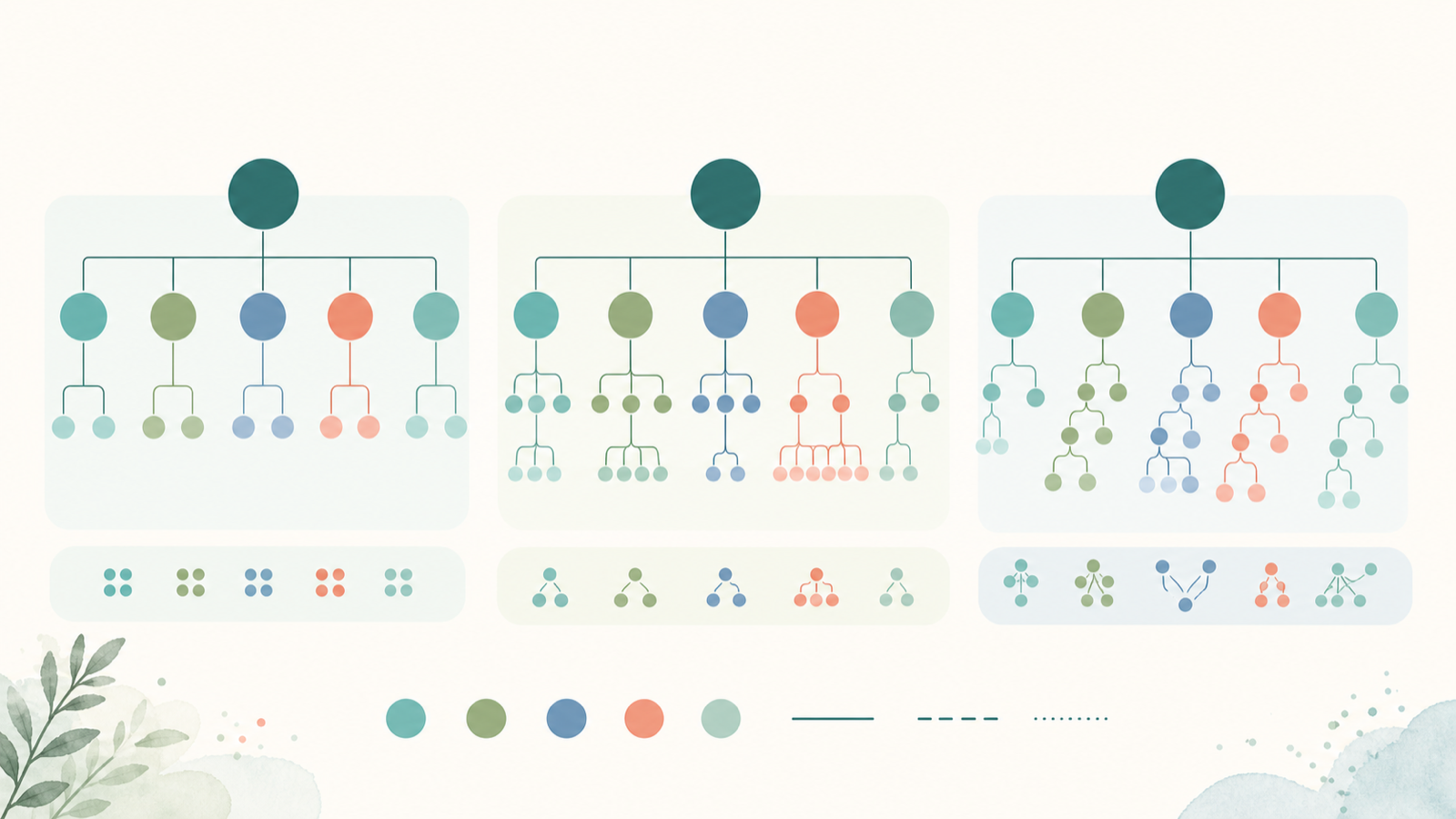
Placed in a Big Five hierarchy, the differences are easier to see:
At the broadest level are the Big Five domains: Neuroticism, Extraversion, Openness, Agreeableness, and Conscientiousness. Goldberg’s (1990) lexical factor analysis found that five broad factors generalized in that sample, whereas an attempted sixth factor did not generalize consistently [S1]. This source concerns factor stability at the domain level; it does not analyze facets or aspects.
In the middle are aspects: 2 per domain, 10 in all, measured by the 100-item BFAS [S4].
At a narrower level are facets: 6 per domain and 30 in all for the NEO-PI-R; 3 per domain and 15 in all for BFI-2 [S2, S5, S6].
In short: NEO-PI-R 240 items → 30 facets; BFI-2 → 15 facets; BFAS 100 items → 10 aspects. All three belong to the Big Five family, but they differ in granularity, construct boundaries, and scoring. Scores cannot be aligned by name alone. When someone says the Big Five has “N facets,” that number already hints at an assumed level and instrument.
Why Identically Named Facets Are Not Automatically Equivalent
Return to the opening example. Two reports both say “assertiveness,” with scores of 82 and 58. Is one report more accurate? The two numbers alone cannot answer that. We do not yet know whether the reports use the same instrument, version, score type, or scoring rules. “Assertiveness” is a shared label, not proof that either score is more “real.”
Here is a working rule:a facet label alone cannot establish that identically named indicators in two reports measure equivalent constructs . There are three reasons.
First, a label names a construct; it does not define it. The same English facet name can be operationalized with different sets of items across instruments. NEO-PI-R Assertiveness and BFI-2 Assertiveness share a name, but their item sets, scoring keys, and construct boundaries must be checked against the respective manuals before judging whether they align.
Second, the constructs may be operationalized differently. NEO-PI-R measures 6 facets under each domain; BFI-2 measures 3. Each domain can be divided into 2 aspects, which BFAS measures as 10 aspects in total. An indicator called “assertiveness” may therefore have different item combinations or theoretical boundaries across instruments. The number of facets alone does not show which division is “broader,” “narrower,” or more accurate.
Third, the sound conclusion is not that two identically named indicators must differ. It is to keep the unknowns explicit:because they come from different instruments, do not assume their definitions, items, and scoring are equivalent. Establishing equivalence requires the source instruments’ manuals and scoring keys, not a guess based on labels.
This boundary matters for readers too. This review did not access the NEO-PI-R manual text or use complete BFI-2 or BFAS manuals to verify cross-instrument equivalence. Structural descriptions rest on checked abstracts or excerpts of original research, public technical reports, and the IPIP comparison table [S2, S4, S5, S6]. Material from manuals not directly accessed remains bibliographic only [S3].
Two Reports Say “Assertiveness”: Can 82 and 58 Be Compared?
The 82 and 58 here are illustrative numbers only. They do not come from a real person or represent a common scale. The article provides no evidence that they share a scale, so they cannot be compared directly; this does not establish that two actual reports necessarily use different scales.
Why? An indicator called “assertiveness” on each report might come from one of BFI-2’s 15 facets or one of the NEO-PI-R’s 30 facets. One report might give a 1–5 Likert mean, while the other gives a T score, percentile, or custom standard score. They might also use different norm samples and reference points.
Putting 82 and 58 side by side assumes two unverified claims: that the scores use the same scale and that “assertiveness” refers to the same construct. Neither assumption is justified by the labels.
Before comparing, identify the score types. Raw scores, means, standard scores, and percentiles are not interchangeable. A number becomes interpretable only with its scale, scoring method, and reference information. For example, one report could provide a T score (M=50, SD=10) and the other a percentile. Even identical-looking numbers would mean different things. Both might display “82,” but one could be a T score of 82 (well above the mean) and the other a percentile of 82 (whose specific meaning depends on the reference group and norm information). There is no automatic conversion between them, and a public crosswalk may not exist.
Different instruments, score types, or testing conditions may each prevent direct comparison. With insufficient information, do not assign a specific cause.
A Three-Step Alignment Check: Identify the Instrument → Read the Definition → Compare the Constructs
If you want a meaningful comparison across reports, consider this editorial three-step checklist. It is not a validated equivalence test or score-conversion method. It begins the “interpret” stage of “measure → interpret → act → review.”
Step 1: Identify the instrument. Check the report’s footnotes or appendix for the instrument used: NEO-PI-R, BFI-2, BFAS, or another tool. If it says only “based on the Big Five model” without an instrument name and version, you start with uncertainty. You may not even know whether the report means 30 facets or 15, so a detailed comparison cannot yet begin.
Step 2: Read the definition. Find the official definition or item-set description of the facet in that instrument. For “Assertiveness,” ask what it measures there: initiating behavior, strength of opinion expression, or a mixture. Pay attention to the construct’s scope. Differences in instrument, score type, or testing conditions may make results incomparable; with insufficient information, do not infer the exact cause.
Step 3: Compare the constructs. After the first two steps for both reports, ask whether their “assertiveness” indicators measure the same construct. Using the same instrument, version, score type, and scoring rules is only one necessary condition for basic comparability. It does not by itself prove real change or an individual difference. Without checked evidence of equivalence, conversion, or association, identically named indicators across instruments permit only qualitative reading. Do not calculate a gap or invent a similarity score.
These steps are meant to prevent a shared label from creating a falsely precise comparison.
Limits and Next Steps: What This Article Can and Cannot Do
FermatMind disclosures and evidence limits. FermatMind’s public Big Five page describes 120-question and 90-question versions, five domains and 30 facets, reverse scoring, facet means and domain means. These disclosed structures and scoring rules do not establish equivalence to the specific items, constructs or norms of NEO-PI-R, BFI-2 or BFAS, or independently validate FermatMind’s psychometric properties. To compare an “assertiveness” result, still check the actual version, construct description, score type and norm status. Undisclosed or unvalidated details remain unknown.
Educational self-reflection. This article is educational content for self-reflection . It is not a basis for clinical diagnosis, mental health assessment, career decisions, or hiring decisions. For those uses, consult a suitably qualified professional and formally authorized assessment tools.
What to do next. If you have just received a Big Five report, use this article’s three-step check: identify the instrument, read its definitions, and compare the constructs. If the report does not name the instrument and version, ask the issuing platform. Asking about the instrument before comparing scores is itself part of the “review” stage of “measure → interpret → act → review.” For a broader view of the Big Five model, revisit Big Five personality overview and the Big Five topic hub index
For further educational self-observation, you can try FermatMind’s Big Five personality test. Afterward, rely on what the actual report discloses; keep undisclosed instrument, version, scoring, and norm details marked Unknown.
References
S1 Goldberg, L. R. (1990). An alternative “description of personality”: The Big-Five factor structure. Journal of Personality and Social Psychology, 59(6), 1216–1229. DOI: 10.1037/0022-3514.59.6.1216. https://pubmed.ncbi.nlm.nih.gov/2283588/ — Scope: five broad factors generalized in the lexical factor-analysis sample, while a sixth factor did not. It does not analyze facets or aspects. Checked scope: abstract.
S2 Soto, C. J., & John, O. P. (2017). The Next Big Five Inventory (BFI-2): Developing and Assessing a Hierarchical Model With 15 Facets to Enhance Bandwidth, Fidelity, and Predictive Power. Journal of Personality and Social Psychology, 113(1), 117–143. DOI: 10.1037/pspp0000096. https://www.colby.edu/wp-content/uploads/2013/08/Soto_John_2017.pdf — BFI-2 has 15 facets and controls acquiescent responding; compared with the original BFI it seeks greater bandwidth, fidelity, and predictive power. The original BFI was not initially designed as a hierarchical facet measure; later post hoc facet scales are not the BFI-2 15-facet structure. Checked scope: abstract, introduction, and facet-model excerpts.
S3 Costa, P. T., & McCrae, R. R. (1992). NEO-PI-R Manual. PAR. https://www.parinc.com/Products/Pkey/336 — Bibliographic reference only; the manual text was not directly accessed. Bibliographic information only.
S4 DeYoung, C. G., Quilty, L. C., & Peterson, J. B. (2007). Between facets and domains: 10 aspects of the Big Five. Journal of Personality and Social Psychology, 93(5), 880–896. DOI: 10.1037/0022-3514.93.5.880. https://experts.umn.edu/en/publications/between-facets-and-domains-10-aspects-of-the-big-five/ — Aspects are an intermediate level, 2 per domain and 10 in all. BFAS is a 100-item instrument with 10 aspect scales. The constructed 100-item BFAS measure was validated in a second sample (N=480). Checked scope: abstract (author institution abstract checked in this review).
S5 Goldberg, L. R., & Saucier, G. (2016). The Eugene-Springfield Community Sample: Information Available from the Research Participants. ORI Technical Report, 56(1). https://ipip.ori.org/ESCS_TechnicalReport_January2016.pdf — NEO-PI-R: 240 items, 30 facets, 6 per domain. Checked scope: text excerpt (technical report page 2 checked directly in this review).
S6 IPIP NEO Facets Table. https://ipip.ori.org/newNEO_FacetsTable.htm — All 30 English facet names checked. Checked scope: complete public comparison table.
Frequently Asked Questions
Q1: What are the 30 NEO-PI-R facets? Grouped into 5 domains, with 6 facets per domain. Neuroticism: Anxiety, Angry Hostility, Depression, Self-Consciousness, Impulsiveness, Vulnerability. Extraversion: Warmth, Gregariousness, Assertiveness, Activity, Excitement-Seeking, Positive Emotions. Openness: Fantasy, Aesthetics, Feelings, Actions, Ideas, Values. Agreeableness: Trust, Straightforwardness, Altruism, Compliance, Modesty, Tender-Mindedness. Conscientiousness: Competence, Order, Dutifulness, Achievement Striving, Self-Discipline, Deliberation. That is 30 in all, as checked against the IPIP NEO Facets Table [S6].
Q2: Is BFAS a third Big Five instrument? BFAS itself is a 100-item instrument that measures 10 aspects. Aspects are the level between domains and facets. BFAS divides the model differently from NEO-PI-R and BFI-2, and their scores cannot be aligned by name alone.
Q3: Are 30 facets standard for all Big Five tests? No. 30 facets are the NEO-PI-R structure (240 items, 6 per domain) [S5]. BFI-2 uses 15 facets, with 3 per domain [S2]. Calling 30 the “Big Five standard” misrepresents the structure of other Big Five instruments.
Q4: Both reports say “assertiveness.” Can I compare them directly? A shared label does not establish equivalence. Check which instrument each report uses, its official definition of “assertiveness,” the item set, and the scoring method. Even the same instrument, version, score type, and scoring rules provide only some necessary conditions for basic comparability. They do not alone prove real change or an individual difference. First distinguish raw scores, means, standard scores, and percentiles.
Q5: Are BFI-2 and NEO-PI-R very different in facet count? BFI-2 has 15 facets, 3 per domain. NEO-PI-R has 30 facets, 6 per domain [S2, S5]. Whether identically named facets represent the same construct requires checking their definitions. Different instruments, score types, or testing conditions may make results incomparable; without enough information, do not infer a specific cause.
Q6: Are facets in a FermatMind report equivalent to NEO-PI-R facets? Do not assume so. The public page discloses versions, structure and scoring, but those disclosures do not establish facet equivalence to NEO-PI-R or replace independent psychometric validation. Check what the actual FermatMind report discloses, then use “identify the instrument → read the definition → compare the constructs.”
Q7: Can this article be used for diagnosis or career decisions? No. This article is educational content for self-reflection. It is not a basis for clinical diagnosis, mental health assessment, career decisions, or hiring decisions. For those uses, consult a suitably qualified professional and formally authorized assessment tools.