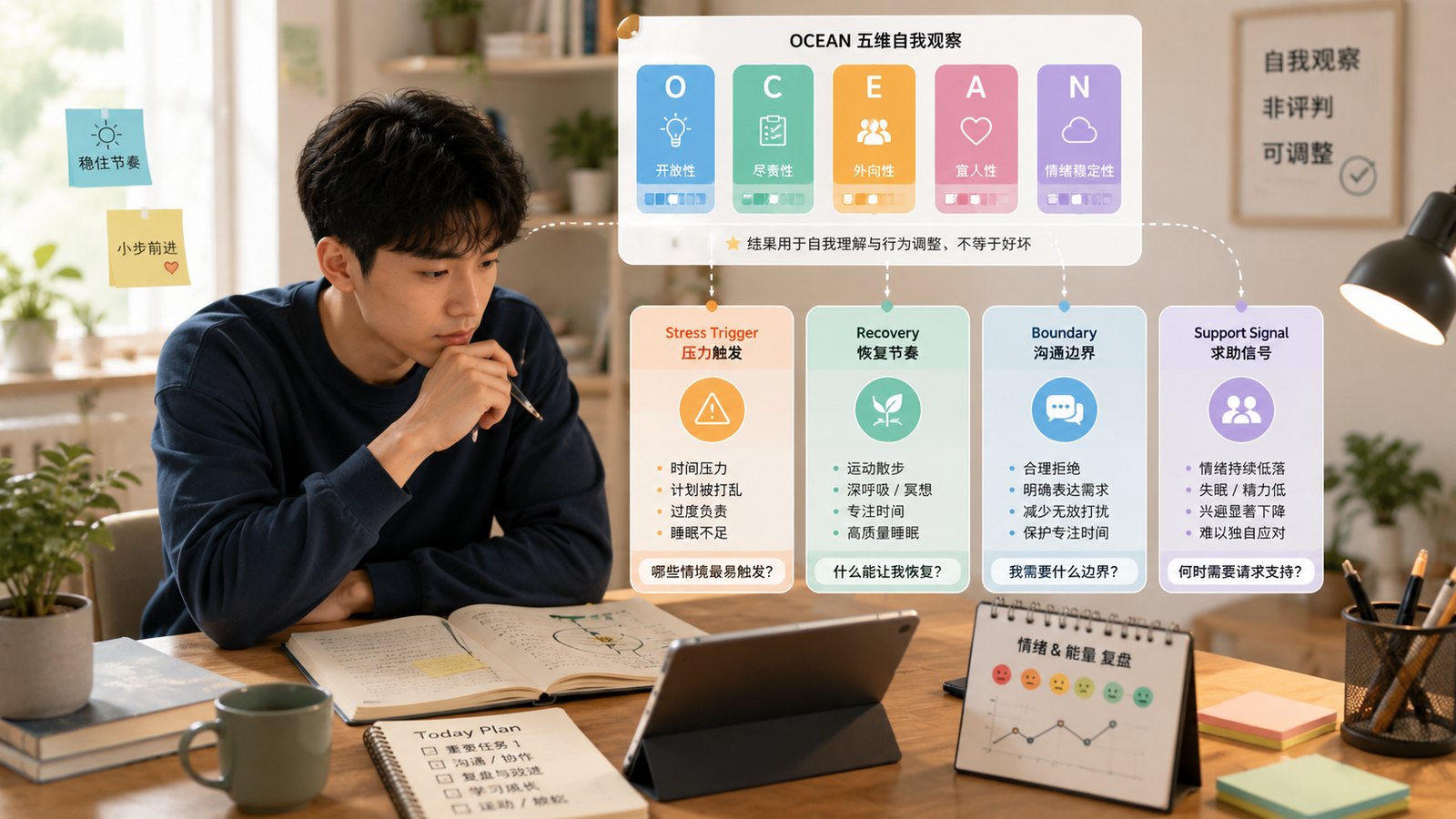
Low Emotional Stability in the Big Five: Stress Triggers, Recovery Habits, and Communication Boundaries
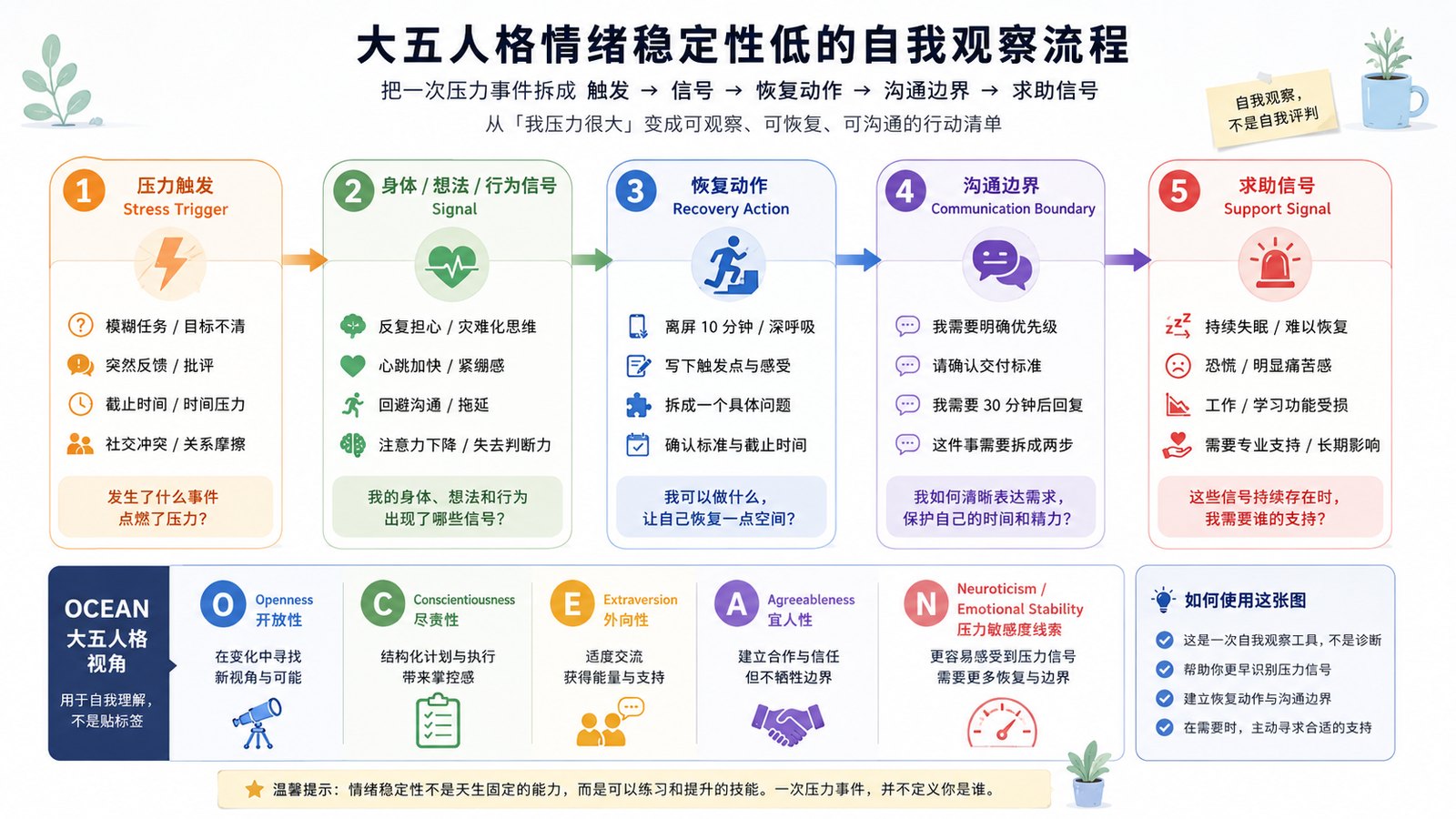
Use low Emotional Stability as a stress-sensitivity signal, not a diagnosis. Map triggers, recovery habits, communication boundaries, and support signals.
Quick answer: what should you do with low Emotional Stability in the Big Five?
Low Emotional Stability in the Big Five is not a diagnosis, a weakness label, or a career verdict. Use it as a stress-sensitivity signal: identify what triggers tension, how your body and thoughts amplify it, what helps you recover, and what communication boundaries reduce repeat pressure. If distress keeps disrupting sleep, work, study, relationships, or safety, seek professional support.
A lower Emotional Stability score can feel personal because it touches fear, worry, criticism, uncertainty, and recovery time. The useful question is not “What is wrong with me?” The useful question is: “Where does pressure enter, how does it escalate, what helps me regain judgment, and what boundary should I set before the next cycle
Goal, deadline, priority, response window, standard of done
“If this is added today, item A moves to tomorrow”
Turn emotion into a negotiable fact
If a result only makes you dislike yourself, it is being used poorly. It should create an operating map, not a label.
What does low Emotional Stability actually mean? Separate trait, state, environment, and support signal
Emotional Stability is commonly discussed opposite Neuroticism in the Big Five. Lower Emotional Stability may point to stronger sensitivity to threat, uncertainty, criticism, or loss of control. That still does not tell the whole story.
What you notice
Better category
Do not conclude
Check first
Two stressful weeks with poor sleep and irritability
Short-term state
“My personality is broken”
Sleep, workload, deadline pressure, health load
Anxiety whenever work is vague
Task-structure trigger
“I cannot handle responsibility”
Are goals, priority, deadline, and standards clear?
Only one team or relationship makes you collapse
Environment problem
“I am too unstable”
Is there chronic invalidation, boundary violation, or unsafe conflict?
Long-term panic, severe distress, or functional impairment
Professional-support signal
“I should just endure it”
Consider counseling, medical support, or institutional support resources
These categories require different responses. Reducing all of them to “high Neuroticism” makes the problem less precise.
Stress trigger table: not all tension comes from the same source
A useful log does not say “today was stressful.” It says what hit you, what changed, and what action reduced the load.
Stress trigger
Body / thought signal
Behavior signal
First stabilizing move
Ambiguous task: “Improve this quickly”
Racing thoughts, worst-case rehearsal
Delay, over-editing, late submission
Ask for goal, deadline, and standard of done
Negative feedback in public
Heat, stomach tightness, self-attack
Defensive silence or over-explaining
Convert feedback into specific revision items
Social coldness
Repeated guessing about rejection
Over-checking or sudden withdrawal
Confirm the observable fact with low-emotion wording
Multiple demands at once
Fragmented attention
Many open files, no completed task
Keep only one or two must-finish actions today
Sudden extra work
Irritation, loss of control
Passive resistance or hidden overload
Make the trade-off visible: add B, move A
Chronic poor sleep
Small problems feel large
Extreme judgment, crying, anger
Restore sleep window before major decisions
Waiting for results
Refreshing messages, no deep work
Time lost without progress
Set checking windows and do low-cost actions between them
Value conflict
Freeze, anger, repeated arguing
Resistance that looks like procrastination
Separate method conflict, ethical conflict, and role conflict
This shifts the language from “I am too sensitive” to “this kind of pressure enters through this door.” One is a label. The other is usable data.
Scenario map: trigger → signal → recovery action → communication boundary
Am I using anxiety as an escape from the first step?
Use external reminders and small task starts
Can low Emotional Stability guide career choice?
It can inform work-environment questions, but it should not decide your career. A single Big Five dimension cannot determine job fit.
Work environment
What to observe
How to test it
Do not conclude
Fast-changing roles
Can you keep minimum action under uncertainty?
Run a one-week multi-priority schedule
“I am sensitive, so I cannot do this”
High-feedback environments
Can you convert feedback into revision tasks?
Do a mock review or project retrospective
“Feedback discomfort means misfit”
High-interaction roles
Can boundaries protect energy?
Track social load and recovery for one week
“Sensitivity means I cannot work with people”
Independent research or creative work
Does solitude help or create rumination?
Finish a small project without external pressure
“Quiet work must fit me”
Process-heavy roles
Does structure calm or suffocate you?
Try a repeated standardized task
“Stable work is automatically easy”
When is this no longer a self-regulation issue?
A Big Five test cannot diagnose anxiety, depression, panic, trauma, or any mental-health condition. Use it only as an observation tool. Seek support when the problem is persistent, intense, or impairing.
Signal
Do not conclude
Safer response
Ongoing insomnia, appetite change, body discomfort
“This is just low Emotional Stability”
Consider counseling, medical care, or school/work support resources
Panic, strong loss of control, repeated body symptoms
“I am bad under pressure”
Seek professional assessment
Inability to complete basic study, work, or daily tasks
“I am not suited to this life”
Address functional impairment before career conclusions
Self-harm thoughts or safety risk
“I should endure it”
Contact trusted people and local emergency/crisis support immediately
Chronic bullying, coercion, or unsafe relationship pressure
“I should become more stable”
Prioritize safety and support, not endurance training
A practical threshold: if distress repeatedly disrupts sleep, study, work, relationships, or basic living, do not use a test result as the main explanation.
A 7-day observation log and a 30-day recovery experiment
7-day observation log
Day
Trigger
Body/thought signal
Behavior response
Recovery action
Recovery time
Boundary for next time
D1
D2
D3
D4
D5
D6
D7
30-day recovery experiment
Week
Goal
Action
Indicator
Week 1
Find top three triggers
Record one trigger-signal-recovery-boundary chain per day
Repeated patterns appear
Week 2
Fix one recovery action
Choose walking, screen break, task splitting, or feedback clarification
Recovery time shortens or becomes more predictable
Week 3
Practice one boundary sentence
Use it in a low-risk situation
Less guessing and less after-the-fact replay
Week 4
Decide whether outside support is needed
Review sleep, function, relationship load, and safety signs
Support plan becomes clear
Take the Big Five test, then return to the reality table
If you do not yet have an OCEAN profile, take the Big Five Personality Test first. Then return to the table below.
The test result is self-observation material. It does not diagnose you, predict performance, decide relationships, or determine a career.
FAQ
Does low Emotional Stability mean I have a mental-health problem?
No. A lower Emotional Stability or higher Neuroticism score is only a self-observation signal about stress sensitivity and emotional reactivity. It cannot diagnose a mental-health condition. If distress is persistent or functionally impairing, seek professional support.
Is high Neuroticism a bad personality trait?
No. It is not a moral judgment or an ability judgment. It may mean you notice risk, conflict, uncertainty, or criticism more intensely and need clearer structure and recovery habits.
What jobs are good for people with lower Emotional Stability?
A single trait cannot decide career fit. Look at the work environment: clarity of goals, feedback quality, pace, conflict load, recovery space, and support. The same person may function very differently across teams.
Can Big Five results be used for career decisions?
They can support reflection, but they should not decide a career. Career decisions also require interests, skills, real tasks, job requirements, and opportunity context.
Does work stress prove that my Emotional Stability is low?
No. Stress may come from overload, poor management, sleep loss, conflict, unhealthy team norms, or external pressure. A test result does not replace situational analysis.
When should I seek professional help?
Consider professional support if emotional distress repeatedly disrupts sleep, study, work, relationships, or basic daily functioning, or if you experience panic, self-harm thoughts, or safety risk.
Big Five Emotional Stability: Stress Triggers and Recovery | FermatMind