Big Five Traits Are Continuums, Not Personality Boxes
Big Five labels do not define fixed types. Read dimensions alongside context, observations, and counterexamples. The examples are not diagnosis or product validation.
Big Five Traits Are Continuums, Not Personality Boxes
In this fictional teaching scenario, as soon as the project debrief ended, Acheng noticed “lower conscientiousness” in her report. A colleague casually added, “No wonder—you’re the procrastinating type.” She did not immediately object. When vague tasks pile up and feedback is slow, she does take a long time to get started. But when deliverables are clear and someone helps break the work into steps, she often finishes early. The question is not whether the description brings familiar experiences to mind. It is whether a convenient phrase can define her.
There is no need to choose between “the report is useless” and “this is who I am from now on.” The Big Five is better understood as a dimensional framework for describing personality differences. “Higher” and “lower” compress information for communication. They cannot, on their own, establish that people fall into a few clearly bounded categories, and they cannot replace observations of specific situations and counterexamples.
Continue from the article into a more structured topic entry surface.
Start by Treating “High” and “Low” as Compression Tools
People easily become attached to short labels. Labels immediately give complex experiences a name: highly extraverted, low in agreeableness, a procrastinator, a leader. A name creates a sense of order, especially after saying the wrong thing in a meeting or a difficult collaboration. Finding a name can feel like finding the cause and the solution at the same time.
Yet the shorter a label makes the information, the more a reader needs to know what has been left out. It may leave out how the scale is constructed, how results are presented, how close someone is to a display boundary, and experiences that point the other way. “Not socially proactive,” for example, can hide several distinctions: staying quiet with unfamiliar clients but leading discussions in a familiar group; hesitating to speak without preparation but presenting a proposal clearly after preparing. Calling all of these “low extraversion” does not automatically establish which description fits what actually happens.
Goldberg (1990) provides important background for research on the five-factor structure of personality. The limited conclusion used here is that the Big Five is a structural framework for organizing personality descriptions, not a roster assigning everyone a fixed identity. Describing tendencies and deciding “what kind of person you are” are different uses.
Different Labels Do Not Necessarily Put Two People on Opposite Sides
This entirely fictional numerical example illustrates a display cutoff. It is not FermatMind scoring, a norm, a percentile or a real user's result. On a teaching scale from 0 to 100, suppose values below 50 are displayed as “lower” and values from 50 upward as “higher.”
Teaching value
Display label
What the label alone omits
A: 49
Lower
Only 2 teaching units from B
B: 51
Higher
Close to A, despite a different label
C: 80
Higher
The same label as B, despite a distance of 29
Two kinds of information disappear: nearby positions across the cutoff look like different kinds of people, while more distant positions within a range share one name. Neither a gap of 2 nor a gap of 29 establishes the size of an actual personality difference or whether it exceeds measurement error. This example supplies no such evidence.
Changing the display cutoff could also change a label without changing the responses or numerical value. Before interpreting different labels, check the instrument, version, scale, reference and display rule. Identical labels do not establish identical degrees either. Ranges can simplify communication; a display convention does not demonstrate a natural break.
MacCallum, Zhang, Preacher and Rucker (2002) discuss the broader methodological problem that dichotomizing quantitative variables can lose information and affect interpretation. That supports retaining the underlying information, not a claim about FermatMind's cutoffs, precision or effects.
A Broad Domain Is Not a Complete Manual for a Person
“Lower conscientiousness” easily becomes a verdict because it sounds like a complete explanation. In fact, it may combine quite different issues. Someone may struggle to begin open-ended tasks, have trouble managing time, resist work that feels meaningless, or show strong persistence when goals and acceptance criteria are clear. The broad label cannot replace identifying these differences.
Soto and John (2017) proposed a hierarchical model in their BFI-2 research, with 15 facets nested within the five Big Five domains. This applies only to the BFI-2 structure studied in that research; it does not mean that every Big Five tool has the same facets or presents results in the same way. It still offers a useful limitation: even within one specific five-domain model, broad domains may summarize more detailed information. A single domain name should therefore not become a complete explanation of all of someone’s behavior.
For Acheng, “Am I the procrastinating type?” is a question that pressures her to choose an identity. “Which tasks take me a long time to start, and under what conditions do I move forward?” is a question that experience can revise. The latter does not guarantee an attractive answer, but it is closer to what she wants to understand.
Bring Labels Back to Observable Statements
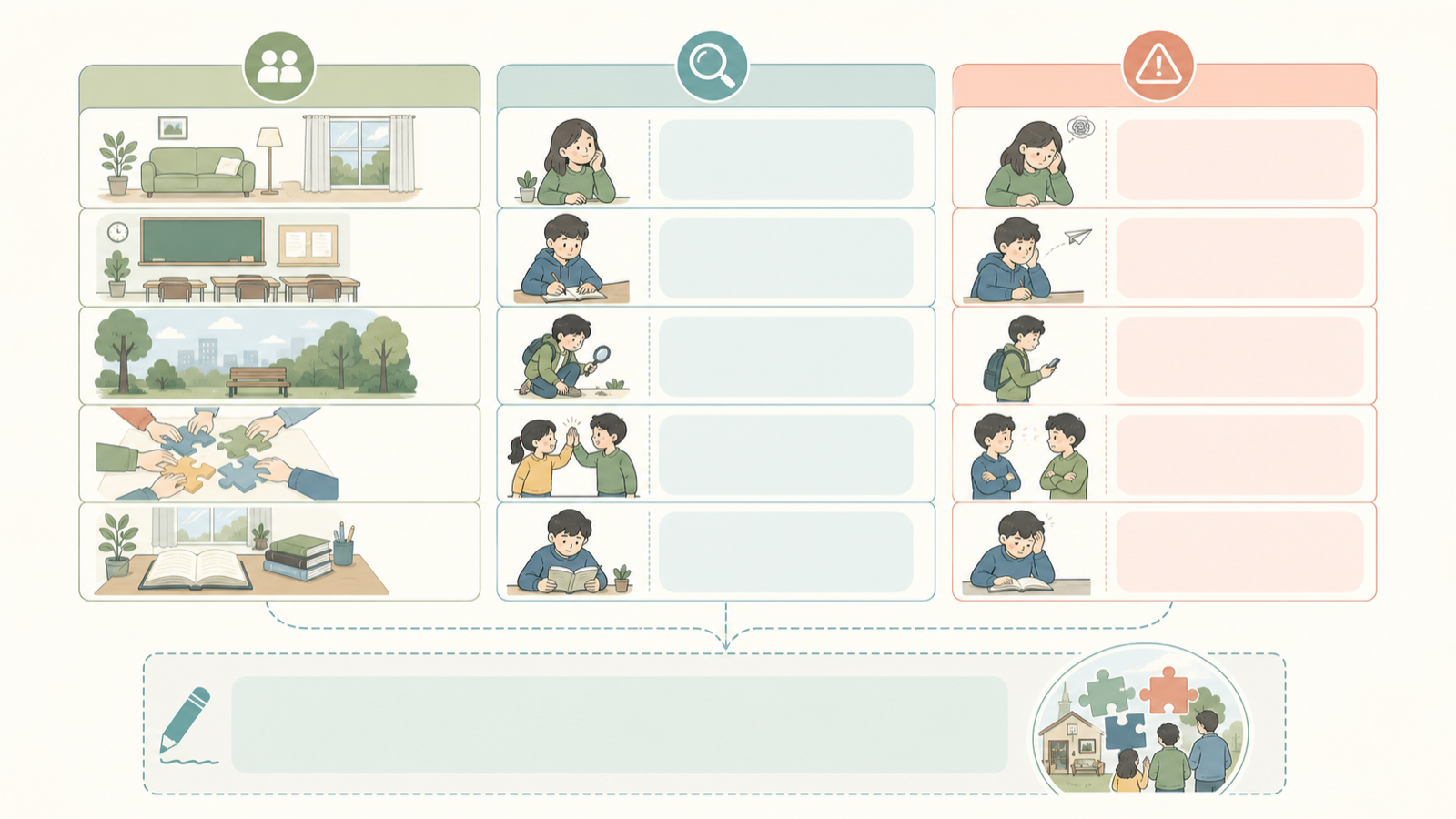
If a high or low description matters to you, you can temporarily treat it as an observation hypothesis. The table and its three records are editorial examples, not customer data or research results, and are not for scoring, diagnosis, or comparing who is better. Its purpose is to bring a general term back to experiences that can be checked.
Original label
What information is still missing?
Supporting observation
Counterexample or exception
What to observe next
Lower conscientiousness
Is the task clear? Is there collaboration and a clear acceptance process?
An open-ended task sat untouched for three days
A project with clear acceptance criteria was completed early
Compare how long it takes to start the two kinds of tasks
Lower extraversion
How familiar are the people, how much preparation time is available, and what are the rules?
Spoke little when meeting unfamiliar clients without preparation
Proactively summarized a proposal in a familiar team
Record the conditions for participation in three meetings
Lower agreeableness
Is the person expressing disagreement or disregarding others’ feelings?
Pointed out risks first during a review
Added a proposal and asked for opinions afterward
Record how one disagreement is raised and answered
This article suggests retaining a “counterexample or exception” column. Collecting only material that fits a label may reinforce an existing judgment. Recording experiences that do not fit can help you check whether task design, relationships, preparation, and role requirements also need consideration. Observation is not an attempt to prove the report right, nor a rush to prove it wrong. It gives the next judgment more evidence than the last label contained.
Do Not Turn Self-Description into Decisions for Someone Else
Labels carry another risk: they often slide from self-understanding into decisions for other people. When someone says, “I’m not very proactive in unfamiliar settings,” they are describing limited experience. If a listener rewrites this as “You’re not suited to meeting clients,” several steps have already been skipped. Those steps include what abilities the work requires, whether the person has conditions that allow preparation, whether contrary experiences exist, and who has authority to make that decision.
This distinction is particularly important in teams. Someone who rarely competes for speaking time in a large meeting may still do work that requires patient communication. Someone who directly identifies risks in a discussion is not automatically disrespectful toward colleagues. If personality language only makes communication faster without making judgments more precise, it should not be used to allocate opportunities, assess worth, or replace information about actual performance.
You can keep labels about yourself within “what I want to observe further.” Labels about other people require an additional limit: do you really have enough information, and are you affecting their opportunities? When the answer is unclear, this article suggests returning to the person’s demonstrated behavior, conditions, and actual needs rather than choosing a gentler box.
Check the Score Information before Your Interpretation
Separate “lower, therefore I am a kind of person” into two questions: what numerical, range and reference information does the report actually provide, and what category did you add yourself? Preserve the report's wording. If values or division rules are absent, do not reconstruct a position, percentile or error interval.
Everyday examples can clarify what a word brings to mind; they cannot reconstruct the scale. The contextual table preserves behavior and exceptions rather than correcting scores. Reading several dimensions together is a separate task: keep each dimension visible instead of turning their combination into a new identity code.
Relatively Enduring Does Not Mean Identical in Every Situation
Some people worry that keeping people out of boxes means personality drifts arbitrarily with the environment. That is not this article’s conclusion either. The APA Dictionary of Psychology’s trait entry describes a personality trait as an enduring characteristic that describes or influences behavior across situations. This article uses “relatively enduring” to explain that tendencies need not be identical in every instance. That is the interpretive boundary here; the dictionary definition is not expanded into “never changes” or “is identical in every situation.”
Continuous dimensions and observation of context can therefore coexist. You may find that you are often more reserved in unfamiliar social settings, and also that you are more willing to speak when you have preparation time, clear turns, and a familiar topic. These observations do not evade tendencies. They avoid describing tendencies more broadly than the evidence supports.
Likewise, one instance of silence may involve more than personality alone. Fatigue, power relationships, language, meeting design, and what happened that day may all be necessary for understanding the situation. One instance of efficiency may not establish or overturn any broad label either. Big Five language can offer an angle for asking questions; it cannot replace understanding the circumstances themselves.
When to Stop Drawing Further Conclusions from a Label
When a label begins making high-impact judgments for you, pause. It should not, on its own, decide whether you are suited to a job, whether someone else should be hired, whether you can enter a particular school, whether a relationship is destined to fail, or whether a health problem exists. Those conclusions require different and additional evidence, and involve other people’s opportunities and rights.
“Lower” does not mean deficient, and “higher” is not a free pass. A more cautious stopping rule is this: when you jump from a description to “so I will never,” “so they definitely will,” or “so a major decision must be made immediately,” return to observable facts. Ask: Which measurement or description is this? Which dimension does it actually address? When, in what task, and in what relationship did the behavior I observed occur? If these questions have no answers, retaining uncertainty is more honest than delivering a verdict about yourself or someone else.
FermatMind Product Information: Distinguish Disclosures from Uses Not Validated Here
This article discusses general personality structure and the limits of interpreting quantitative information. It is not a technical description of FermatMind. This article does not individually verify FermatMind’s questionnaire version, scoring methods, norms, measurement precision, or evidence for intended uses. It therefore cannot label all product information Unknown. Read disclosed information within its actual content and version; methodological disclosure also does not replace validation for a specific interpretation or use.
Goldberg’s structural research, the BFI-2 hierarchical model, and methodological papers on dichotomizing variables therefore cannot establish that FermatMind scores are necessarily displayed on a continuous scale, that cutoffs do or do not exist, that the product has any reliability or validity, or that it can predict individual outcomes. Interpret the report only within what its public documentation actually states. When sufficient information is unavailable, withhold the relevant judgment rather than inferring that the product as a whole is validated or unknown.
References and Your Next Reading
Goldberg, L. R. (1990). An alternative “description of personality”: The Big-Five factor structure. Journal of Personality and Social Psychology, 59(6), 1216–1229. DOI:10.1037/0022-3514.59.6.1216. This article uses it only as research background for the five-factor structure of personality descriptions.
Soto, C. J., & John, O. P. (2017). The Next Big Five Inventory (BFI-2): Developing and Assessing a Hierarchical Model With 15 Facets to Enhance Bandwidth, Fidelity, and Predictive Power. Journal of Personality and Social Psychology, 113(1), 117–143. DOI:10.1037/pspp0000096. This article uses it only for the domain–facet hierarchy in this particular BFI-2 study.
MacCallum, R. C., Zhang, S., Preacher, K. J., & Rucker, D. D. (2002). On the practice of dichotomization of quantitative variables. Psychological Methods, 7(1), 19–40. DOI:10.1037/1082-989X.7.1.19. This article uses it only as a general methodological reminder that dichotomizing quantitative information can lose information.
American Psychological Association. APA Dictionary of Psychology: trait. This article uses it only to explain the term “relatively enduring trait.”
The next time you see “high,” “low,” or a type-like label, you do not need to adopt it immediately or rush to reject it. Treat it first as compressed information awaiting observation. What conditions does it omit? Which experiences support it? Which experiences do not fit? This article suggests retaining descriptions that can change with counterexamples, rather than reaching a verdict from a flattering or unflattering label alone.
Big Five Traits Are Continuums, Not Personality Boxes | FermatMind