Content category
SEO Articles

Not sure what career is right for you? Learn how to use RIASEC, MBTI, Big Five, and real-world validation to build a practical career exploration map.
By: Fermat Institute
Published: Sep 20, 2026
Updated: Sep 20, 2026
14 min read
Human review completed · Sep 20, 2026When should I use this article?
Use this article when you want to connect public content with tests, personality profiles, or career guidance from a single starting point.
Does this replace formal judgment?
No. It offers public explanation and action cues, but does not replace medical, legal, or professional judgment.
Content category
SEO Articles
Related tags
RIASEC, MBTI, Big Five, Personality Test
Return to the article hub to keep expanding the public reading chain.
Continue from the article into a more structured topic entry surface.

Visual guide
If you want to turn reading into self-measurement, continue into an assessment.
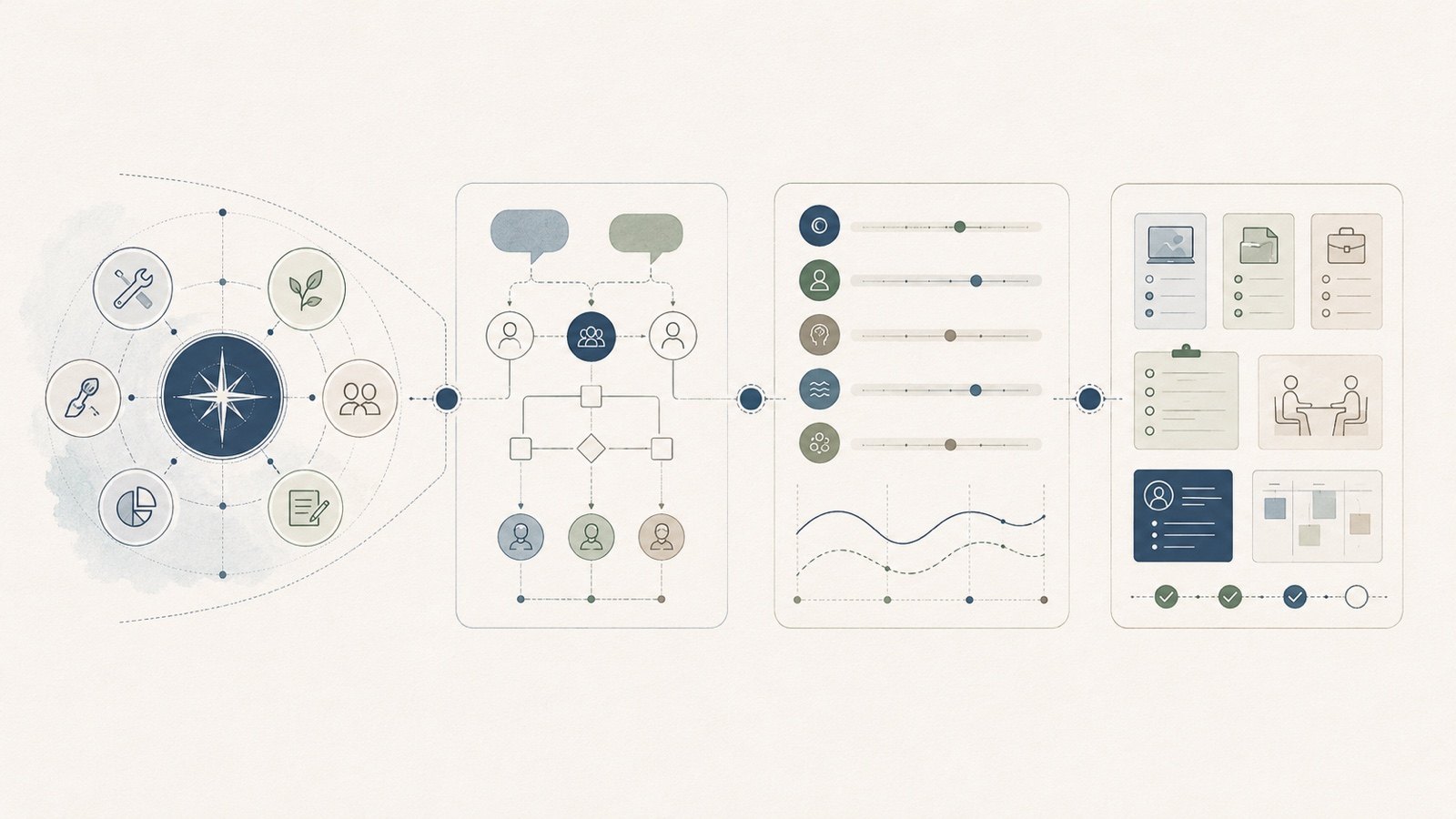
When people say, “I don’t know what career is right for me,” they often combine several different problems: interests, personality preferences, skill level, industry opportunity, family pressure, income goals, and location constraints.
No single test can solve all of those questions at once. A safer approach is to separate them into layers, then test each layer with evidence.
Instead of asking, “What career is right for me?”, ask:
This shift matters. A test result should not replace your judgment. It should help you decide what to observe next.
RIASEC / Holland is usually the most direct starting point for career exploration. It helps you notice whether you are more drawn to concrete systems, analysis, creative expression, helping people, organizing resources, or building order.
This article will not deeply define the model. If you are still comparing test types, read Career Interest Test Vs Personality Test.
For this page, the important point is simple: RIASEC helps narrow exploration. It is not a career verdict.
MBTI is better used as a work-style reflection tool. It can help you notice how you prefer to communicate, make decisions, process information, and interact with a team.
Some people need a clear big-picture frame before action. Others prefer concrete steps. Some think best alone; others clarify ideas through conversation. These preferences can shape the work experience, but they should not decide your industry by themselves.
Big Five can add context about broad behavioral tendencies. It is useful for questions such as: Do I enjoy novelty? Do I maintain structure over time? Do I need frequent social feedback? Do high-uncertainty settings drain me quickly?
This information is best used to design support systems. It should not be used to rule out entire careers. For example, high stress sensitivity does not mean someone cannot work in a fast-changing field; it may mean they need clearer routines, boundaries, and fallback plans.
| If your question is… | Start with… | It helps you… | Do not use it to… |
|---|---|---|---|
| Which career directions should I explore? | RIASEC / Holland | Narrow work activities and environments | Decide your career outcome |
| How do I work with people and information? | MBTI | Understand interaction and decision style | Attach job labels to type |
| What long-term habits should I watch? | Big Five | Observe broad tendencies and stress boundaries | Predict career success |
| Is this direction realistic for me? | Real-world validation | Test hypotheses with tasks and feedback | Skip experience and rely only on scores |
If you have no direction at all, start with RIASEC / Holland. Your question is about career direction, so the first filter should be work activities and environments.
If you already have several career options, use MBTI to understand how you might operate inside those environments.
If you want to understand longer-term habits, use Big Five as a behavioral tendency layer. It is useful context, not a final answer.
A mismatch does not automatically mean something is wrong. It may mean the tools are answering different layers.
For example, someone may show interest in investigative and structured work activities, while also preferring collaborative discussion and visible feedback. That does not create a contradiction. It may suggest a role that combines analysis with communication.
When results differ, write down three hypotheses:
Tests form hypotheses. Real situations test them.
Use a low-cost validation plan:
This stage matters more than debating labels. Many career directions only become clear after the real work begins.
Do not use a test result to say:
Use the result to:
If you have no clear direction yet, start with Holland/RIASEC career interest test. RIASEC is the most direct starting point for work activities and environments.
If you have already taken MBTI but still feel unclear about career direction, take RIASEC next instead of attaching job labels to your type.
If you have already taken RIASEC, use MBTI personality test to understand working style and Big Five personality test to observe broader behavioral tendencies.
If you have completed several tests, read Method boundaries before treating any result as a decision rule.
Start by separating the problem into layers: career interests, work style, broad behavior patterns, and real-world validation. If you need a first test, RIASEC / Holland is usually the most direct starting point.
No. It can help you explore work activities and environments, but it cannot guarantee a best career. Career decisions also require skills, experience, industry research, and real feedback.
It can be useful as a work-style reference, but it should not be used alone to choose a career. MBTI is better for understanding communication, decision-making, and information-processing preferences.
Treat the results as different layers of information. RIASEC may point to work activities, MBTI may describe work style, and Big Five may add context about behavioral tendencies. The next step is to test hypotheses in real tasks.
Real-world experience should carry more weight. Test results can help you form clearer hypotheses, but courses, projects, interviews, internships, and real tasks are needed before making major decisions.