Content category
Workplace Communication

Deconstruct office friction using the Enneagram lens. Map core motivations to concrete feedback loops, stress patterns, and safer communication experiments.
By: Fermat Institute
Published: Jun 30, 2026
Updated: Jun 30, 2026
24 min read
Human review completed · Jun 30, 2026When should I use this article?
Use this article when you want to connect public content with tests, personality profiles, or career guidance from a single starting point.
Does this replace formal judgment?
No. It offers public explanation and action cues, but does not replace medical, legal, or professional judgment.
Content category
Workplace Communication
Related tags
Enneagram, workplace friction, communication, stress response
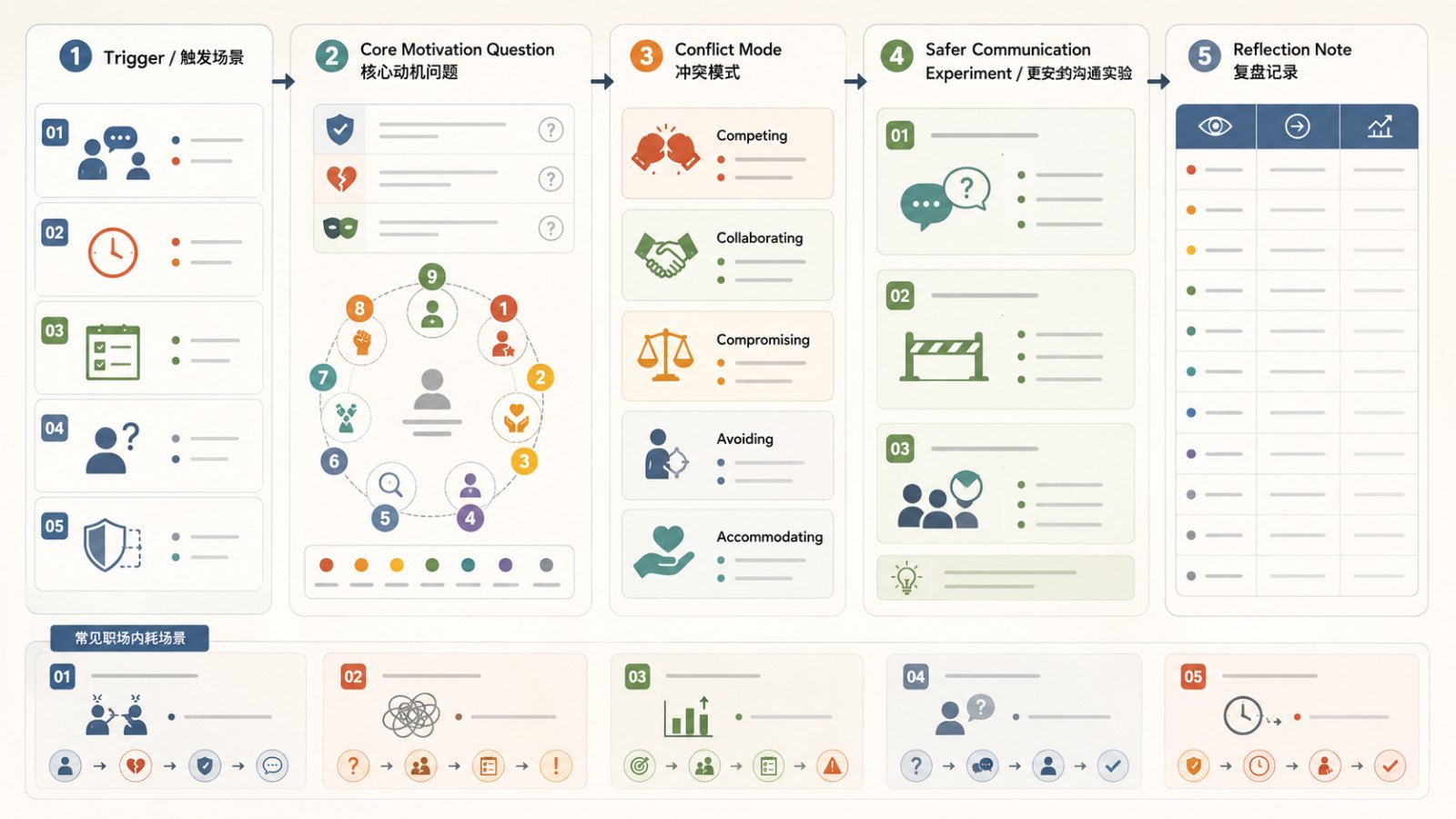
Enneagram workplace friction is the practice of using core motivations as a self-observation lens for feedback loops, deadline stress, role ambiguity, and boundary defense. It is not a diagnostic system, a hiring screen, or a performance model. Used well, it helps a person ask: what am I protecting, what conflict strategy am I defaulting to, and what safer communication experiment should I try next?
The most useful unit is not a type label. It is the observable chain: trigger → perceived threat → self-protective behavior → effect on the work system. That chain is what turns a personality idea into a practical workplace reflection tool.
Enneagram workplace friction refers to recurring collaboration breakdowns that may be shaped by core motivation, stress response, and communication habits. In organizational behavior language, it can be used as a non-clinical reflection framework for deadline stress, negative feedback loops, cognitive friction, role ambiguity, and boundary defense. It cannot establish job fit, leadership potential, promotion likelihood, burnout risk, salary, or mental health status.
A useful Enneagram workplace conversation does not sound like “She is Type 8, so she is controlling.” It sounds like: “Under unclear decision rights, I notice a control-protective response. What role boundary or communication experiment would reduce the friction?”
If you want a result before using this guide, start with the Enneagram test, then return to the tables below. Treat the result as a hypothesis for observation, not as an identity cage.
Core motivation is a recurring self-protective concern that may shape attention under pressure. In workplace settings, it is usually visible as a micro-behavior: correcting, rescuing, performing, withdrawing, questioning, reframing, controlling, smoothing, or avoiding. The risk is not the motivation itself; the risk is using the same protection strategy in every context.
This is where Enneagram language can connect with conflict-management frameworks. The Thomas-Kilmann Conflict Mode Instrument is commonly summarized through five strategies: competing, collaborating, compromising, avoiding, and accommodating. Harvard-style principled negotiation emphasizes separating people from the problem, focusing on interests rather than positions, generating options, and using objective criteria. In this article, those frameworks are used as practical vocabulary, not as scientific proof of Enneagram validity.
The working question is:
In this situation, what am I protecting, and is my protection strategy improving the work or increasing the friction?
An Enneagram workplace friction map connects type hypotheses, core motivations, conflict-mode drift, and concrete workplace micro-actions. It should never be used to type coworkers in meetings. Use it to audit your own repeated friction pattern.
| Type | Core motivation to examine | Common workplace friction | Likely conflict-mode drift | Micro-action to watch | Safer experiment |
|---|---|---|---|---|---|
| Type 1 | Protecting quality, order, and correctness | Review meetings turn into defect hunts; standards become social pressure | Competing through standards | Marking every flaw in a deliverable without separating launch blockers from later improvements | Split feedback into must-fix, next-iteration, and preference before speaking |
| Type 2 | Protecting connection and usefulness | Over-helping becomes hidden resentment; boundaries stay invisible until late | Accommodating until resentment | Saying “I can take that” while mentally adding unpaid emotional labor | State the help boundary before accepting the request |
| Type 3 | Protecting visible value and achievement | Metrics, recognition, and speed become defensive performance loops | Competing through output | Turning a project update into a polished status defense instead of naming the blocker | Report completed work, risk, decision needed, and next checkpoint in four lines |
| Type 4 | Protecting authenticity and meaning | Standardized workflows feel like erasure; disagreement becomes value judgment | Avoiding, then competing through critique | Saying “this has no meaning” without proposing an executable alternative | Offer one concrete improvement before explaining the deeper concern |
| Type 5 | Protecting cognitive space and information control | Meetings, interruptions, and incomplete data create withdrawal | Avoiding through analysis delay | Holding back until every variable is understood, leaving teammates without a usable signal | Give a 60% answer and label the unresolved variables |
| Type 6 | Protecting security, role clarity, and risk control | Ambiguous authority creates repeated confirmation loops | Compromising, accommodating, then challenging | Requesting repeated executive verbal confirmation until a decision workflow stalls | Classify questions as must-confirm, can-proceed, or acceptable risk |
| Type 7 | Protecting optionality and momentum | Long execution cycles trigger novelty-seeking and unfinished work | Avoiding closure through new options | Starting a new initiative before the previous one has a minimum viable closeout | Define the closeout condition before opening another option |
| Type 8 | Protecting autonomy, control, and directness | Decision ambiguity becomes a power contest | Competing through control | Taking over a meeting before decision rights are explicit | Clarify the decision owner, then state non-negotiables and negotiables |
| Type 9 | Protecting harmony and stability | Conflict avoidance delays important disagreement | Accommodating or avoiding | Agreeing in the meeting and slowing down execution afterward | Prepare one necessary disagreement and voice it early |
Use case: select one row that resembles your current behavior. Do not assign it to another person as a fact. Write the trigger, the protection need, the conflict-mode drift, and the next safer experiment.
Communication conflict is not just a tone problem. It is a system problem created by unclear decision rights, unequal information, threat signals, role ambiguity, and incompatible default strategies. The Enneagram can help name the motivation. TKI can help name the conflict mode. Principled negotiation can help keep the conversation anchored in interests and objective criteria.
A negative feedback loop starts when one person offers a correction and the other hears a status threat, competence threat, or relationship threat. The loop then moves into defense: over-explaining, withdrawing, counterattacking, or pleasing.
A cleaner feedback structure:
Instead of saying, “You always resist feedback,” say, “This revision has three launch blockers. I am not evaluating your value; I am naming the work items we need to resolve.”
Role ambiguity turns meetings into threat environments. One person wants to decide; another wants to analyze; another wants to maintain consensus; another wants decision rights clarified before acting. Without a decision protocol, the group mistakes friction for personality.
A better meeting closeout includes:
| Meeting element | Better wording | Avoid |
|---|---|---|
| Decision owner | “Who owns the final call after this discussion?” | “Let’s align later.” |
| Evidence gap | “Which facts are still missing?” | “We need more clarity” without naming the gap |
| Disagreement | “What risk are we not saying out loud?” | Silent agreement followed by slow execution |
| Next action | “Who does what by when?” | “Everyone should follow up” |
Boundary defense appears when a person’s time, responsibility, emotional labor, or response window is repeatedly invaded. The behavior may look like coldness, delay, passive resistance, or sudden intensity. The underlying issue may be workload design rather than personality.
A safer boundary statement:
“I can support the first version of this work, but I cannot become the long-term owner unless another priority is removed.”
This keeps the conversation on workload design, not moral character.
Deadline stress compresses decision time and exposes the default conflict strategy. Some people seize control. Some appease. Some disappear. Some over-verify. Some open new options to avoid closure. Observing that default is more useful than arguing about type.
Ask three questions before the final 72 hours of a project:
A stress-response checklist links signal, felt experience, unsafe conclusion, negotiation boundary, and one next action. It should not be used as a mental-health assessment. It is a behavioral reflection tool.
| Signal | What it may feel like | What not to conclude | Negotiation boundary | One next action |
|---|---|---|---|---|
| Constant correction | “If I miss one flaw, the whole thing may fail.” | “I am difficult” or “they are incompetent” | Separate people from the problem | Sort feedback into launch blocker, later improvement, personal preference |
| Over-accommodation | “If I say no, I damage the relationship.” | “I have no choice” | Focus on interests: delivery, boundaries, priority | State what you can own and what must be deprioritized |
| Defensive status updates | “If I name the blocker, I look weak.” | “I must prove my value at all times” | Use objective criteria | Report completed work, blocker, decision needed, next deadline |
| Withdrawal | “Explaining will not help.” | “This team is hopeless” | Name the problem before judging the person | Write one observable fact and one requested change |
| Information hoarding | “I cannot speak until I know everything.” | “A partial answer is irresponsible” | Generate options | Offer a preliminary answer with unresolved variables listed |
| Repeated confirmation | “If the ground shifts, I will take the blame.” | “No one is trustworthy” | Use verifiable criteria | Ask for written confirmation on only the three irreversible risks |
| Escaping closure | “This is stale; the next idea is better.” | “I lack discipline” | Finish current problem before expanding options | Define a minimum closeout condition |
| Control surge | “If I do not take over, this will fail.” | “Only I am reliable” | Clarify decision rights | Ask who owns the final call before taking action |
| Silent compliance | “Disagreement will create trouble.” | “My view does not matter” | Convert position to interest | Voice one necessary risk in the first part of the meeting |
A workplace friction chain is a recurring sequence: trigger, protection strategy, social response, and work consequence. Enneagram language helps only when it is tied to that chain.
When goals expand but resources and decision rights do not, people protect themselves. Some overperform, some ask for repeated confirmation, some lower quality standards quietly, and some use collaboration language to avoid ownership.
Question: Am I solving the operating constraint, or protecting myself from blame?
A new hire may avoid asking questions because they do not want to look unprepared. A middle manager may push for progress because their own upward reporting depends on visible movement. The friction is not simply “confidence” or “attitude.” It may be a failure of psychological safety and role clarity.
Question: Are we treating missing information as a motivation problem?
A retrospective without a fact table becomes a stage for self-protection. One person protects standards. Another protects reputation. Another protects safety. Another protects harmony. The meeting needs facts, impact, and next rules—not type labels.
Question: Did that sentence add evidence, or did it add defense?
Career change around age thirty or later often raises identity threat. Feedback can sound like a judgment of worth, and slow progress can feel like proof of failure. The Enneagram can help identify the defense pattern, but the solution still requires skill evidence, practice design, and safer feedback conditions.
Question: Am I learning a new task, or trying to prove I still deserve to be here?
A seven-day reflection checklist turns Enneagram language into evidence. Do not attempt to change your whole personality in a week. Track one repeated workplace trigger and run one safer communication experiment.
| Day | Task | What to write |
|---|---|---|
| Day 1 | Trigger | Who said what? What action immediately made you tense, angry, defensive, or absent? |
| Day 2 | Protection need | What were you protecting: quality, connection, value, space, security, freedom, control, or harmony? |
| Day 3 | Conflict mode | Were you competing, collaborating, compromising, avoiding, or accommodating? |
| Day 4 | Cost | Did the reaction damage clarity, trust, boundary, or task progress? |
| Day 5 | Alternative wording | What sentence would be more specific and less defensive next time? |
| Day 6 | Small experiment | Try the sentence in a low-risk moment. |
| Day 7 | Review | Did the experiment make the work clearer? What evidence is still missing? |
The Enneagram can offer language for motivation, stress triggers, communication tendencies, boundary patterns, and safer experiments. It cannot tell you who should be hired, promoted, trusted, fired, or assigned to a role. It cannot predict performance, income, leadership potential, burnout, relationship outcomes, or career success.
Use it for:
Do not use it for:
If you want to begin with a result, take the Enneagram test, then use this article to track one real workplace friction pattern. The result is a reflection prompt, not a verdict.
It can help organize observations about motivation, stress response, and communication patterns. It cannot explain every workplace problem. Workload, role ambiguity, management style, incentives, psychological safety, resources, and culture may create friction even when personality has little to do with it.
No. An Enneagram type should not be used as job-fit proof. It can help you ask what motivation, feedback, control, structure, recognition, and boundary patterns affect you at work, but job decisions require skills, role design, experience, market context, and evidence from real tasks.
Context changes behavior. The same person may look calm in a team with clear roles and psychological safety, but defensive in a team with unstable priorities, vague authority, and punitive feedback. Type language must be read together with system design.
Read them as behavioral prompts. Ask what triggered the response, what you were protecting, which conflict mode you used, and whether that mode improved the work. Do not read them as symptoms, fixed traits, or clinical indicators.
It should not be used for hiring, promotion, performance judgment, or forced team labeling. If teams use it at all, it should be voluntary, non-punitive, and focused on communication reflection, not decisions about opportunity or status.