Content category
College Major Choice / Career Exploration

Use course modules, work activities, and Holland/RIASEC clues to decide whether a popular major belongs in keep, verify, or deprioritize.
By: Fermat Institute
Published: Jun 30, 2026
Updated: Jun 30, 2026
28 min read
Human review completed · Jun 30, 2026When should I use this article?
Use this article when you want to connect public content with tests, personality profiles, or career guidance from a single starting point.
Does this replace formal judgment?
No. It offers public explanation and action cues, but does not replace medical, legal, or professional judgment.
Content category
College Major Choice / Career Exploration
Related tags
RIASEC, Holland Code, Career Interest Test, college major choice
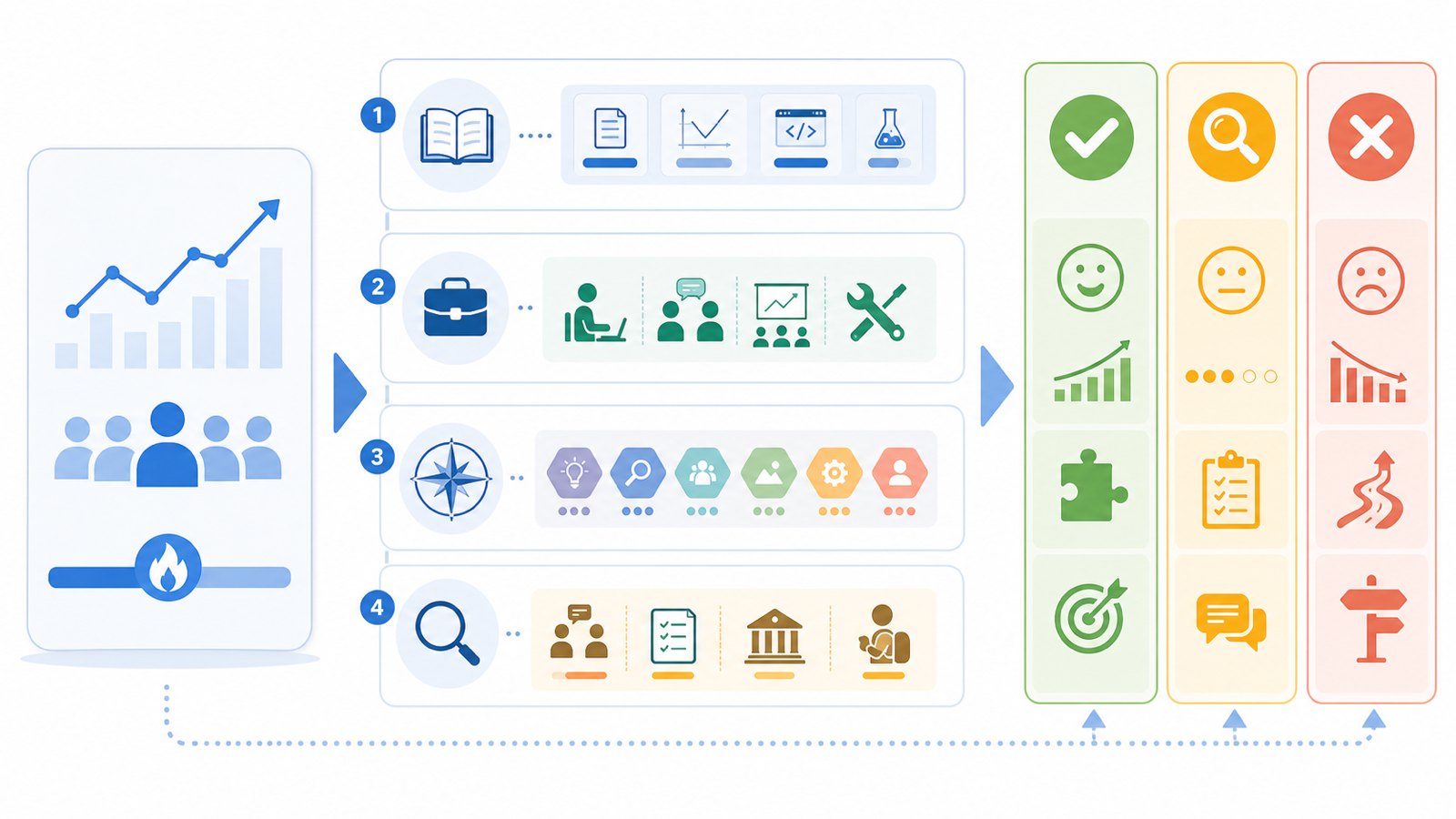
When a major is called popular, the real question is not “Should I choose it?” It is whether you can tolerate the course sequence, whether you understand the work activities the major often leads to, and whether your interest evidence supports those activities. A popular major can enter your shortlist, but it should not bypass inspection. Run it through three gates: courses, work activities, and Holland/RIASEC interest clues. Then label it: keep, verify, or deprioritize.
Popularity is not useless. It may reflect demand, visibility, funding, or strong institutional pipelines. But it is not a personal fit signal. A major can be popular and still be a poor behavioral match for the way you learn, work, solve problems, and tolerate repetitive tasks.
This guide is not a generic “how to choose a major” essay. It is a field manual for one problem: a major looks attractive because the market, school, family, or media narrative makes it sound attractive. How do you test whether it belongs on your list?
Popular majors often come with a social script:
The risk is not only choosing a field you dislike. The deeper risk is academic attrition risk: the gap between the story of a major and the behaviors required to survive its courses, projects, exams, and early work settings.
Before you keep a popular major, ask three questions:
A popular major earns attention. It does not earn automatic commitment.
| Popular-major signal | Under-the-hood question to check | Holland/RIASEC or work-activity clue | Decision output |
|---|---|---|---|
| “AI, data science, and intelligent systems are the future.” | Can you stay focused through weeks of abstract algebra, probability, data cleaning, failed models, and invisible progress? | Investigative interests may support analysis and modeling. Conventional tolerance helps with documentation and repeatable processes. | Verify first: inspect math/programming modules and attempt a small data or coding task. |
| “Computer science leads to strong jobs.” | Are you attracted to the actual work: debugging legacy code, reading poor documentation, tracing interface failures, fixing edge cases, and negotiating requirements? | Realistic + Investigative may support system troubleshooting; Conventional may support disciplined engineering workflows. | Keep only if the engineering routine is tolerable, not just the job-market story. |
| “Business, finance, and management are practical.” | Which version of the field do you mean: sales targets, audit trails, risk models, client work, market analysis, operations, or accounting close cycles? | Enterprising supports influence and resource movement; Conventional supports records, compliance, and process discipline. | Split the major into job families before deciding. |
| “Medicine, law, and education are stable.” | Can you tolerate licensing paths, long training cycles, dense reading, duty schedules, documentation, and responsibility pressure? | Social interests may support service and teaching; Conventional supports rules and procedures; Investigative supports case analysis. | Keep only if the training path and responsibility load are acceptable. |
| “The major is new, interdisciplinary, and exciting.” | Is the curriculum owned by a clear department? Are faculty, labs, projects, internship paths, and graduate routes visible? | Artistic + Investigative may help with open-ended problems; some students need a more established structure. | Deprioritize if institutional resources are unclear. |
| “Everyone around me is applying.” | What evidence belongs to you rather than to the crowd? | Other people’s preferences do not prove your task tolerance. RIASEC can help ask what activities you would repeat. | Mark as verify unless you have personal evidence. |
| “The name sounds impressive.” | Does the required coursework still look tolerable after the marketing language is removed? | Name attraction is a surface signal; work-activity tolerance is the durable signal. | Inspect course modules before keeping it. |
A good triage table does not tell you which major is right. It prevents a popular label from skipping the evidence gate.
Major names are often aspirational. Course lists are more honest.
Artificial intelligence may sound like frontier technology, but the program may ask for linear algebra, probability, programming, algorithms, machine learning, optimization, and long debugging cycles. Fintech may sound like finance plus technology, but it may lean toward risk modeling, software implementation, compliance, business analytics, or market infrastructure. Communication may sound creative, but the actual work can include interviewing, writing, audience research, data communication, media operations, advertising strategy, and repeated revision. Law may sound stable and respected, but the training path may involve dense reading, case retrieval, argument structure, procedural detail, and licensing pressure. Medicine and life sciences may look secure from the outside, but the training cycle, responsibility load, lab discipline, and service pressure are not small costs.
For each major, check:
Difficulty is not the same as incompatibility. But stable avoidance is a signal.
| Course module | What it asks from you | Related work activity | Keep / verify / deprioritize signal |
|---|---|---|---|
| Calculus, linear algebra, probability, statistics, optimization | Staying with symbols, matrices, uncertainty, distributions, error, and proof-like reasoning without quick emotional reward | Translating vague problems into measurable structures; explaining noisy data and model limits to non-specialists | Keep if repeated abstract work is tolerable; verify if you only like the industry narrative. |
| Programming, data structures, algorithms, operating systems | Decomposing problems into edge cases; reading errors; debugging when the system gives no sympathy | Troubleshooting undocumented legacy code, tracing deadlocks, fixing interface overflow, reading logs, and negotiating requirements | Keep if debugging feels like a puzzle; deprioritize if error loops create persistent avoidance. |
| Databases, analytics, machine learning, data engineering | Cleaning messy data, aligning field definitions, checking missing values, and defending assumptions | Pulling multi-table data, reconciling metrics, writing explanations for business users, and accepting repeated challenge | Keep if data hygiene is tolerable; verify if you only want the glamorous model layer. |
| Accounting, finance, economics, risk management | Reading statements, reconciling numbers, understanding risk exposure, and documenting decisions | Closing accounts, investigating abnormal movement, preparing audit evidence, explaining risk in structured language | Keep if rules and numbers are energizing; verify if only high-income stories attract you. |
| Law, public policy, governance | Dense reading, case comparison, procedural thinking, evidence chains, and written reasoning | Locating rules in long documents, drafting memos, reviewing compliance risk, and arguing from evidence | Keep if text density and procedure are acceptable; verify if the attraction is only status or stability. |
| Medicine, life science, pharmacy, nursing-related modules | Long-cycle memorization, lab records, ethics, protocols, service responsibility, and sustained training | Documenting samples, checking data, communicating with patients or teams, reducing mistakes under responsibility pressure | Keep if responsibility and training length are acceptable; verify if the field is chosen only for security. |
| Communication, design, digital media, product experience | Interviewing, writing, user observation, iteration, critique, and public-facing output | Rewriting briefs, absorbing user feedback, changing drafts after stakeholder review, turning vague needs into content or interface decisions | Keep if repeated revision is acceptable; verify if creativity is imagined as low-friction freedom. |
| Engineering, automation, civil, energy, electrical systems | Drawings, instruments, equipment, safety rules, experiments, field constraints | Checking tolerances, calibrating systems, recording abnormal results, communicating with sites, suppliers, or test platforms | Keep if concrete systems and field constraints are attractive; verify if only the title “engineer” attracts you. |
This table is deliberately less glamorous than a major ranking. Rankings describe external attention. Courses and work activities describe the cost of participation.
Holland/RIASEC should not be used as a major-matching engine. It is better used as a vocabulary for work activities.
Read it this way:
A popular major becomes clearer when you convert it into activities. Computer science is not only “technology.” It may be debugging, infrastructure, modeling, testing, or product implementation. Finance is not only “money.” It may be compliance, client pressure, risk review, or data reconciliation. Communication is not only “creative.” It may be interviews, deadlines, edits, criticism, and measurement.
If you want a structured starting point, take the Holland/RIASEC career interest test. Use the result as an exploration input, not as a verdict. It cannot determine admission outcomes, grades, employment, salary, or career success.
Do not keep every popular major by default. Build a short list with status labels.
| Status | Evidence threshold | Next action |
|---|---|---|
| Keep | Official requirements are plausible; course modules are tolerable; work activities have interest evidence; family, cost, location, and program constraints are manageable. | Compare programs, school fit, transfer policy, admission rules, and risk tradeoffs. |
| Verify | The major is attractive, but course difficulty, work activities, institutional resources, or personal interest evidence are incomplete. | Inspect a curriculum, interview students, try a task, and review official program details. |
| Deprioritize | Hard constraints fail, core modules are persistently intolerable, work activities conflict with interest evidence, or constraints are not acceptable. | Remove from the priority shortlist unless new evidence changes the case. |
Deprioritizing is not an ability diagnosis. It is a resource allocation decision. Shortlist space is limited; a popular major without evidence should not occupy the front row.
Do not decide from the words “AI” or “technology.” Check whether you can tolerate programming, mathematics, algorithms, documentation, rapid change, debugging, and systems that fail without telling you why. If your concern is mathematical weakness, inspect that separately instead of using a slogan either way.
Finance and business paths can lead to audit, sales, consulting, operations, data analysis, risk, supply chain, or client work. Those are behaviorally different jobs. A student attracted to market analysis may not tolerate sales targets. A student who likes structured accounting may not enjoy ambiguous strategy work.
These fields often look stable from the outside. But stability may come with licensing paths, dense reading, long study cycles, procedural responsibility, emotional labor, or duty schedules. The question is not whether the field is respected. The question is whether the route is behaviorally tolerable.
Creative fields are not automatically light or free. They often involve interviews, critique, deadlines, repeated revision, ambiguous clients, user feedback, and measurable performance. Interest in expression is useful, but revision tolerance matters just as much.
Family conversations around popular majors often collapse into two claims:
Both are incomplete. Replace them with evidence questions.
| Argument | Evidence question | Next action |
|---|---|---|
| “This major is popular, so choose it.” | Which roles, industries, cities, and skill paths make it attractive? | Read job descriptions and program outcomes instead of relying on second-hand claims. |
| “I just dislike it.” | Is the resistance about courses, tasks, school, city, or unfamiliarity? | Inspect the curriculum, talk to a student, and try one low-cost task. |
| “This field is stable.” | Where does the stability come from: licensing, public-sector routes, demand, or family preference? | Check official requirements, training length, and constraints. |
| “Everyone is applying.” | What evidence is personal to you? | Without personal evidence, the major stays in verify. |
This is also where major-choice conflict needs a separate process. If the core issue is family disagreement, use the parent-student checklist article if available in your locale. This article only handles whether a popular major deserves to stay on the list.
You do not need a perfect answer this week. You need better evidence.
Unverified excitement is not enough. Unverified fear may also be misleading. The sprint separates the two.
This article helps you:
It does not:
For a broader explanation of Holland Code and career interests, see What Is RIASEC? Understanding Holland Code Career Interests. If you want to compare career-interest tests with personality tests, see career interest test vs personality test.
If a popular major is already on your shortlist, do not remove it simply because it is crowded. Do not keep it simply because it is crowded either.
Take the Holland/RIASEC career interest test, then return to the two tables above. Ask:
A popular major becomes useful only after it survives the evidence gate.
Not automatically. Popularity may reflect demand, visibility, or cultural attention, but it does not prove personal fit, admission likelihood, academic persistence, employment, salary, or career success.
No. It can help you understand preferred work activities and environments. It should be used as an exploration input, not as a decision engine or outcome predictor.
Look beyond the name. Review the course modules, inspect common work activities, try a small task, and compare those activities with your interest evidence. If evidence is incomplete, mark the major as verify.
Job prospects matter, but they are not enough. You still need to know which roles are involved, what skills they require, which cities or industries create the opportunity, and whether you can tolerate the work.
Move the conversation from preference to evidence. Ask what jobs, courses, constraints, and risks they are actually referring to. Then compare those facts with your interests and tolerance.
No. Deprioritizing means the current evidence is weak or the fit is questionable. It is not a diagnosis of ability, intelligence, or potential.