Put New Big Five Research in Context Before Updating Claims
A new Big Five study can repeat, extend or challenge earlier findings. Compare the actual question, measures, sample and uncertainty before changing a claim.
Put New Big Five Research in Context Before Updating Claims
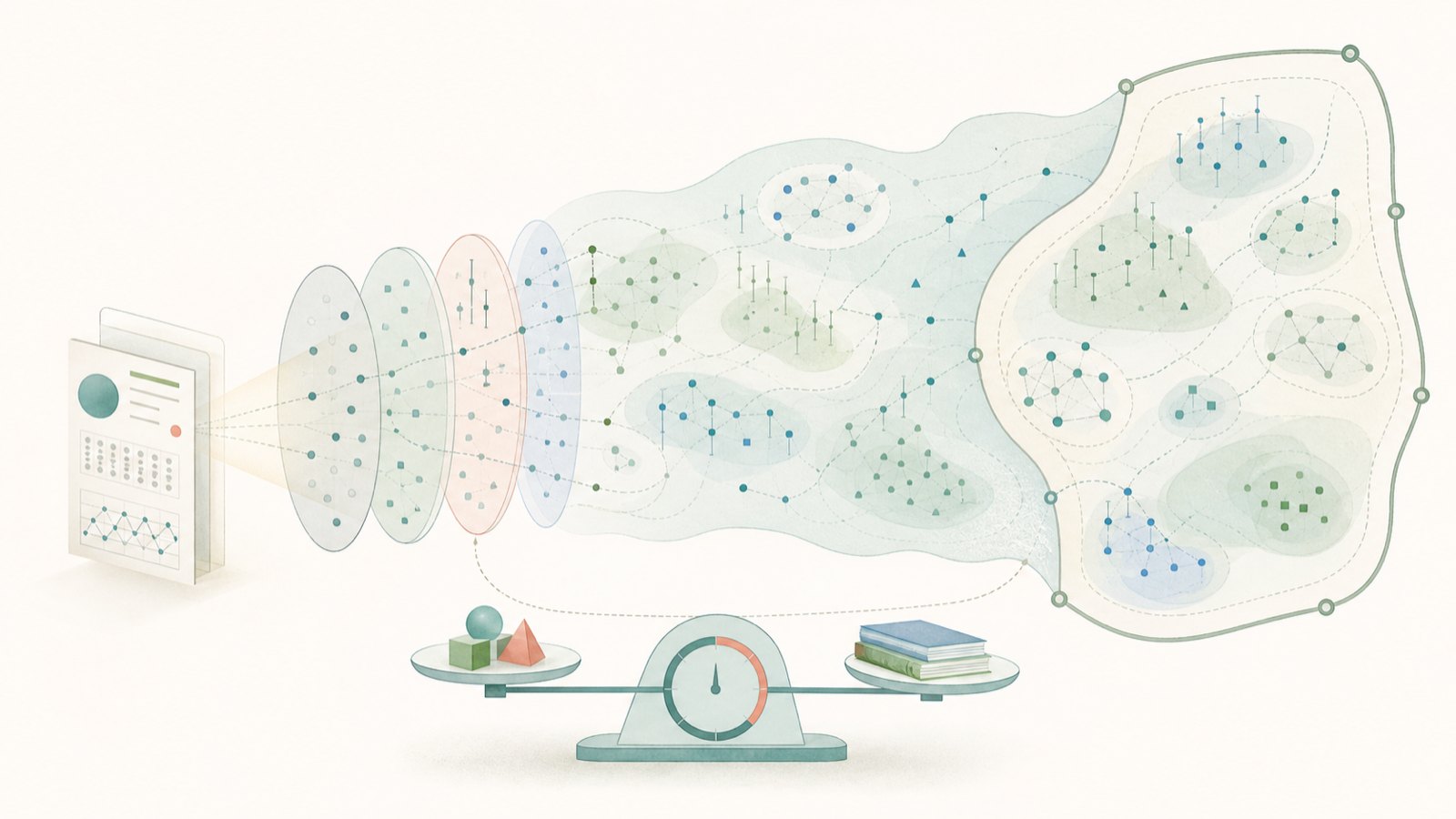
When you see news claiming that “the latest study rewrites Big Five personality,” the easiest reactions are to believe it immediately or dismiss it immediately. Both are too quick. A new publication only means it has entered the record for discussion, not that it has replaced earlier evidence. A paper can be rigorous and important while answering only a narrow question. A more cautious approach puts it back in context:What exactly did it ask, which instrument, sample, and design did it use, how large and uncertain was the estimate, and what do independent replications and reviews say about the same question?
These four sets of questions do not judge a paper as “true” or “false.” They help readers rephrase a “new discovery” as a limited claim that can be checked. This article does not update anyone’s personality judgments or turn general research into FermatMind product claims, psychometric proof, career advice, medical explanations, or predictions. This article does not establish those product-level claims.
A New Publication Does Not Mean Earlier Evidence Is Obsolete
The scientific record accumulates and undergoes revision. A new study may repeat an existing finding, place a question in another population or language, compare another measure, identify conditional differences, or present a contradiction worth further testing. Its value does not require calling it “revolutionary.” Conversely, an older study is not automatically irrelevant. What matters is whether its question, materials, and methods remain relevant to the current discussion.
Avoid treating “new” as a level of evidence. If a paper examines the item structure of a questionnaire, it primarily provides measurement information about that instrument under those study conditions. If it examines the co-occurrence of two variables in one sample, it primarily provides group-level association information. A title alone cannot extend either into “The Big Five has been overturned,” “Everyone will behave this way,” or “This product is now validated.”
The most useful first question when encountering new information is often: “What did this study observe, and under what conditions?” It brings the discussion from exchanging positions back to checkable subjects, measurements, designs, and estimates.
Compare Research Questions First: Are the Studies Really Asking the Same Thing?
“Studying the Big Five” is not one question. Some researchers ask whether five broad dimensions can organize a particular set of materials. Others develop or evaluate a specific questionnaire, compare associations between traits and another variable, or track changes in certain reports over time. Even when all use words such as “extraversion” and “conscientiousness,” their subjects, outcome variables, and scope of inference may differ.
When reading, divide the original claim into five components: who was studied, how the trait or outcome was operationalized, what was compared, what kind of result was obtained, and whether the authors mean description, association, prediction, or causation. A new study of a short scale in one language cannot directly establish the validity of a different full-length scale. A group-level correlation cannot explain an individual’s causes, value, ability, or future.
This step is especially useful for preventing negative wording from expanding a claim. “Two factors were not clearly distinguished in one sample” is not the same claim as “A dimension does not exist in any context.” “A property of an instrument needs further study” likewise does not mean “The entire Big Five framework has been abandoned.” Align the questions first to determine whether results repeat, extend, contradict, or simply cannot be compared directly.
Compare Instruments Next: Shared Labels Do Not Mean the Same Thing Was Measured
Personality constructs cannot be measured directly in the way height can. Researchers use items, response formats, versions, languages, scoring, and analysis rules to turn concepts into observable data. Instrument names therefore matter. The five Big Five labels can appear in questionnaires with different lengths, facet divisions, translations, and sources. Identically named dimensions do not guarantee that questions, scores, or interpretive scope are interchangeable.
Soto and John’s research on the BFI-2 concerns a specifically named instrument, its hierarchical structure, and its development and evaluation. Such material helps readers understand that evidence about an instrument belongs to that instrument, its samples, and the reported scope. It does not automatically cover all self-report questionnaires, Chinese versions, pages, or products. Even if a new paper also uses “Big Five,” check the actual version, whether items were removed or modified, response instructions, scoring method, and measurement information.
When instrument details are missing, retain Unknown rather than guessing “They must be the same” or “They definitely cannot be compared.” Measurement transparency allows questions about the scope of a conclusion. It does not itself establish that a study is correct or authorize turning general methodological literature into a negative judgment of a particular scale or platform.
Samples and Designs Determine Whom and Which Conditions an Observation Initially Applies To
Sample size provides information, but not all the information needed. Check recruitment sources, language and everyday context, inclusion criteria, data-collection timing, attrition or missing data, and how far those conditions differ from the question you care about. A large sample may make some estimates more precise without representing every population. A carefully targeted sample is not devoid of information simply because it is smaller. What it supports must fit the “who” in the claim.
Read designs in relation to their questions too. A one-time questionnaire can describe patterns at one time, but cannot by itself establish temporal order or exclude all alternative explanations. Longitudinal research adds timing information, while still requiring attention to intervals, attrition, repeated measures, and unmeasured factors. Experiments can test a causal question more directly under clearly manipulated and compared conditions, but their tasks, participants, and settings also limit generalization. Scale-development studies primarily address instrument construction and evaluation, not automatically interventions, careers, or life outcomes.
There is no need to place designs in a simple ranking. Ask whether the design can support the actual sentence the authors wrote. If a paper did not study a particular Chinese-speaking reader, work situation, high-risk choice, or product, its conclusion should not quietly add those subjects.
Effects and Uncertainty: Ask How Much a Result Supports, Not Just Whether It Exists
New studies are often condensed into “found a relationship” or “found no relationship.” That wording skips the most important details: the estimate’s direction and size, the width of intervals or other uncertainty information, sensitivity to sample, measurement, and analysis choices, and practical meaning for the current question. Statistical significance is not synonymous with practical importance, causal truth, broad applicability, or individual prediction. Not reaching a threshold is not synonymous with “no information whatsoever.”
In Big Five research, correlations, mean differences, structural parameters, and predictive models describe different types of results. An average group-level association cannot explain why a particular reader is this way or guarantee what will happen next time. Even if a model performs well in a study sample, ask whether it has been checked in an independent sample with the same instrument and similar outcomes.
Gardner and Altman (1986) argue for reading estimated magnitudes and confidence intervals rather than reducing results to a significance label. General readers need not recalculate statistics themselves. They should simply avoid turning a striking number or significance label into a certain individual conclusion. Keeping uncheckable figures, boundaries, and applicability Unknown is more reliable than filling an entire story with one result.
Replication Is Not a Seal of Approval, and a Review Is Not Automatically the Final Word
Independent replication adds opportunities to test the existing record, but “replicated” is not a quality label detached from details. Check whether the replication’s question, sample, materials, measurements, and analyses are sufficiently close to the original, and which differences matter. A similar result adds confidence in an observation under particular conditions; a different result calls for further explanation. Neither turns the original study or its replication into a verdict on all personality research.
Nosek and colleagues’ review discusses replicability, robustness, and reproducibility in the context of research progress and self-correction. The useful lesson is not to label an entire field “reliable” or “unreliable,” but to treat replication as part of cumulative evidence, making questions, methods, and differences easier to test and discuss.
A systematic review or meta-analysis can organize multiple studies, but still requires asking whether the included studies address the same question, whether samples, instruments, designs, and outcomes are sufficiently comparable, whether search and inclusion criteria are clear, and how differences among studies are represented. A review cannot erase limitations in original studies. An original study need not be excluded from discussion because it is not a review. The best unit of comparison remains “Which precise claim can this evidence support?”
A Reader Scenario: News Says “A New Study Changes the Meaning of Conscientiousness”
Suppose a news report says a new study found a smaller relationship between conscientiousness and a work outcome than previously assumed, then concludes: “Conscientiousness no longer matters; all Big Five tests are outdated.” Do not rush to take sides. Find the original study or preprint, confirm which record the report refers to, and ask which conscientiousness instrument, sample, and outcome it studied, and which earlier research it actually compared.
If the paper reports only a cross-sectional self-report association in a particular sample, it may add information about the estimate for that question. It cannot alone establish causal mechanisms, tell everyone whether something “matters,” or evaluate a particular assessment, report, or career choice. If results differ from existing studies, check differences in measures, samples, timing, and analyses, and look for independent related records or synthesized evidence rather than announcing that one side has won.
This scenario illustrates an often-overlooked boundary: a new study is not an instruction to update your personality label. A group average alone cannot tell a particular reader how to define themselves, which job to apply for, what treatment to receive, or how to judge someone else.
Four Layers of Comparison: Put a “New Discovery” in Its Proper Place
When reading a new Big Five study, keep four lines in your notes instead of immediately grading its conclusion.
Question. Does the paper test structure, an instrument, association, prediction, or causation? Does it ask the same question as existing research?
Instrument, sample, and design. Which version, data, participants, timing, and comparisons were actually used? Which boundaries prevent interchanging the new and earlier results?
Effect and uncertainty. What did the authors estimate, how precisely, and which checkable information is missing? Do not record only “significant” or “latest.”
Cumulative record. Are there independent repetitions, transparent methods, related studies, or reviews? Do they converge, conflict, or remain incomparable?
Add one final line: “What this does not imply.” For example: it does not turn group associations into individual causes, instrument papers into product validation, one inconsistency into the death of a model, or general research into hiring, admissions, medical, legal, financial, or relationship decisions. This is not excessive caution; it keeps conclusions within the reach of the actual evidence.
FermatMind: General Research Cannot Automatically Update Product Claims
FermatMind’s public Big Five test guide describes its 90-question and 120-question versions, five domains and 30 facets, reverse scoring, aggregation, and z-score/T-score conversions. These method descriptions do not establish product validation. A percentile calculated from an assumed normal model is not an observed rank in a representative population; read the stated reference source and norm status. The full item key and product-specific research on reliability, validity, measurement error, cross-language equivalence, retesting, meaningful change, intervention effects, individual prediction, and career or relationship matching are not established by these public explanations. Their evidential support remains Unknown here.
Instrument research on the BFI-2, measurement-method papers, replication reviews, or any new personality research can at most help readers understand the limited questions each addresses. They do not automatically certify a product or establish that a particular reader’s score is accurate, stable, comparable, predictive, or suitable for action. Separating general research from product evidence does not reject either research or products; it avoids transferring evidence across boundaries.
Do Not Turn Research Reading into Diagnosis or High-Risk Decisions
This article is educational material for reading research and limited self-reflection. It does not diagnose psychological or medical conditions, judge personality as good or bad, or assess ability, hiring eligibility, admissions eligibility, career fit, relationship quality, legal responsibility, financial choices, or future outcomes. No article, personality study, review statistic, or self-test should alone carry a decision that substantially affects your own or others’ interests.
Likewise, confusion after reading a new study need not be interpreted as a personal problem. If ongoing distress, health, safety, rights, or urgent risks are involved, prioritize real-world and professional support appropriate to the specific situation rather than replacing judgment with personality labels or research news. Research helps us ask clearer questions; it does not make decisions beyond the evidence for us.
Frequently Asked Questions
Is the Latest Study Necessarily More Reliable Than Older Research?
No. Publication date is not a universal evidence ranking. Compare the question, instrument, sample, design, estimates, and uncertainty, then check whether it repeats, extends, conflicts with, or cannot directly be compared with the existing record.
Can a Very Large Sample Automatically Make Results Applicable to Me?
No. A large sample may improve the precision of some estimates, but it does not replace checking sample sources, measurements, language, context, or group-to-individual boundaries. Group results do not directly answer individual causes or futures.
If One Replication Finds a Different Result, Is the Original Paper Completely Wrong?
That generalization does not follow. Check the question, procedures, samples, measures, analyses, and uncertainty. Different results add information to the cumulative record; they are not context-free judgments of truth or falsity.
Can I Skip Original Study Details If There Is a Systematic Review or Meta-Analysis?
No. Reviews help organize studies, but you still need to check comparability, treatment of heterogeneity, and whether the synthesized conclusion fits the current claim. They do not automatically solve generalization, causation, or individual prediction problems.
Can New Big Five Research Prove That FermatMind Results Are Accurate or Predict the Future?
No. General research supports only its own question, instrument, sample, design, and analytical scope. FermatMind-specific psychometrics, effects, predictions, and matching details are all Unknown in this article.
Sources and Scope
These sources address instrument development, estimation, and replication. They support the reading questions above; they do not validate FermatMind or turn a new result into advice about an individual.
When a new study looks compelling, the most cautious next step is not to update every claim immediately. Ask what it actually answered, what it omitted, and which independent records are needed to determine its place on the overall evidence map.
How to Put New Big Five Research in Context | FermatMind