Content category
Career Planning

Turn an unrelated major into job evidence with JD analysis, projects, internships, resume language, and Holland/RIASEC validation.
By: Fermat Institute
Published: Jul 2, 2026
Updated: Jul 2, 2026
29 min read
Human review completed · Jul 2, 2026When should I use this article?
Use this article when you want to connect public content with tests, personality profiles, or career guidance from a single starting point.
Does this replace formal judgment?
No. It offers public explanation and action cues, but does not replace medical, legal, or professional judgment.
Content category
Career Planning
Related tags
RIASEC, Holland Code, career mismatch, unrelated major
When your major does not match the job you want, the weakest resume move is usually an apology. The stronger move is evidence: what tasks does the target role repeat, what have you already done, and what proof can you build through projects, internships, portfolio work, or formal training?
A history major applying for product operations, a biology student considering UX research, or an economics graduate moving toward analytics may not be starting from zero. The degree label is one part of the story. The harder gap is that coursework, projects, writing, research, and analysis are often still written in school language, not hiring language.
This guide stays in one lane: cross-major job search
“Unrelated major” can mean several different problems. Each problem needs a different response.
| Mismatch type | What it looks like | What it may mean | Next action |
|---|---|---|---|
| Title mismatch | Your degree title does not match the role title | You may still have transferable evidence | Translate coursework and projects into role language |
| Method mismatch | You lack methods such as statistics, research design, coding, accounting, lab technique, or writing formats | You need structured learning before applying widely | Build a focused course-and-project plan |
| Skill-evidence mismatch | You say you can do the job, but have no artifact | Employers cannot evaluate readiness | Build portfolio, internship, or project proof |
| Internship mismatch | You have work experience, but it does not obviously connect to the role | The experience may need reframing around transferable tasks | Extract coordination, analysis, writing, customer, or process evidence |
| Credential mismatch | The role requires a license, accredited training, or regulated qualification | Interest and projects may not be enough | Verify formal requirements before investing deeply |
| Work-activity mismatch | You like the field image but avoid the daily work | The role may be hard to sustain | Validate with work samples, informational interviews, and RIASEC-style activity reflection |
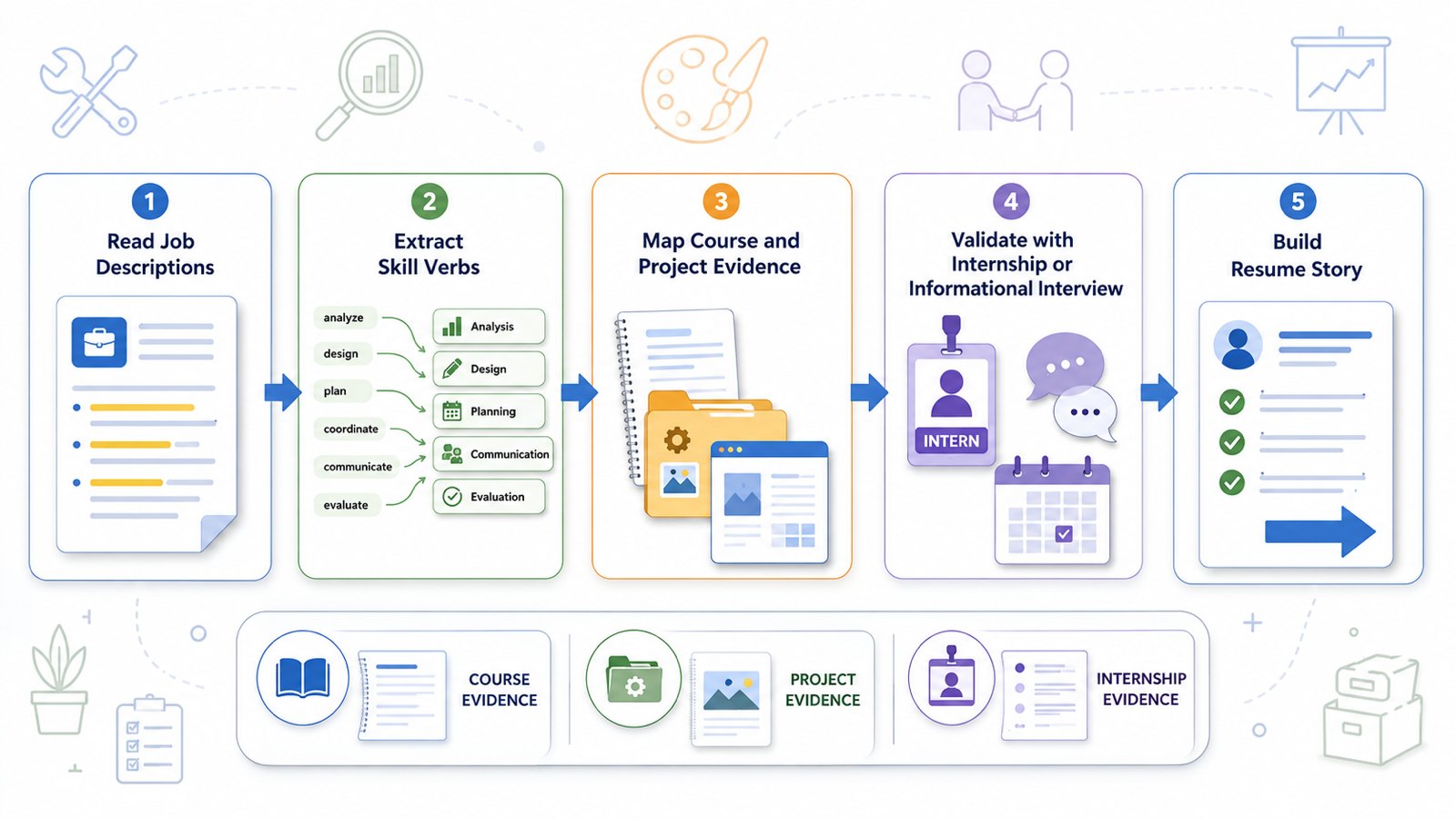
Next action: collect ten job descriptions for the role you want. Delete adjectives such as “motivated,” “excellent,” and “passionate.” Keep the verbs and deliverables: analyze, interview, write, test, build, debug, coordinate, document, present, monitor, launch, maintain. Those verbs are the real entry points.
A first-year student, a junior, a senior, and a recent graduate should not use the same plan. The danger is not discovering a mismatch. The danger is staying in abstract regret while the evidence window closes.
| Stage | Common mistake | Priority | Output |
|---|---|---|---|
| First year | Assuming one bad course means the whole major is useless | Explore real tasks through clubs, projects, classes, and conversations | Two or three career directions to test |
| Sophomore year | Sampling many directions without building evidence | Choose one or two targets and build early artifacts | First skills map and project draft |
| Junior year | Collecting certificates without role-specific proof | Follow job-description verbs and build internship-ready evidence | Portfolio, resume version, internship feedback |
| Senior / new graduate | Writing the resume like an apology | Connect coursework, projects, and role tasks | One-page resume, three project stories, interview narrative |
| 0-2 years after graduation | Saying “I want to switch” without proof | Use work output, projects, and industry understanding to prove the move is not impulsive | Work samples, postmortems, referrals, or verified deliverables |
Changing majors can be one academic option, but it is not the main path here. It depends on institutional policy, grades, timing, available seats, and target-program requirements. In the job market, the more common path is to build evidence outside the degree title.
A job description is not only a list of requirements. It is a map of what the employer wants to see you do.
| Repeated JD phrase | Likely skill behind it | Proof artifact | How to build evidence |
|---|---|---|---|
| User interviews, needs research, competitor analysis | Research design, interviewing, synthesis, report writing | Interview guide, notes, insight memo, competitor matrix | Interview five users for a product and write a structured research report |
| Data cleaning, metrics, SQL, spreadsheets, dashboard | Data handling, metric logic, structured communication | Cleaned dataset, dashboard, analysis memo | Use public data to build a business-analysis dashboard |
| Content planning, campaign review, conversion analysis | Topic selection, writing, distribution, feedback analysis | Content calendar, screenshots, metrics, postmortem | Run a small content experiment for 30 days |
| Project coordination, cross-functional communication, timeline | Task breakdown, coordination, risk tracking | Project plan, meeting notes, timeline, risk log | Manage a small project and document the process |
| Testing, debugging, deployment, maintenance | Technical reasoning, detail checking, problem isolation | Bug log, test cases, demo, repair notes | Build a small tool or webpage and document fixes |
| Client communication, solution presentation, account support | Needs understanding, presentation, trust building | Proposal deck, mock pitch, customer needs sheet | Create a three-page solution pitch and get feedback |
| Research, market scan, memo writing | Information filtering, judgment, structured writing | Research folder, framework, executive summary | Write a 2,000-word market memo with source notes |
A stronger resume does not say, “My major is unrelated, but I am willing to learn.” It says, “I have already practiced the role’s entry-level tasks.”
Many career transitions fail because learning never becomes evidence. A hiring manager cannot evaluate “I watched a course” or “I am interested.” They can evaluate artifacts.
| Evidence level | Examples | Credibility | How to use it |
|---|---|---|---|
| Weak evidence | Watched courses, read books, attended talks, saved resources | Shows exposure only | Use for preparation, not as the main resume argument |
| Medium evidence | Course project, small portfolio item, public-data analysis, practice memo | Shows basic task performance | Use in project experience with task, tools, and output |
| Strong evidence | Internship, real user/client feedback, live work, competition output, supervisor-verified deliverable | Shows execution in a real environment | Place high on the resume and discuss in interviews |
| Gatekeeping evidence | License, accredited training, advanced technical project, research experience | Needed for regulated or deep technical roles | Verify requirements before investing heavily |
If you only have weak evidence, do not simply polish the resume. Upgrade one learning item into a concrete artifact.
Evidence often exists, but it is written in academic language instead of hiring language.
| Major evidence | Transferable skill | Proof artifact | Resume sentence direction |
|---|---|---|---|
| Literature review | Research, source evaluation, structured writing | Annotated bibliography, outline, synthesis memo | “Reviewed 20+ sources and produced a structured analysis memo.” |
| Lab report | Procedure, measurement, error analysis | Lab notes, chart, conclusion | “Recorded experimental data and reviewed outlier results.” |
| Field research / survey | Interviewing, sampling, coding | Interview guide, coded notes, report | “Designed interview prompts and grouped responses into recurring themes.” |
| Engineering or design project | Requirements, implementation, testing | Project document, demo, code | “Contributed to a course project from requirements to test documentation.” |
| Group presentation | Synthesis, communication, collaboration | Slide deck, division of work, feedback | “Converted complex source material into a concise presentation for non-specialist peers.” |
| Student organization or competition | Execution, scheduling, stakeholder coordination | Plan, metrics, postmortem | “Managed a student project timeline and documented execution learnings.” |
The task is not to pretend your major was something else. The task is to show which parts of your training are usable in the target role.
A Holland/RIASEC result is most useful when it helps you ask better questions about work activities. It does not decide your job.
If you have not taken it yet, the Holland/RIASEC career interest test can be used as a starting point for work-activity reflection.
| RIASEC theme | Work activities | Cross-major validation task | What not to conclude |
|---|---|---|---|
| Realistic | Build, operate, repair, test concrete systems | Build or troubleshoot a small practical system | “Realistic means I must choose an engineering job.” |
| Investigative | Analyze, research, model, test hypotheses | Complete a data or research mini-project | “Investigative means I am automatically suited for research.” |
| Artistic | Create, design, write, reframe open-ended problems | Build a portfolio piece or content project | “Artistic means I cannot do structured work.” |
| Social | Teach, support, interview, facilitate, explain | Conduct interviews or build a training guide | “Social means every people-facing role will fit.” |
| Enterprising | Persuade, organize, negotiate, move projects forward | Create a pitch or run a small initiative | “Enterprising means I should become a manager.” |
| Conventional | Structure, document, track, audit, standardize | Build a process tracker or QA checklist | “Conventional means I can only do repetitive work.” |
If your target role demands tasks you repeatedly avoid—analysis, writing, ambiguity, stakeholder communication, debugging, customer contact, documentation—that is a signal to validate carefully before committing.
<!-- body_visual:major_career_mismatch_transition_map -->
Thirty days will not complete a career transition, but it can show whether the path has traction.
| Time frame | Task | Output | Question answered |
|---|---|---|---|
| Days 1-3 | Collect 10 target job descriptions | Verb list and skill map | What does this role actually do? |
| Days 4-7 | Map your current evidence | Course/project evidence sheet | What do I already have? |
| Days 8-14 | Complete one small project | Link, report, code, screenshot, or portfolio sample | Can I produce something role-relevant? |
| Days 15-21 | Interview two people in the field | Interview notes | How different is the work from my imagination? |
| Days 22-30 | Revise resume and apply to low-risk opportunities | Resume version and application log | Does the market give any signal back? |
At the end of 30 days, classify the path:
Keep: I can produce evidence and want to continue.
Verify: I am interested, but the evidence is still weak.
Pause: I like the idea, but the real work or formal gate looks incompatible right now.The most common mistake is confusing learning with evidence. Courses matter, but employers need artifacts.
| Time | Goal | Action | Output |
|---|---|---|---|
| Days 1-30 | Test direction | JD analysis, mini-project, interviews, resume draft | First evidence and direction judgment |
| Days 31-60 | Build a visible portfolio | Complete a second, more realistic project; seek feedback; apply for internships | Portfolio, postmortem, feedback notes |
| Days 61-90 | Take evidence to the market | Apply to 30-50 targeted roles; revise resume; close skill gaps | Application log, interview feedback, revised resume |
| After 90 days | Decide whether to continue, shift, or seek formal training | Review response quality and task tolerance | Continue / pivot / formal training decision |
If after 90 days you have no project, no interview, no feedback, no application record, and no clearer skill map, the issue is not just the major. The transition plan has not been executed.
An unrelated major should not turn your resume into a confession. Connect the major to usable evidence, then move quickly to role-specific proof.
| Resume area | What to include | What to avoid |
|---|---|---|
| Summary | Target role, evidence, one core strength | “My major is unrelated, but I am passionate.” |
| Education | Relevant coursework, methods, projects | Listing every course equally |
| Projects | Context, action, tools, output, reflection | Saying only “participated in” without deliverables |
| Skills | Skills that match repeated JD verbs | Long lists of unverifiable “familiar with” claims |
| Narrative | How your major connects to role tasks | Overexplaining regret, anxiety, or family conflict |
Weak:
My major is not product-related, but I am very interested in technology.
Stronger:
Humanities coursework trained structured reading and synthesis
completed two user-interview projects, organized 15 interview notes into recurring pain points, and wrote a competitor comparison memo for product research practice.
Weak:
I am good at communication even though my major is technical.
Stronger:
Technical coursework helped me understand product constraints
ran a 30-day niche content project with topic planning, publishing cadence, interaction tracking, and weekly performance review.
Weak:
I self-studied Python.
Stronger:
Business coursework trained metric interpretation
used public data to complete a funnel analysis, customer segmentation dashboard, and recommendation memo using Python and spreadsheets.
Some paths require formal training, credentials, or legal eligibility.
| Path type | Why projects are not enough | What to verify |
|---|---|---|
| Clinical healthcare, therapy, legal practice | Legal and ethical responsibility | Degree, license, supervised training |
| Teaching, public-sector roles, statutory professions | Formal exams or certificates may apply | Local requirements and eligibility |
| High-risk engineering or laboratory roles | Safety and technical responsibility | Accredited training, lab or engineering standards |
| Finance, audit, compliance, risk | Employers may require specific credentials or internships | Role requirements, certification relevance |
| Algorithms, hardware, chip design, advanced research | Deep math, engineering, or research background | Coursework depth, research evidence, technical interviews |
RIASEC can help you decide whether the work activities are worth exploring. It cannot remove formal requirements.
Do not only say, “I want to switch paths.” That sounds like risk. Bring evidence.
| Evidence | Purpose |
|---|---|
| Target job description summary | Shows you understand the market |
| Skill-gap table | Shows you know what is missing |
| Current coursework/project evidence | Shows you are not starting from zero |
| 30/90-day plan | Shows this is not impulsive |
| Backup path | Shows you can manage uncertainty |
A grounded script:
I am not rejecting my major, and I am not relying only on interest. I collected 20 job descriptions, identified repeated skill requirements, and mapped what I already have. Over the next 90 days I will complete two projects, talk to three people in the field, apply to selected internships, and review whether the market gives real feedback.
That conversation is much stronger than “I do not like my major.”
This article can help you:
It cannot:
Take the Holland/RIASEC career interest test if you need a structured starting point. After you get a result, do not ask, “What job does this type guarantee?” Ask:
You can also use an MBTI-style test to reflect on communication and decision preferences, or a Big Five test for broader behavioral tendencies. Keep all of them in the exploration lane, not the guarantee lane.
Yes, but the stronger question is whether you can show job-relevant evidence. A different major is less of a blocker when your resume includes projects, internships, portfolios, writing samples, data work, code, research notes, customer-facing experience, or other proof that maps to the role.
The most useful evidence is visible, role-specific work: a portfolio, a project write-up, an internship, a GitHub repository, a research memo, a campaign analysis, a customer interview report, a dashboard, a certification, or a supervisor-confirmed deliverable. Generic interest is not enough.
No. A Holland/RIASEC result can help you notice which work activities you may be more willing to sustain, but it cannot guarantee job fit, salary, interview success, hiring outcomes, or career success. Use it as a question generator, not as a decision engine.
Do not over-apologize. Connect your major to transferable evidence and then move quickly to role-specific proof. For example: “Economics major with repeated coursework in data interpretation; built two Python dashboards and completed a market-sizing project for early-stage SaaS research.”
Build a small but credible proof artifact. Analyze five job descriptions, pick one repeated skill cluster, complete a 2-4 week project, document the process, and ask for feedback from someone in the target field. This does not replace a full internship, but it gives recruiters something concrete to evaluate.
Regulated or credentialed paths often require formal training or licenses: clinical healthcare, legal practice, public accounting, certain engineering responsibilities, teaching credentials, laboratory safety roles, and compliance-heavy work. Always verify local requirements and employer expectations.