College Major Choice / Career ExplorationRIASECHolland Codemajor transferbroad major category
How Do You Choose a Major Track After Broad-Category Admission? Build a Pre-Enrollment Checklist with Course Directions, Holland Interests, and Major-Change Windows
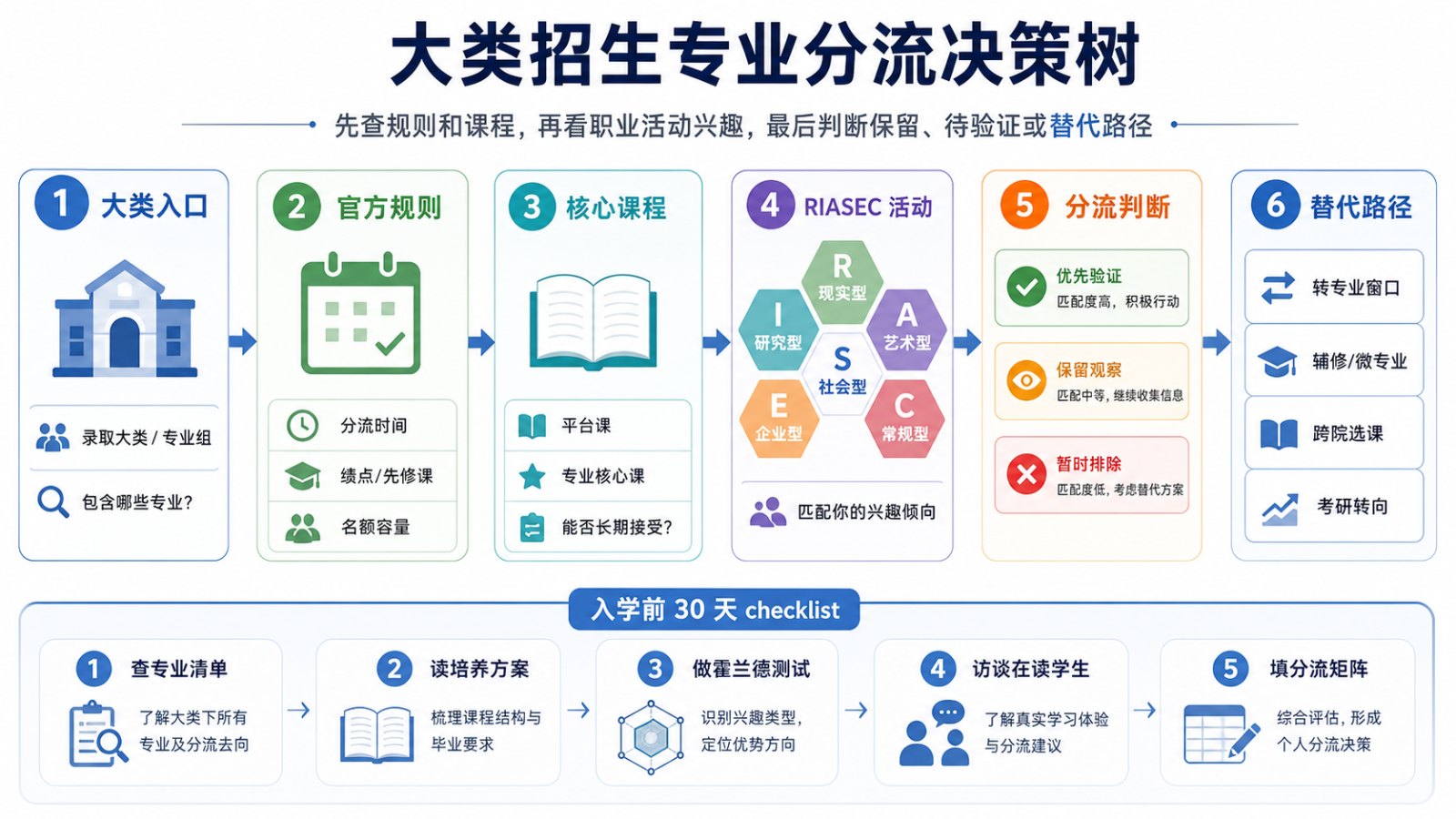
Before enrollment through broad-category admission, check the major list, allocation rules, core courses, and windows for changing majors. Then use Holland interests to align course tasks with future work activities.
How Do You Choose a Major Track After Broad-Category Admission? Do Not Treat "Decide Later" as Insurance
Direct answer: First check which specific majors the category includes, what determines track allocation, whether you can accept the core courses, and whether there are windows for changing majors or taking a minor. Then use Holland interests to align course tasks with future work activities. Do not rank directions only by popularity.
When an admission letter says "Computer Science Category," "Engineering Experimental Class," "Economics and Management Experimental Class," "Broad Science Category," or "Humanities Experimental Class," many families breathe a sigh of relief: the student has entered the university and can choose a major later. The real issue is that major-track allocation does not wait until you have gradually thought everything through and can freely choose. From the first day of enrollment, courses, GPA, quotas, preference order, and faculty rules move the process forward.
Content category
College Major Choice / Career Exploration
Related tags
RIASEC, Holland Code, major transfer, broad major category
What matters most now is not immediately choosing the direction that "looks most popular." Break how to choose a major track after broad-category admission into evidence you can check: official rules, core courses, grade thresholds, windows for changing majors, and actual work activities. Before enrollment, this helps you distinguish directions worth validating first, names that merely sound appealing, and directions requiring alternative paths prepared in advance.
What Does Major-Track Allocation After Broad-Category Admission Mean?
Broad-category admission means "being admitted first to a wider category, then entering a specific major or direction under university rules." It commonly appears in major categories, faculty platforms, experimental classes, elite classes, engineering platforms, economics and management platforms, or interdisciplinary programs. It is not the same as a "university major group": the latter is a grouping unit used during gaokao preference admission; broad-category admission and major-track allocation are educational and secondary-choice mechanisms after enrollment.
What matters is the available pool and the rules, not the name. A "Computer Science Category" may include computer science, software engineering, artificial intelligence, cybersecurity, and data science. An "Engineering Experimental Class" may lead to mechanical engineering, automation, materials, energy, civil engineering, or electronic information. The broader the name, the less you should rely only on a promotional page.
Admission name you see
Easy misjudgment
Facts to check before enrollment
Next action
Computer Science / Electronic Information Category
Assuming every direction means "coding" or "AI"
Specific major list, track quotas, differences in core courses, whether coding tests/interviews apply
Find training plans and recent allocation procedures
Engineering Experimental Class
Treating engineering as one whole
Courses and work activities differ greatly across mechanical engineering, materials, automation, energy, civil engineering, and others
List course and laboratory requirements for each direction separately
Economics and Management Experimental Class
Looking only at "finance/accounting/management" employment labels
Mathematics, statistics, accounting, English, internship resources, and allocation capacity may differ
Check the course platform and allocation proportions
Broad Science Category
Assuming that "liking science" means being able to study all of it
Training methods differ greatly across mathematics, physics, chemistry, biology, and statistics
Check first-year platform courses and GPA calculation
Humanities Experimental Class
Assuming it is all reading and writing
Language, history, philosophy, journalism, and sociology differ in training, work samples, and employment paths
Check graduation requirements and restrictions on directions
Next action: Search the admission category name on the university's undergraduate admissions site, faculty website, and academic affairs website. Use keywords such as "track allocation implementation procedures," "training plan," "major confirmation," "major change procedures," and "course plan." Claims without official documents should initially be recorded as rumors.
Which Allocation Rules Should You Check Before Enrollment?
Allocation rules determine your actual choices a year later. Many students assume "enter the category first and choose later," but the actual rule may be "student preferences + first-year GPA + prerequisite courses + quota capacity + special assessments." If you wait until the second semester of your first year to check, you may already have missed the earliest course and grade windows.
Information item
Specific question to ask
Why it affects allocation
Evidence level
Available major list
Which majors can this category ultimately lead to? Are some directions not open to applicants?
Determines your actual choice pool
University document > faculty notice > verbal claim
Allocation time
At the end of the first year, the start of the second year, or soon after enrollment?
Earlier timing means a shorter validation window
Academic affairs/faculty notice
Allocation basis
GPA, preferences, prerequisites, interviews, comprehensive evaluation, or special tests?
Determines which courses to safeguard in the first semester
The current year's procedure matters most
Quota capacity
Do popular directions have caps? Is admission rank-based?
Do platform courses, general education, or major introductions count toward allocation GPA?
Affects early learning strategy
Training plan/allocation details
Special restrictions
Are there subject-choice, medical, individual-subject, foreign-language, competition, or interview requirements?
May directly exclude some directions
Admissions regulations/faculty rules
Major change window
Can you change after allocation? What are the conditions for transferring in/out?
An alternative path, not a guaranteed fallback
University major change procedures
Minor/micro-major
Can you supplement skills or certificates if you miss your target direction?
Affects the flexibility of "study first and validate later"
Academic affairs system/program description
Next action: Write the source after each rule. If the source is "a senior said," "the group chat said," or "an agency said," do not yet use it for a major decision. Turn it into a question to confirm with the faculty, academic affairs office, or official consultation session.
Can You Choose a Track Based Only on Popularity?
No. Popular directions may have more resources and opportunities, but also stronger competition, denser courses, tighter quotas, and higher allocation thresholds. Less popular directions are not necessarily worse. Some are simply less understood externally, while their actual courses and future work activities may fit you better.
A more effective comparison is:course direction × future work activities × allocation threshold × alternative paths.
Track direction
Core course direction
Work activities that may recur
What to check about allocation thresholds
Initial judgment
Computer science / software engineering
Programming, data structures, algorithms, systems, databases, software engineering
Coding, debugging, reading documentation, breaking down requirements, collaborative delivery
Next action: For each candidate direction, find at least 3 core courses, 2 typical projects, and 1 examples of graduate destinations. Knowing only "good employment," "sounds advanced," or "could lead to a major company" is insufficient for a track-allocation judgment.
How Can You Use Holland Interests to Examine Courses and Future Work Activities?
Holland/RIASEC's value is not giving you a major answer. It breaks "like/dislike" into specific learning and work activities. It is suited to asking: What does this direction do over the long term? Am I willing to keep engaging with these tasks? Which activities are unfamiliar but testable, and which do I clearly reject?
RIASEC tendency
Course interest signals
Future work activity signals
Practical questions about allocation thresholds
Conclusions you cannot draw
R Realistic
Experiments, equipment, structures, operations, engineering training
Hardware debugging, field execution, equipment maintenance, implementing processes
Can you accept the intensity of laboratory and engineering training?
Cannot guarantee suitability for all engineering fields
Can you accept competition, metrics, and uncertainty?
Cannot guarantee leadership or income
C Conventional
Order, spreadsheets, rules, data, processes
Finance, auditing, compliance, operations, data governance
Can you accept standardized, repetitive, detailed tasks?
Does not mean you can only do office work
If you have not taken a career interest test, first complete the Holland Career Interest Test, then place your RIASEC tendencies in the table above. Remember: this is material for self-observation, not a conclusion about major-track allocation, admission, employment, or pay.
Next action: For each of your 2-3 most desired directions, write two sentences: one about "course tasks I am willing to engage with continuously for two years," and one about "work activities I clearly do not want to engage with over the long term." If you cannot write them, you may still like the major's name rather than understand life in that major.
How Do You Build a Decision Matrix of Course Interests × Career Activities × Allocation Thresholds?
Do not choose a track through a vote based on feelings. Put each direction in the same matrix to see where the risks lie.
Direction
Can you accept the core courses?
Are you willing to validate the work activities?
Is the allocation threshold achievable?
Are there alternative paths?
Current status
Target direction A
Acceptable / barely / clearly rejected
Willing to do a project / interviews needed / clearly unwilling
Rules clear with a chance / high threshold / not found
Change major / minor / micro-major / change direction in postgraduate study
Retain / needs validation / temporarily exclude
Target direction B
Acceptable / barely / clearly rejected
Willing to do a project / interviews needed / clearly unwilling
Rules clear with a chance / high threshold / not found
Change major / minor / micro-major / change direction in postgraduate study
Retain / needs validation / temporarily exclude
Target direction C
Acceptable / barely / clearly rejected
Willing to do a project / interviews needed / clearly unwilling
Rules clear with a chance / high threshold / not found
Change major / minor / micro-major / change direction in postgraduate study
Retain / needs validation / temporarily exclude
Judgment rules:
Retain: Official rules are clear, courses are not rejected, work activities are worth validating, and there is an actionable preparation path.
Needs validation: It sounds appealing, but evidence about courses, quotas, GPA calculation, project experience, or interviews is insufficient.
Temporarily exclude: Core courses are rejected over the long term, allocation thresholds are clearly unrealistic, and there is no credible alternative path.
Next action: Do not compare more than a dozen directions at once. Start by filling the matrix for the 3 most likely directions, then decide whether to broaden the range.
Fictional completed example (does not represent any university, entry cohort, or major-track allocation policy)
Direction
Course trial
Task to test
Rule source and entry cohort
Deadline
Unknowns
Current status
A: Data analysis (fictional)
Complete an introductory statistics exercise and record the manageable and difficult parts
Clean and visualize a public example dataset
To verify: the university's training plan and allocation rules for the applicable entry cohort
To verify
Available majors, grade calculation, quotas
To validate
B: Engineering design (fictional)
Try a basic drafting or design lesson and record your engagement
Complete a small design task that can be revised
To verify: the university's training plan and allocation rules for the applicable entry cohort
To verify
Prerequisites, major capacity, application rules
To validate
C: Organization and communication (fictional)
Try a management or communication lesson and write a learning note
Plan a group coordination task and review what happened
To verify: the university's training plan and allocation rules for the applicable entry cohort
To verify
Available directions, major-change and minor requirements
To validate
What Alternative Paths Exist If the Allocated Direction Does Not Fit?
The greatest concern with broad-category admission is discovering a mismatch only just before allocation. Alternative paths are risk management, not merely a failure contingency.
Path
Suitable situation
What to check before enrollment
Risk boundary
Compete for the target direction within the category
Target direction remains acceptable and rules are clear
GPA calculation, prerequisites, quotas, rules from previous years
Does not guarantee entry into the target direction
Change major
Most directions within the category do not fit and the university has a window
Conditions for transferring in/out, quotas, exams/interviews, timing
University policies vary greatly; this cannot be treated as certain to succeed
Minor / micro-major
Main major is manageable but you want skills in another direction
Credits, timetable conflicts, available courses
Cannot replace your main-major identity
Cross-faculty courses / projects
You want to validate interests or add project evidence
Requires active effort; opportunities are not guaranteed
Change direction through postgraduate entrance or recommendation
Undergraduate direction is manageable but you want a different long-term direction
Foundation courses, grades, research/project requirements for the target direction
Postgraduate study is not a zero-cost fallback
Delay a major decision
Both core courses and future activities are strongly rejected
Family costs, psychological capacity, university rules, costs of withdrawal/repeating the gaokao year
Requires care and is not suited to impulsive decisions
Next action: Rewrite "I dislike this major" as "Which courses, work activities, and rule-related risks can I not accept?" The more specific this sentence is, the more effectively you can communicate with parents, advisers, and faculty teachers.
What Should You Do in the 30 Days Before Enrollment?
Time
What to do
Output
Days 1-3
Collect the majors included in the category, allocation procedures, and training plans
A table of information sources
Days 4-7
List core courses and typical projects for each direction
A comparison of major directions
Days 8-10
Take a Holland/RIASEC test and record high- and low-interest activities
An interest activity list
Days 11-15
Watch 1-2 open lectures or introductory classes and try a small task
A course tolerance record
Days 16-20
Interview 1 current students or senior students
Actual experience records
Days 21-24
Check rules for changing majors, minors, micro-majors, and cross-faculty courses
An alternative-path table
Days 25-30
Assign each direction a status: retain, needs validation, temporarily exclude
A track-allocation decision matrix
Next action: Write every conclusion as "evidence + status," not "I feel." For example: "Artificial intelligence needs validation: core courses include linear algebra, probability and statistics, and programming. I am willing to try a one-week Python project, but have not yet validated my long-term tolerance for mathematics."
How Do You Discuss Broad-Category Track Allocation with Parents?
Parents usually care most about risk rather than the major's name: whether you will miss a good direction, have poor employment prospects, or waste four years of study. Students also care about more than interest: they worry about being trapped in courses they dislike. Do not argue "You do not understand" or "I just want this." Use a shared evidence table.
Situation
What not to say
More effective phrasing
Parents look only at popular directions
"You are just following the crowd."
"I will first check courses, quotas, and allocation conditions for popular directions, then judge whether pursuing them is worthwhile."
Student only says they dislike it
"I just do not want to study it."
"I reject these courses and work activities, not simply the name."
Family worries about employment
"We can discuss employment later."
"I will check graduate destinations, but first establish whether I can handle courses and project training."
Changing majors seems too easy
"I will change if it does not fit."
"I will first check the major-change window and conditions, treating it as an option rather than a guarantee."
Students can begin this way: "I am not choosing only on interest. I will first check each track's core courses, allocation thresholds, and alternative paths. Then I will use Holland interests as validation questions, without letting one test decide for me."
Parents can ask: "Which three courses are most central to your preferred direction? If you do not enter it, what is your second path? How will you check that you are not just attracted to the name of a popular major?"
What Does This Article Cover, and What Does It Not Cover?
This article helps turn broad-category admission, major-track allocation, and interest validation into an actionable checklist. It does not predict which direction you will enter or replace the university's current-year allocation policies, training plans, admissions regulations, academic affairs interpretations, or family decisions.
Holland/RIASEC can help you observe interest tendencies and preferred work activities. It cannot guarantee successful allocation, changing majors, employment, pay, or career success. Actual decisions should consider university documents, course evidence, grade foundations, family costs, personal execution, and feedback from actual experience together.
Take the Holland Career Interest Test, Then Build a Track-Validation Table
If all you know now is "I want computer science/finance/design/automation," but you cannot describe the tasks you are willing to do over the long term, first take the Holland Career Interest Test. After obtaining RIASEC tendencies, do not directly ask "Which major suits me?" Ask:
Which course tasks resemble my high-interest activities?
Which future work activities am I willing to validate in advance?
Which directions are popular, but have courses and tasks I do not want to engage with over the long term?
If allocation into my first-choice direction fails, is my alternative path realistic?
FAQ: Common Questions About Major-Track Allocation After Broad-Category Admission
Does Broad-Category Admission Mean You Do Not Yet Have a Major?
No. Broad-category admission usually means entering a wider category first and then being allocated to a specific major or direction under university rules. You still need to examine the included majors, allocation timing and basis, quota capacity, and windows for changing majors.
Does Major-Track Allocation Mainly Depend on Grades?
Many universities consider GPA or core-course grades, but not necessarily grades alone. Some also incorporate preference order, prerequisites, interviews, comprehensive evaluation, major capacity, or faculty rules. The university's current-year allocation procedures and academic affairs documents must be authoritative.
Can You Choose Only Popular Directions in Broad-Category Track Allocation?
Relying only on popularity is not recommended. Consider together whether you can accept courses long term, whether you are willing to validate future work activities, whether allocation thresholds are realistic, and whether a minor, micro-major, major change, or postgraduate redirection exists if you miss the target direction.
Can the Holland Interest Test Decide Major-Track Allocation?
No. Holland/RIASEC only helps you observe interest tendencies and preferred work activities. It cannot decide a major, predict grades, or guarantee allocation success or employment outcomes. It is suited to generating validation questions.
What If You Discover After the First Year That a Direction Does Not Fit?
First examine university rules for changing majors, minors, micro-majors, cross-faculty courses, practical projects, and redirection at postgraduate level. Do not treat changing majors as a guaranteed fallback, or equate one instance of difficulty adapting with failure.
Should You Examine the Training Plan or Employment Prospects Before Enrollment?
Start with the training plan and allocation rules, then employment prospects. Employment prospects describe outcomes; training plans and course directions determine whether you can stay involved for four years. Looking only at employment and ignoring courses and rules makes it easy to discover risks only just before allocation.
Choosing a Major Track: Courses, Interests and Rules | FermatMind