Content category
Personality Testing

Learn how to read a full MBTI-style report beyond the four-letter label, with career, relationship, communication, teamwork, and self-growth examples.
By: Fermat Institute
Published: Jun 29, 2026
Updated: Sep 5, 2026
26 min read
Human review completed · Jun 29, 2026What does a full MBTI report usually include?
It usually includes the type label, four preference pairs, strengths, possible blind spots, stress reactions, career exploration suggestions, relationship communication patterns, and action recommendations. Exact modules vary by platform.
Can a free MBTI test show full results?
FermatMind provides a free MBTI test with a readable 16 personality result. The exact report modules should be verified on the current product page. Free or paid, the result should be treated as self-observation input, not diagnosis or career verdict.
Can I use MBTI to choose a college major?
Only as a secondary input. MBTI can help you reflect on learning style, communication preference, decision habits, and stress response. Major choice still requires admission rules, curriculum, cost, location, academic fit, and real task validation.
Can MBTI decide which career fits me?
No. MBTI can help you ask better questions about tasks and work environments, but it cannot predict career success, income, promotion, or job fit.
Can MBTI results change?
They can. Results may vary with life stage, test state, environment, question interpretation, and self-awareness. Focus on repeated behavioral patterns rather than a single result.
Is MBTI accurate?
It can be useful for describing preferences and communication patterns for some people, but it should not be treated as a medical diagnosis, formal psychological assessment, or ability measure. Use it as a hypothesis and test it against real behavior.
Can MBTI tell whether a relationship will work?
No. It can help you discuss communication rhythm, planning needs, conflict style, and feedback preferences. It cannot predict relationship success or guarantee compatibility.
What should I do after taking MBTI?
Compare the report with real behavior, ask for feedback, and test one small action in work, study, relationships, or teamwork. Do not keep reading type descriptions forever without changing any behavior.
Content category
Personality Testing
Related tags
MBTI, career exploration, 16 personality test, personality results
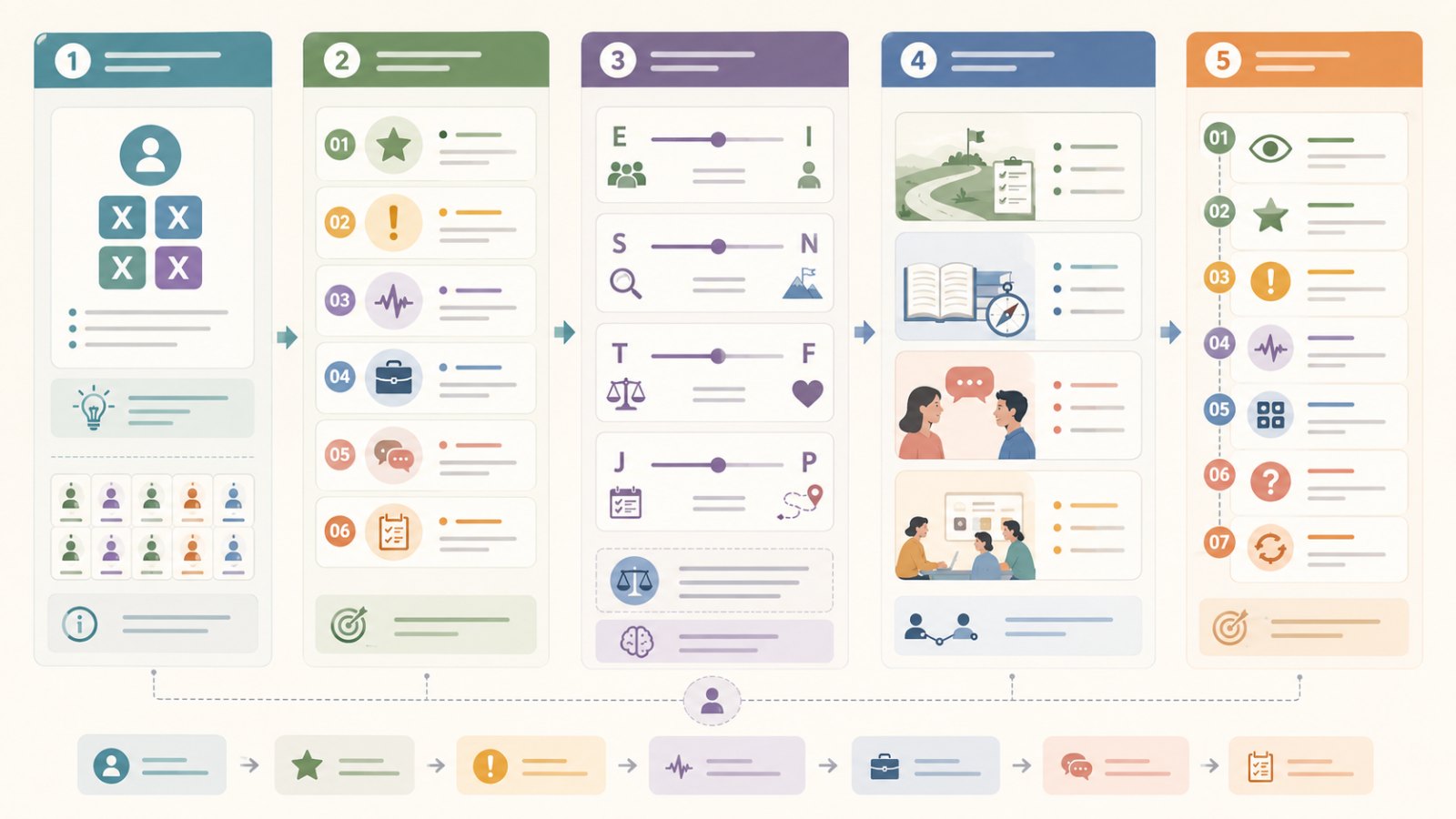
Most people see INFP, ENTJ, ISTJ, or another four-letter result and immediately look for the “best career” or “best match.” That is where the report often gets flattened into a label. To read a full MBTI-style report well, look beyond the type name and examine six layers: preference pairs, likely strengths, blind spots, stress reactions, career or major-exploration clues, and relationship or teamwork communication patterns. A useful report turns a type result into testable questions. It should not decide your job, major, relationship, identity, hiring fit, or future success.
If you do not have a result yet, take the free MBTI 16 personality test first. Once you have your 16 personality result, use the tables and checklist below as a practical reading worksheet. Treat the result as preference reflection, not diagnosis or life instruction.
Many people finish a test, see INFP, ENTJ, ISTJ, or ENFP, and immediately search for the type’s best career, best partner, or hidden meaning. That is understandable. It is also the point where many people start misusing the report.
The better question is not “What does this type say I am?” It is:
If you stop at the label, the report becomes a box. If you keep reading, it can become a practical self-observation tool.
A useful full report should help you read at least six layers. The type name is only the first one.
| Report section | What to look for | How to use it | How not to use it |
|---|---|---|---|
| Type entry point | The four-letter preference pattern and how the report explains each pair | Use it as an index for the rest of the report | Treat it as a fixed identity, status symbol, or personal limit |
| Strengths | Tasks, communication styles, and decision patterns that may feel natural | Notice where clarity, energy, or confidence often appears | Treat strengths as proof of ability or a guaranteed career path |
| Blind spots | Information, details, emotions, or risks you may overlook | Build safeguards: feedback loops, checklists, time delays, second opinions | Use blind spots as excuses or fixed flaws |
| Stress reactions | Patterns that may appear when you are tired, rushed, criticized, or uncertain | Recognize early warning signs and plan recovery or communication steps | Treat them as diagnosis or clinical explanation |
| Career and major exploration | Work tasks and learning environments worth testing | Turn suggestions into research questions and small experiments | Let MBTI decide your career, major, income, admission, or future success |
| Relationships and teamwork | How you express needs, hear feedback, handle disagreement, and set boundaries | Build clearer scripts and collaboration agreements | Predict relationship outcomes or label coworkers with certainty |
The report should not make you feel that the answer is finished. It should help you decide what to observe next.
<!-- body_visual:mbti_full_report_reading_path -->
The four preference pairs are not personality grades. They describe default ways of orienting attention, information, decisions, and structure. Read them as scenario prompts.
| Dimension | Key question | Scenario reminder | Boundary reminder |
|---|---|---|---|
| E / I | Do you recover more through interaction or internal processing? | In work, check collaboration density. In relationships, check alone-time needs. In teams, check meeting rhythm. | This does not measure social skill, maturity, or friendliness. |
| S / N | Do you start with concrete facts or patterns and possibilities? | In study and work, check instructions, evidence, ambiguity, and abstract tasks. | This does not measure intelligence or creativity. |
| T / F | Do you first weigh logical structure or human impact and values? | In conflict, check feedback language. In teams, check decision framing. | This does not measure kindness, coldness, or character. |
| J / P | Do you prefer closure and planning or flexibility and open options? | In projects, check deadlines. In relationships, check stress around changing plans. | This does not determine discipline, reliability, or execution ability. |
For each pair, add the missing sentence: “Where can I verify this in real life?” Without a scenario, it is only a label.
The report is not something to believe blindly. It is something to test carefully.
A full report can become another saved tab you never open again. Use a short reading protocol instead.
| Time | What to do | Output |
|---|---|---|
| Minutes 1-3 | Read the type name and four preference pairs | Choose the one pair you most want to verify |
| Minutes 4-6 | Read strengths | Write one real situation where the strength may appear |
| Minutes 7-9 | Read blind spots and stress reactions | Write one trigger that may cause miscommunication or avoidance |
| Minutes 10-12 | Read career, relationship, and teamwork suggestions | Choose one small action you can test this week |
| Minutes 13-15 | Write a review question | Set a date to revisit the result instead of endlessly reading type descriptions |
This turns “What type am I?” into “What will I try next?”
Career suggestions are the most tempting part of a full MBTI report. They are also the easiest to overuse.
Suppose the report says you may prefer independent analysis, long-range planning, or structured judgment. That does not prove you should become a consultant, product manager, investor, programmer, researcher, or strategist. You still need to test the tasks behind those labels.
| Question you may ask | Better validation question | Next action | What to observe |
|---|---|---|---|
| Do I fit consulting? | Am I willing to read material, structure ambiguity, interview people, and write conclusions repeatedly? | Take one public business case and write a one-page answer | Notice whether the work feels engaging, draining, or only prestigious from the outside |
| Do I fit product work? | Am I willing to handle unclear requirements, user tradeoffs, conflict, and iteration? | Read a product requirement template and rewrite a small feature | Notice whether you like problem framing or only the job title |
| Do I fit technical work? | Am I willing to debug, read documentation, and stay with abstract problems? | Try a small coding or data task | Notice whether you want to keep troubleshooting after the first block |
| Do I fit operations or growth? | Am I willing to look at data, coordinate resources, write copy, and handle feedback swings? | Analyze a real campaign or account and write three hypotheses | Notice whether you enjoy content, numbers, coordination, or none of them |
MBTI can help you create better career questions. It cannot predict career success, income, promotion, or job fit.
MBTI is often dragged into major choice. People ask whether INFPs should study psychology, whether INTJs should choose computer science, or whether ENFJs fit education.
Use those questions only as a starting point. Major choice should follow a safer order:
If your main question is college-major choice, use the dedicated guide: How to use Holland, MBTI, and career-interest tests when choosing a major. This page focuses on reading a full MBTI report. It does not replace admissions rules or predict admission outcomes.
Relationship content built around type matching is attractive, but it can become misleading quickly.
A better use is to examine communication rhythm.
The point is not to decide who is more mature. The point is to notice where the system breaks.
| Relationship friction | Avoid saying | Try saying | Next action |
|---|---|---|---|
| They do not reply immediately | “You do not care about me.” | “I need to know when you can come back to this conversation.” | Agree on a response window rather than guessing motives |
| They analyze when you want comfort | “You are cold.” | “I need to feel understood first. Can we problem-solve in ten minutes?” | Separate emotional support from solution design |
| They resist planning too early | “You are unreliable.” | “I can allow flexibility, but I need the latest decision time.” | Define the last acceptable decision point |
| You need time alone | “I am an introvert, leave me alone.” | “I need thirty minutes to sort this out, and I will come back tonight.” | Give a return time so solitude does not become disappearance |
A report becomes useful when it changes the conversation from “What is wrong with you?” to “Where are our default rhythms different?”
The wrong workplace use of MBTI is to label coworkers. The better use is to create lightweight collaboration agreements.
| Team friction | Possible preference difference | Better action | Misuse to avoid |
|---|---|---|---|
| Some people feel meetings are excessive; others feel unsafe without discussion | E / I | Put important information in writing; use meetings for decisions and unresolved issues | “Introverts are not team players.” |
| Some people talk vision; others ask for steps | S / N | State the goal, then list constraints, timeline, and deliverables | “S types lack imagination / N types cannot execute.” |
| Some people find feedback too cold; others find it too indirect | T / F | Include facts, impact, and next-step recommendation in feedback | “T is cold / F is irrational.” |
| Some people want early closure; others work near the deadline | J / P | Break the final deadline into midpoint reviews | “P is unreliable / J is controlling.” |
If you lead a team, the stronger question is not “Which type should own this role?” It is:
A full report should not make you perform a new personality. It should help you identify your default move and add another move when the situation calls for it.
| If the report suggests | Do not conclude | Better growth action |
|---|---|---|
| You lean I | “I cannot speak publicly.” | Prepare key points before important conversations and plan recovery after intense interaction. |
| You lean P | “I am simply undisciplined.” | Externalize deadlines and set midpoint checks. |
| You lean T | “I do not need to consider feelings.” | Add one sentence about human impact before giving a critique. |
| You lean F | “I cannot make rational decisions.” | Separate facts, risks, and value impact into three columns. |
| You lean N | “Details are not my job.” | Ask for a detail review while you own the larger pattern. |
| You lean S | “I am not imaginative.” | Build from facts first, then ask what the facts may make possible. |
Growth is not living against your preferences. It is having one more option in important situations.
That happens often. Do not reject the entire report immediately, and do not force yourself to accept it.
Check four things:
| Review item | How to write it |
|---|---|
| Three statements that fit | Use specific events, not vague agreement |
| Two statements that do not fit | Write whether the mismatch may come from context, state, or wording |
| One action to test next week | Choose a communication, study, work, or relationship situation |
Use this as a reading map for a full MBTI-style report. It helps turn the result into questions for career exploration, relationships, communication, teamwork, and self-growth.
It does not:
FermatMind’s MBTI test is for self-understanding and preference reflection. It is not an official MBTI certification tool and not a medical or psychological diagnosis.
If you do not have a result yet, take the free MBTI test. Once you have your 16 personality result, read it through six questions:
A full report is useful only when it helps you describe yourself more precisely and act more deliberately in real situations.
It usually includes the type label, four preference pairs, strengths, possible blind spots, stress reactions, career exploration suggestions, relationship communication patterns, and action recommendations. Exact modules vary by platform.
FermatMind provides a free MBTI test with a readable 16 personality result. The exact report modules should be verified on the current product page. Free or paid, the result should be treated as self-observation input, not diagnosis or career verdict.
Only as a secondary input. MBTI can help you reflect on learning style, communication preference, decision habits, and stress response. Major choice still requires admission rules, curriculum, cost, location, academic fit, and real task validation.
No. MBTI can help you ask better questions about tasks and work environments, but it cannot predict career success, income, promotion, or job fit.
They can. Results may vary with life stage, test state, environment, question interpretation, and self-awareness. Focus on repeated behavioral patterns rather than a single result.
It can be useful for describing preferences and communication patterns for some people, but it should not be treated as a medical diagnosis, formal psychological assessment, or ability measure. Use it as a hypothesis and test it against real behavior.
No. It can help you discuss communication rhythm, planning needs, conflict style, and feedback preferences. It cannot predict relationship success or guarantee compatibility.
Compare the report with real behavior, ask for feedback, and test one small action in work, study, relationships, or teamwork. Do not keep reading type descriptions forever without changing any behavior.