Education & Career PlanningRIASECcollege major choiceassigned majorrepeat year decision
Disappointed With Your Admitted Major: Retake or Enroll? A Checklist of Course Costs, Transfer Windows, and Holland Interests
If your admitted major disappoints you, check course boundaries, transfer windows, family costs, and aversion first. Compare enrollment, transfers, minors, postgraduate redirection, and retaking.
Direct answer: Check evidence before deciding whether to retake the exam or enroll
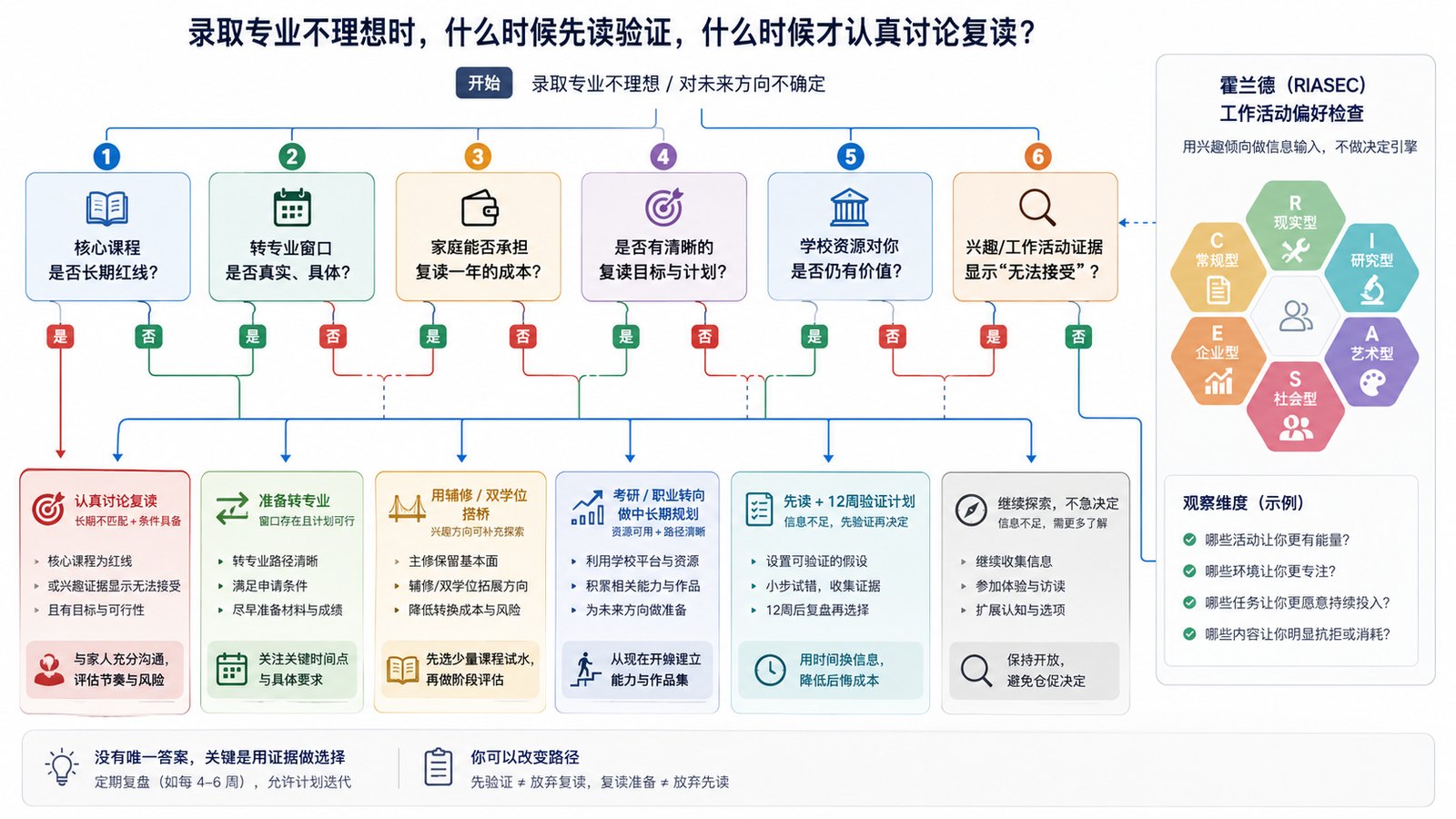
If your admitted major is disappointing, do not start by asking whether to retake the entrance exam or accept your fate. Check course boundaries, transfer windows, family costs, university resources, and the strength of your aversion. When evidence is insufficient, keep enrollment with observation, retaking, and other routes as options to verify, rather than automatically choosing enrollment. If you enroll, 12 weeks is only an adjustable observation example: first check application deadlines and costs. If several boundaries are crossed at once, discuss retaking or alternatives in a family options table.
A disappointing admitted major: Start with more than “Should I retake?”
After admission, families often split into two camps: the student does not want the major, while parents think the university is good and suggest enrolling first. Both reactions are understandable, but insufficient. The evidence behind the emotions needs attention.
A “disappointing major” can mean at least five different problems:
Problem
Common expression
Evidence to investigate
Conclusion to avoid rushing into
Dislike of the name
Rejecting the major upon hearing its name
Timetable, training plan, specializations
“I definitely do not fit”
Difficulty with coursework
Fear of mathematics, labs, memorization, writing, programming, or drawing
Frequency, difficulty, and assessment of core courses
“I will definitely fail”
Unclear route
Wanting to transfer without knowing whether it is possible
University policy, target faculty places, GPA/ranking requirements
“I can definitely transfer after enrolling”
High cost pressure
Retaking, transferring, and minors strain the family
Money, time, psychological pressure, family support
“Another year of effort will definitely improve things”
This article does not decide whether you should retake. It turns post-admission confusion into an evidence table: what is confirmed, what is rumor, and what needs testing in the first semester.
Check four things first: Courses, transfer windows, family costs, and aversion to activities
1. Course costs: Do you reject the name or four years of recurring tasks?
Major names can mislead. Disliking “management” does not mean you cannot analyze data, improve processes, or research users. Liking “artificial intelligence” does not mean you can sustain linear algebra, probability and statistics, optimization, algorithms, debugging, and reading papers.
Consider course costs at three levels:
Level
What to examine
Question
Status
Introductory courses
First-year general and introductory classes
Is the dislike limited to the introductory stage, or is the core direction already apparent?
Observe first
Core courses
Recurring specialist classes in the second and third years
Are they tightly connected to tasks you reject over time?
Tolerable/needs strengthening/difficult to tolerate
Whether you can study a major depends less on its name than on whether you can repeatedly face its core tasks over 2-4 years.
2. Transfer windows: An available transfer is not a completed transfer
Many universities have transfer systems, but an existing policy and an executable route are different. Investigate specific thresholds beyond promotional statements that students may apply to transfer.
Check
Insufficient statement
Questions to ask
Timing
The university permits transfers
Which semester is the earliest? How many applications per year? Can you apply after missing a window?
Grades
Good grades allow transfer
What are the requirements for GPA, major ranking, failed courses, and general-course grades?
Places
Places are available
How many students has the target faculty typically accepted? Are places limited to the same subject category or faculty?
Assessment
There is an assessment
Written exam, interview, portfolio, course grades, or combined evaluation?
Failure costs
Deal with failure later
If unsuccessful, can you redirect through a minor, projects, internships, or postgraduate study?
If these questions remain unanswered, transferring is an option to test rather than a main plan.
3. Family costs: Retaking means more than another year of effort
Retaking costs more than tuition: another year, uncertainty in applying again, family relationships, emotional strain, differences from peers' progress, and policy-change risks. Put these on paper instead of relying on “Try harder” at the dinner table.
Use four columns:
Cost
What to specify
What missing detail indicates
Money
Tuition, accommodation, materials, living costs, opportunity costs
Family capacity has not been realistically assessed
Time
Another year preparing, enrollment a year later, continued clarity of the goal
Retaking may simply be an escape from the current major
Pressure sources, family support, sleep/anxiety state, help resources
The retaking environment may amplify difficulties
Retaking should enter an evidence-based discussion. Without a cost table, the decision is often an emotional vote.
4. Aversion: Distinguish unfamiliarity from intolerability
Holland/RIASEC does not decide whether you should retake. It turns “I dislike this major” into questions about work activities. Take a career interest test, then ask whether the major's long-term tasks are worth testing or already clearly unacceptable to you over time.
Status
Typical expression
Next step
Unfamiliar
No interest in the name, little knowledge of courses or tasks
Read the training plan, sample introductory classes, interview senior students
Afraid of difficulty
Difficult courses cause anxiety, but tasks are not wholly rejected
Try 7 days of low-cost course experience to separate weak foundations from interest conflict
Persistent aversion
Clearly unwilling to engage with core courses and future work activities
Mark a boundary and investigate transfers, minors, or retaking costs
Acceptable without enthusiasm
Courses are tolerable, though the direction is not ideal
Design routes through minors, projects, internships, or postgraduate study
RIASEC results cannot replace admission rules, university policies, or family decisions. They belong in a practical decision table to help formulate better questions.
Comparing retaking, enrolling, transferring, minors, and postgraduate redirection
This table is the article's core. Move family discussion beyond “You are impulsive” or “You do not understand me.” Compare each route in one place.
Route
When to discuss it
Concrete evidence to check
Biggest risk
Reason not to use
Retaking
Clear goal, potential score improvement, manageable family and psychological costs
Provincial examination rules, retaking policies, changes to target admission rounds, score potential, family budget
Outcomes may still disappoint a year later
Simply disliking the admission result
Enrolling first
Valuable university resources, no absolute major boundary, room for courses/projects/minors
Training plan, course choice, faculty/project resources, minor policies
Drifting through four years without active testing
“Get into university first and see”
Transferring
Clear university rules, target places, achievable grade/assessment requirements
Timing, GPA/ranking thresholds, past places, assessments, entry restrictions
Returning to the original major after losing competition
“Transfers are permitted, so mine is guaranteed”
Minor/double degree
An acceptable main major with a need for target-direction skills
Availability, timetable conflicts, credit load, recognition of credentials/degrees
Learning both subjects superficially
“A minor automatically cancels out the main major's problems”
Postgraduate study/redirection
The undergraduate major can be a stepping stone, with gaps addressable through courses/projects
Target institution requirements, exams, research/projects, difficulty of cross-major applications
Long preparation and strong competition
“Study anything now and postgraduate study will naturally change it”
A steadier decision rule:
If core courses are tolerable, university resources are good, and transfer/minor/project/postgraduate routes exist, enrolling with a testing plan deserves discussion.
If core courses and long-term tasks are strongly rejected, transfers are severely limited, minors and projects cannot help, and the family can afford retaking, retaking enters serious discussion.
If only the major's name disappoints you and courses and policies remain unchecked, do not make a final decision yet.
A complete example: A good university with an unwanted major
A common situation is an acceptable university, city, and budget with an unwanted major. Parents emphasize the university; the student says they cannot tolerate the subject for a day. Break down evidence instead of comparing status and emotion.
Evidence
Facts to write first
Questions still to test
Initial response
University resources
Value of the city, university resources, postgraduate recommendation/study/internship resources
Are these resources actually open to students in this major?
Usable resources increase the value of enrolling
Major courses
First- through third-year core courses and recurring strongly rejected tasks
Is the aversion about the name, learning style, or long-term tasks?
Test until course boundaries are confirmed
Transfer window
Timing, grades, places, assessments
Does the target faculty accept transfers across faculties/categories? Are historical success rates available?
Treat transfer as a backup, not an accomplished fact
A year, expenses, family support, psychological tolerance, score potential
Is the goal specific, rather than only escaping the current major?
Enter serious discussion when several boundaries are confirmed
The question goes beyond whether university or major matters more. If the name alone disappoints you and real resources and redirection routes exist, enrolling with a first-semester testing plan is more rational. If core courses are persistently rejected, transfers are unrealistic, alternatives narrow, and retaking costs manageable, include retaking in the formal options table.
Write three statements to keep the family discussion productive:
Retain enrollment: University resources are usable and the major's boundaries remain unconfirmed by evidence.
Retain retaking as a backup: Complete the evidence on score potential, family costs, and policy risks first.
Set review dates: Review in weeks 6 and 12 of the first semester so enrollment does not become procrastination.
Decision tree: When to enroll and when to discuss retaking seriously
Use this tree for initial screening:
Question
If yes
If no
Are core courses persistently unacceptable?
Check the boundaries
Try course experience before rushing to retake
Are transfer or minor routes clear?
Design a first-semester testing plan
Investigate postgraduate/project/cross-faculty resources; discuss retaking if still unclear
Can the family bear retaking's financial, time, and emotional costs?
Retaking becomes a backup
Do not make retaking the main route for now
Is the next-exam goal specific rather than just an escape?
Create a retaking options table
Test university-based routes first
Does the admitted university offer usable resources?
Enrolling with active redirection may be valuable
Seriously compare retaking if both university and major are unacceptable
This is not advice to enroll or retake. It turns an emotional choice into a judgment you can revisit.
Use Holland interests to separate unacceptable from untested
“I just dislike it” is a genuine feeling, but imprecise for decisions. Holland/RIASEC can break dislike into testable work activities.
RIASEC dimension
Long-term tasks to observe
Major-decision question
Conclusion to avoid
R: Realistic
Tools, equipment, practical work, engineering sites, system maintenance
Does the major offer hands-on courses or projects with visible results?
Do not decide everything from one exam score or dismiss everything based on a month of emotion. Examine whether you retain basic capacity to engage with recurring tasks, and whether executable alternatives exist if you do not.
Communicating with parents: Present researched evidence
“I dislike it” often sounds to parents like “I am afraid of hard work.” Change the wording.
Wording to avoid
More reliable wording
I simply do not want this major
I checked the training plan. Core courses focus on these tasks; I worry about long-term conflict rather than short-term difficulty
You do not understand me
I want to list courses, transfer routes, family costs, and interest-testing evidence before deciding together
I must retake
I want to establish costs, the next-exam goal, and uncertainty before including retaking in the plan
Enrolling is pointless
If I enroll, I need a first-semester testing plan and redirection backups
Use this script:
I am not rejecting admission because of momentary disappointment. I want to check the training plan, transfer policy, minor opportunities, retaking costs, and family capacity, then use career interests to examine whether the major's long-term tasks are wholly unacceptable to me. Let's write the evidence down before choosing enrollment, transfer preparation, or serious discussion of retaking.
Show parents an evidence table rather than an emotional declaration:
Evidence
Already established
Still unconfirmed
Who confirms
Deadline
Training plan
Unknown
Unknown
Student
Unknown
Transfer policy
Unknown
Unknown
Student/parents
Unknown
Family costs
Unknown
Unknown
Family discussion
Unknown
Holland interest results
Unknown
Unknown
Student
Unknown
Minor/project/postgraduate routes
Unknown
Unknown
Student
Unknown
Keep Unknown as Unknown. Do not invent entries to appear confident.
When should retaking receive serious consideration?
When discussing retaking, check the following information individually; these are not universal thresholds that must all be met:
Condition
Explanation
Persistently unacceptable core tasks
Conflict with core courses, labs, writing, calculation, memorization, practical work, or communication beyond disliking the name
Narrow university alternatives
Little practical scope for transfers, minors, cross-faculty courses, projects, or postgraduate redirection
Clear next-exam goal
A specific university, program group, or direction rather than escape alone
Manageable family and personal costs
Serious discussion of money, time, relationships, and psychological costs
Permitted and verified rules
Current information from provincial examination authorities, admission rules, and retaking policies
These questions can help compare options; they are not universal thresholds or a validated decision tree. When information is incomplete, first check deadlines, reversible options, and personal needs. Even consistent evidence cannot guarantee the outcome of retaking, enrolling, or transferring.
Take the Holland career interest test, then build a practical decision table
If you only know that you dislike the major but cannot specify why, take the Holland career interest test. Do not then ask whether results tell you to retake. Put results in this table instead.
Decision column
What to enter
Current major's core courses
Which recur? Which cross a boundary?
Transfer window
When can you apply? What thresholds and places exist?
Alternatives
Are minors, projects, internships, or postgraduate routes available?
RIASEC work activities
Which tasks are worth testing, and which are persistently rejected?
Family costs
What does retaking, enrolling, or transferring cost?
First-semester testing plan
What evidence can you obtain within 12 weeks?
Current judgment
Enroll and test/prepare transfer/seriously discuss retaking/continue gathering information
FermatMind is not an official university application system and does not predict admission, transfer, employment, pay, or career success. Formal decisions still require provincial examination rules, university admission regulations, transfer policies, training plans, syllabuses, family costs, academic foundations, and personal capacity.
Frequently asked questions
Must I retake the exam if the admitted major is disappointing?
No. Retaking is one route, not the default answer. Check course costs, transfer windows, family costs, retaking risks, and aversion before deciding whether to discuss it.
Should I enroll if I dislike the major but the university is good?
Consider tolerance of core courses, access to projects or minors through university resources, and practical transfer or postgraduate routes. A good university does not automatically remove major-related risks.
Is enrolling first and transferring realistic?
It depends on university rules and target-faculty thresholds. Check timing, grade requirements, failed-course restrictions, exams/interviews, places, cross-faculty limits, and minor/project backups if unsuccessful.
Can the Holland career interest test decide whether I should retake?
No. Holland/RIASEC identifies interest tendencies and activity preferences; it cannot decide retaking, transfers, further study, or career outcomes. It is one column of evidence in the decision checklist.
What if my parents oppose retaking?
Go beyond “I dislike it.” List the training plan, core courses, transfer policy, retaking costs, uncertainty, first-semester testing plan, and alternatives in an evidence table before discussing whether retaking is worthwhile.
Which is more reliable: Transferring, a minor, or postgraduate redirection?
There is no universal answer. Transfers depend on rules and places; minors add skills without replacing the main major; postgraduate redirection takes longer and requires a clear goal and sustained preparation. Judge using university policies and your capacity to execute.
When should I seriously consider retaking?
Discuss retaking alongside other routes. First check official deadlines, rules, reversible options, and personal needs; then compare courses, alternatives, next-exam goals, and family and psychological costs. These are not universal thresholds, and agreement across them does not guarantee an outcome.
Dislike Your Admitted Major? Retake or Enroll Checklist | FermatMind