Content category
Personality Psychology
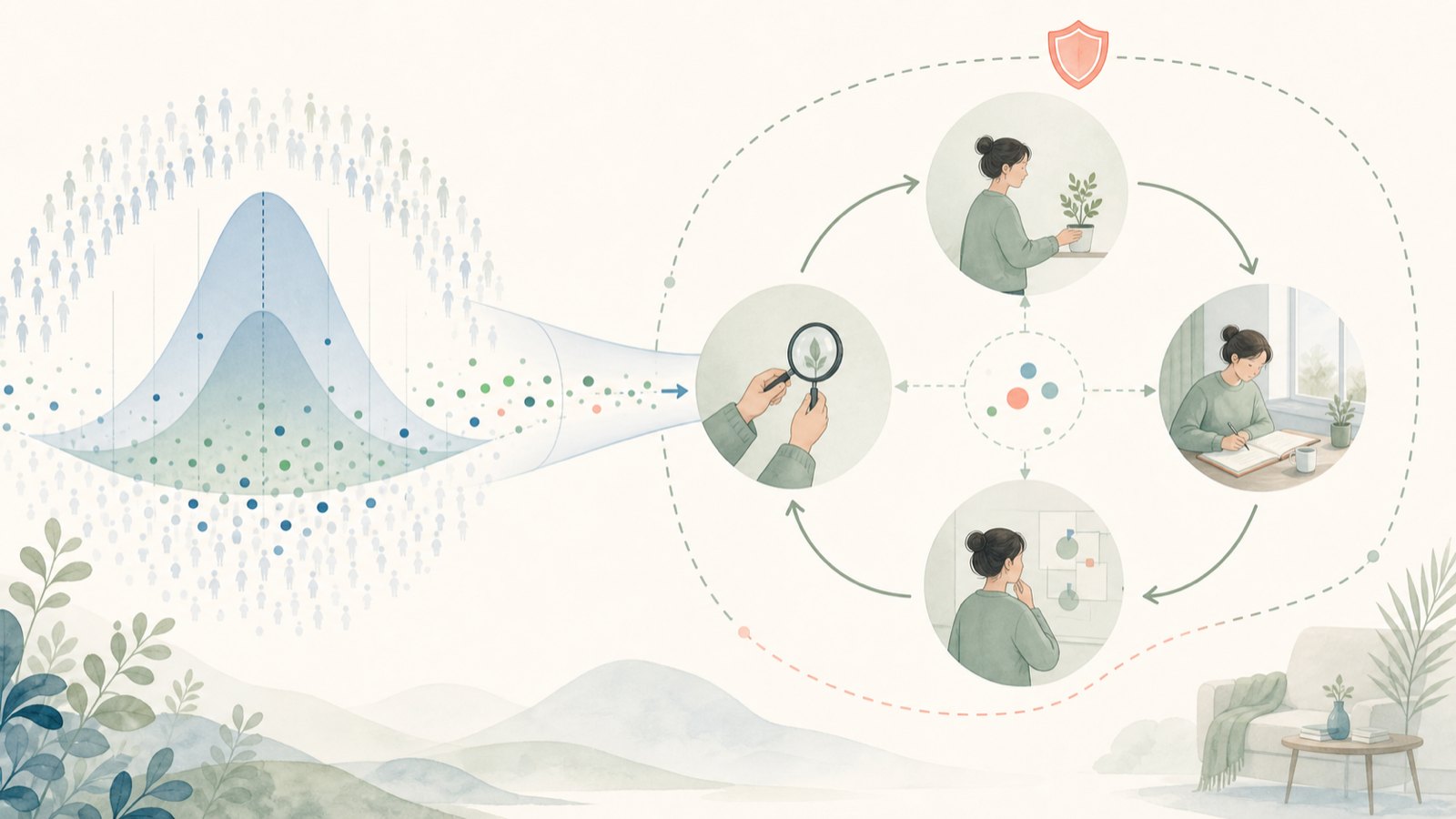
Use personality research to raise questions without overclaiming. Check group-to-person inference and use fictional examples to plan low-consequence observations, without treating associations or short-term experiences as guarantees.
By: Fermat Institute
Published: Oct 2, 2026
Updated: Oct 2, 2026
14 min read
Human review completed · Oct 2, 2026When should I use this article?
Use this article when you want to connect public content with tests, personality profiles, or career guidance from a single starting point.
Does this replace formal judgment?
No. It offers public explanation and action cues, but does not replace medical, legal, or professional judgment.
Content category
Personality Psychology
Related tags
Big Five, Personality Test
Return to the article hub to keep expanding the public reading chain.
Continue from the article into a more structured topic entry surface.
If you want to turn reading into self-measurement, continue into an assessment.
When people read that a personality trait is related to a life outcome, it is easy to turn that sentence into a personal prediction: I do not score highly on this trait, so I probably will not do well; I resemble the group in the study, so a certain path must suit me. That shortcut skips the long distance between the study participants, measures, context, average differences, and an individual life.
The rewriting, note-taking, and comparative trials here are editorial suggestions, not validated measurement or intervention procedures or rigorous single-case experimental designs.
A more careful use of personality research is neither to reject it nor to treat it as the answer. Research can help you raise questions worth observing. Your own life still has to be examined through specific circumstances, counterexamples, choice, and real consequences. Turning a group-level association into a small, low-risk experiment that you can leave, and observing yourself in it, is usually more honest and useful than turning it into a promise about work, health, or relationships.
This article discusses general ways to read evidence and observe yourself. It does not validate any specific website, questionnaire, report, or product. It is not for diagnosis, treatment, hiring, personnel screening, admission, education, career, income, relationship, legal, financial, or other high-stakes decisions.
A personality study often measures traits and another outcome in a group of participants, then analyzes whether the two are associated. Even if the study is carefully designed, its findings first concern the sample, measures, time, analysis, and outcome indicators used in that study. They usually do not describe a reader's whole life, much less provide an instruction that can bypass real-world conditions.
For example, when you see that a trait is associated with a work outcome, do not read it as saying that everyone with the trait will succeed or that everyone without it will fail. Ask more precisely: What trait and outcome did the study actually measure? How stable was the association? Where did the sample come from? Did the study consider other possible factors? Those details determine how the finding can be understood and where its limits are.
The value of personality research does not mean it can generate a destiny manual for a person. A reader's skills, experience, resources, opportunities, job demands, family responsibilities, health, cultural environment, and present choices do not disappear because of a group average.
An association describes a pattern in which variables change together in group data. It is neither causation nor an accurate prediction for every person. Even when two variables are associated in a sample, there may be many individual paths: some people show the trait but not the outcome found in the study; others do not clearly show the trait but reach the same outcome through training, support, environment, or opportunity.
Drawing a personal conclusion directly from a group average risks a mismatch between levels of analysis. A group-level pattern does not automatically describe how one person changes over time. The same person may also act differently across roles, relationships, and conditions of stress. Without relevant validation, a general association provides limited context and cannot guarantee your next interview, relationship, or health outcome. Appropriately validated statistical models can offer predictions with error and a defined scope; those predictions are not promises about an individual outcome.
When you see an association, you can keep two sentences together: first, this might be worth noticing; second, it still is not enough to tell me what will happen to me. Both can be true. The first preserves curiosity; the second preserves autonomy and uncertainty.
The Big Five often organizes self-reported trait differences into broad dimensions such as openness, conscientiousness, extraversion, agreeableness, and neuroticism or emotional stability. Specific measures may use different questions, facets, scoring methods, and comparison references. A score or description therefore makes sense only within the scope of the tool used.
Trait language can help you recall tendencies that have appeared relatively often over a period of time, but it is not a permanent explanation of behavior. Someone who often plans ahead will not necessarily complete every task as planned. Someone who seldom initiates social contact may still engage deeply when the topic is familiar, the role is clear, or the relationship matters. Behavior also depends on task difficulty, power relationships, available time, sleep, support systems, and how a person feels that day.
For observation, it is more useful to frame a trait as a hypothesis that you may respond this way more often under certain conditions than as a statement that you were born a particular kind of person. The hypothesis allows evidence and counterexamples to enter; the fixed identity can easily turn one assessment result into a self-imposed limit.
Some papers discuss prediction, correlation coefficients, average differences, or model performance. These terms have specific research contexts. What counts as the target variable, whether prediction was tested within the original sample or a new one, which inputs were used, how error was handled, and whether results replicate all affect their meaning. Reading prediction in a paper as the ability to predict your personal future is a common but unnecessary expansion.
Three distinctions matter especially. First, a statistical model's performance on a dataset does not automatically become advice for one reader. Second, a measurement tool's performance in a particular study does not automatically establish the same properties for another tool, another language version, or another platform. Third, a single average association cannot by itself justify assigning people to more or less suitable jobs, relationship roles, or life paths; a specific decision still needs applicability checks and other relevant evidence.
When research does not provide public evidence matched to your situation, the tool you used, and your specific goal, the most accurate status is that we do not know. Unknown is not a failure of information; it is a necessary marker against an illusion of precision.
The first step in careful application is to rewrite the sentence. Instead of jumping from people high in conscientiousness are more productive to I must become more conscientious, ask: On days when I have to coordinate several tasks, would writing down priorities in advance help me see the next step? That question does not assume a trait has already determined you or that a practice must work.
A good observation question has several features: it belongs to a specific situation; it describes visible behavior rather than a verdict about personality; it allows for no difference or a difference only under certain conditions; and it does not ask other people to take unnecessary risks. The more specific the question, the less you need a sweeping self-label to explain every outcome.
You can also write down a counterexample question: When have I completed something well without planning ahead? Counterexamples do not undermine self-understanding. They keep you from collecting only material that supports an existing conclusion. A question that can accommodate supporting and contrary evidence is closer to real life than a label that merely sounds apt.
A personal experiment is neither a clinical intervention nor a replication of research. It is only a way to observe your own daily life more clearly. An appropriate small experiment should be small enough to change a low-consequence process, not to resign from a job, move home, stop treatment, end a relationship, borrow money, or decide on behalf of someone else.
For example, if you want to observe whether a clearer way to start a task suits you, try two approaches during ordinary independent work periods. Once, write down the smallest next step before starting; another time, use your usual process. After each period, record only how long it took to start, whether your attention was interrupted, whether the task moved forward, and what external conditions were present. The aim is not that you must become more efficient. The question is what you noticed.
Reversible means you can stop or return to your earlier approach. Easy to leave means you do not have to prove to anyone that you must keep going. If an experiment causes noticeable stress, harms sleep, worsens conflict, involves physical discomfort, or exceeds what you can manage, stopping is reasonable information, not failure. For high-consequence matters involving health, safety, finances, law, workplace rights, or consent in relationships, do not design your own experiment based on a personality article.
You do not need a complicated table. You can start with four notes: what situation occurred; what specific behavior you tried; what you observed; and what other explanations might exist. The last item matters because a change may be due to a deadline, task difficulty, another person's support, weather, your physical state, or chance. It does not need to be attributed to personality immediately.
For example, being more willing to speak at one meeting does not automatically prove that you are actually extraverted. You may have read the material in advance, understood the meeting rules, known the topic well, or been invited by a colleague to speak. Conversely, being quiet one day does not immediately prove that collaboration does not suit you. Keeping conclusions within their specific contexts makes review more informative and reduces stereotypes about yourself and others.
If you wish, revisit the notes after some time and look for recurring conditions instead of calculating a true personality. The purpose of the record is to help you choose the next low-risk adjustment to try, not to rule on what kind of person you are.
The following is a fictional teaching example. One week is the observation period in the story, not a validated intervention dose or retest interval. After Xiao Zhou read material discussing conscientiousness and goal management together, the initial thought was: My score is not high, so I cannot complete a long-term project. That conclusion stacked a group association, one result, and future performance on top of one another. First, Xiao Zhou separated them: What behavior did the material actually discuss? Which tool produced the result, and when was the self-report completed? What examples of completed and interrupted projects exist in the past?
Next, Xiao Zhou changed the question to: Am I more likely to put off a project when the next step is unclear? Xiao Zhou chose a personal organizing task without high consequences and, for one week, tried writing the next step as one actionable sentence before starting each time. The observations were not income, promotion, or personality change. They were whether starting became easier, whether it became easier to stop at an appropriate point, and which days the practice did not help.
After a week, Xiao Zhou felt that starting was easier on several occasions when the task's boundaries were unclear. The same experience did not occur on several occasions involving larger tasks or insufficient rest. These observations alone cannot establish the cause or determine the conditions under which the practice works. That outcome did not prove an inborn lack of discipline or show that a particular study worked for Xiao Zhou. It added one piece of local information: defining the task and getting rest might deserve attention before a personality label.
If a small adjustment makes things feel smoother, the most cautious conclusion is that this practice seemed to help in this situation and during this period. Do not upgrade that to a method for everyone or credit it as a change in personality. Likewise, if you observe no change, you can conclude only that this attempt, under these conditions, did not provide the information you expected.
Personal observations are limited by small numbers of occasions, incomplete records, expectation effects, and changes in life. Acknowledging these limits does not remove the value of the record. It puts that value in the right place: a clue for the next choice, not a universal rule. You can adjust the question, make the experiment smaller, pause observation, or acknowledge that you do not have enough information yet.
Do not use a short-term experience to judge your moral worth. A process that does not suit you usually means the process, time, resources, or situation need to be understood differently. It does not mean you are lazy, defective, or without potential.
General personality research does not directly validate FermatMind's specific item sets, translations, score interpretations, or uses. The current Big Five test explanation describes the 120-item and 90-item versions, five domains and 30 facets, scoring formulas, and how to interpret norm status. Calculation details and norm-status labels are not independent psychometric validation. Reliability, validity, cross-language comparability, and support for a specific use require evidence for the relevant item set, language, population, and use. Unverified matters should be marked as unknown without treating published information as unavailable.
Accordingly, this article does not turn any result into a conclusion about ability, health, income, relationship quality, or future performance. Nor does it promise that a self-observation experiment will improve efficiency, career, health, or relationships. An assessment result can at most be a starting point for structured reflection. It is not a final verdict on fixed identity, destiny, ability, health, or future outcomes.
Private results should remain private. Do not publicly share result reports, order records, or payment details containing identifiable personal information. Self-observation needs safe boundaries, not more identifiable data.
If a concern involves persistent distress, significant impairment in functioning, your safety or someone else's, threats of violence, severe changes in eating or sleep, substance use, a financial crisis, legal duties, or workplace rights, this article's observation framework is insufficient. Do not diagnose yourself, change medication or treatment, make major career or relationship decisions, or ask others to accept a personality explanation based on personality descriptions.
A more appropriate next step is qualified professional support, emergency support, or trusted real-world resources suited to your situation. Personality research can provide vocabulary, but it cannot replace assessment, medical care, legal advice, financial advice, informed consent, or risk management.
You cannot infer from one association that you should change your personality, let alone guarantee that change would bring a particular outcome. Return first to the concrete life question: What behavior or condition do you want to improve? Is there a low-risk process you can observe and leave? If the evidence is insufficient, retaining Unknown is more appropriate than chasing a score.
No. Your observation may suggest that a practice is worth watching in this situation, but it does not replicate or prove a group study. Keeping track of context, time, and other possible explanations makes your review more reliable.
It cannot serve as the sole basis for that decision. Careers and relationships require attention to skills, experience, values, resources, opportunities, responsibilities, rights, and real interactions between the people involved. A personality description cannot guarantee hiring, income, fit, or a relationship outcome.
There is no need to rush to a conclusion. You can examine the circumstances in which you answered, the tool's questions, the comparison reference, and the evidence you have from life. The difference may also remind you that one result cannot cover every situation. It does not require you to choose a permanent label.
For an introduction to the language of continuous traits, see Big Five personality. For more boundaries and methods on the same topic, visit the Big Five topic. If you are ready for an educational self-observation exercise, you can visit the Big Five personality test (OCEAN model) and treat any result as a hypothesis to check against context and counterexamples.
A better order of application is to read what the research actually says, rewrite it as an observable question, choose a low-risk and reversible action, record context and counterexamples, then review only what it suggests for your next step. Research does not promise your future, and an experiment does not define you.
This article provides educational examples of reading research and observing everyday behavior. It is not a research report and does not validate FermatMind's measurement properties, intervention effects, individual predictions, career matching, or outcome guarantees. Check the assessment page for published information about structure and scoring. Specific psychometric interpretations and uses require corresponding public validation materials; the examples in this article and the general personality model cannot supply that evidence.
Methodological references: Fisher, Medaglia, and Jeronimus (2018) examine differences between group and individual statistical estimates and tests of generalizability across levels. Adolf and Fried (2019) clarify that ergodicity is sufficient, but not necessary, for such generalizability. These discussions support checking the conditions for extrapolation, not a claim that all individual prediction is impossible. They do not validate the self-observation practices in this article or FermatMind products. Sources checked: 2026-10-01. Fisher et al.: public abstract and introduction; the existing v2 record also covers relevant publisher-PDF methods and limitations. Adolf and Fried: primary commentary title, bibliography, and the existing v2 indexed-introduction conclusion. No numerical analysis was reproduced. Bilingual product pages were checked for current structure and scoring explanations, not treated as independent validation studies.