Quick answer: what to do if your Big Five conscientiousness is low
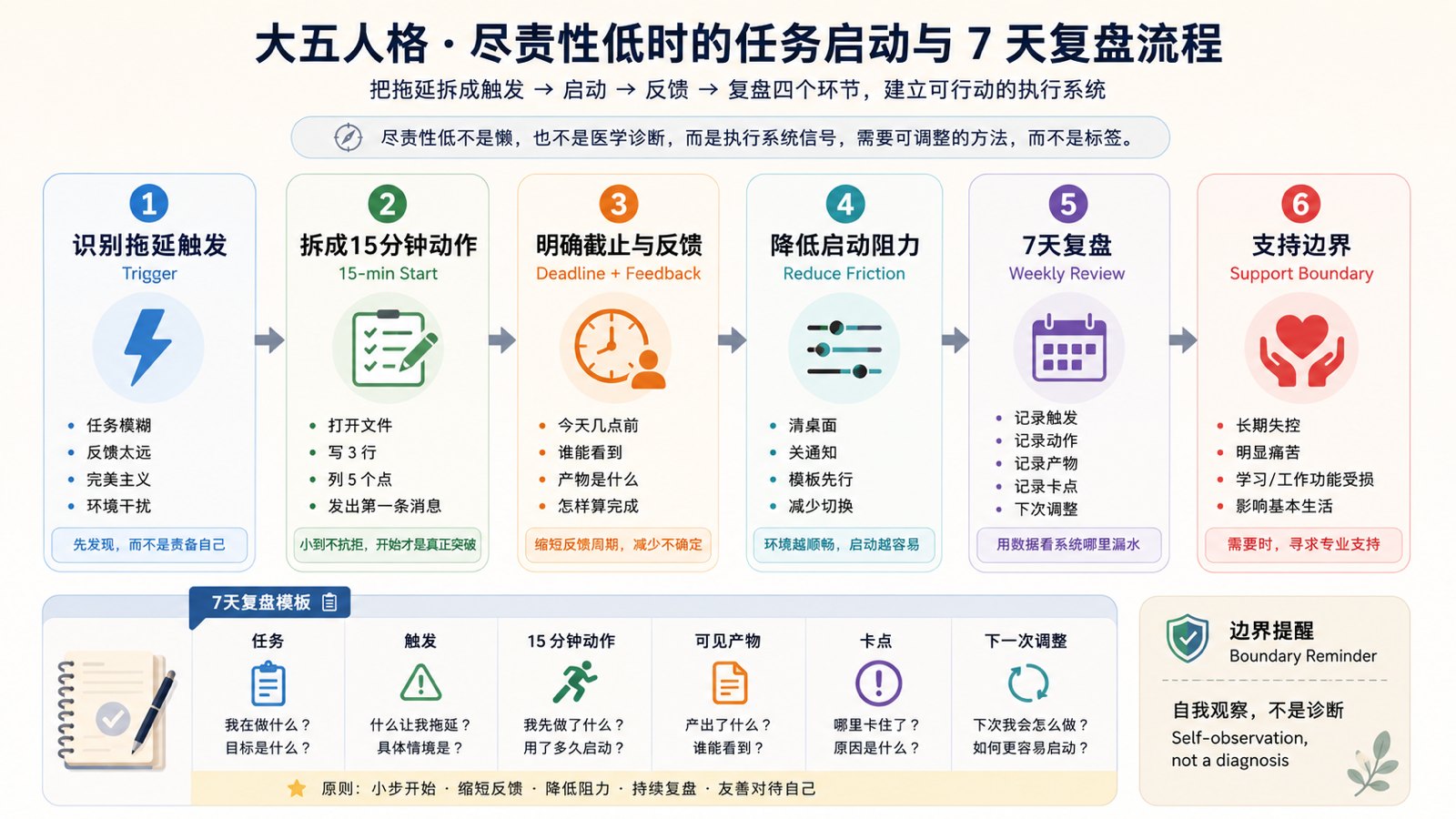
Low conscientiousness is not a laziness verdict, a diagnosis, or proof that you cannot follow through. Treat it as an execution-system signal: identify the trigger, turn the work into a 15-minute starting action, shorten the feedback loop, reduce friction, and review the pattern for one week before judging yourself.
What does low conscientiousness actually point to?
A low conscientiousness result often feels personal because it touches missed deadlines, unfinished projects, and last-minute work.
In the Big Five model, conscientiousness is commonly associated with planning, order, follow-through, reliability, and goal management. But it is not a moral score. It does not diagnose ADHD, depression, anxiety, or any other condition. It does not predict income, performance, promotion, or career success.
Content category
Big Five
Related tags
Big Five, OCEAN, Conscientiousness, Procrastination
A better question is more practical: which part of your execution system breaks first?
If you have not taken the test yet, you can start with the Big Five personality test. Use the result as an observation lens, not as a permanent label.
Procrastination is not one problem: map the trigger first
The word procrastination hides several different mechanisms. A vague task, a boring task, a risky task, and a task with delayed feedback do not need the same fix. More self-blame rarely helps if the task structure is still broken.
Trigger
What it may look like
15-minute starting action
Friction repair
What not to conclude
Ambiguity
You keep thinking but never create an artifact
Write three headings or three unanswered questions
Convert the task into visible next steps
This does not prove low ability
Distant feedback
You feel nothing until the deadline is close
Create a rough version due within 24 hours
Ask for early review
This does not mean panic is your only fuel
Perfectionism
You avoid starting because version one will be bad
Name the file v0.1 and make it intentionally rough
Define the first draft as disposable
High standards are not execution
Digital distraction
You keep switching tabs and messages
Work for 25 minutes with one open file
Move the phone and close feeds
This is not simply weak willpower
Low task meaning
The task feels empty, pointless, or disconnected
Write the concrete problem the task prevents
Tie the work to one visible outcome
This is not a fixed lack of purpose
Too many open loops
You touch many tasks and finish none
Pick one must-move item for today
Separate backlog from today list
You are not permanently disorganized
High emotional load
The task produces avoidance, dread, or shutdown
Record the trigger before forcing completion
Discuss the pattern with trusted support
Do not self-diagnose from a personality result
Use the table to translate “I procrastinated again” into “this trigger showed up again.”
Split the task until it can start
A common planning mistake is writing projects as tasks: prepare for an interview, study statistics, write the report, build a portfolio. These are not tasks. They are containers. A usable task should produce visible movement in 15 minutes.
Use this chain:
Project → deliverable → next action → 15-minute start
Project
Deliverable
Next action
15-minute start
Visible artifact
Write an essay
Rough outline
Create section structure
Open the document and write three section headings
Outline exists
Prepare for an interview
Skill evidence list
Read one job description
Copy five repeated skill verbs
Verb list exists
Learn Python
One working example
Set up or open the environment
Run the smallest example and save the output
Working screenshot
Study for an exam
Weak-concept log
Review mistakes
Solve ten missed questions and tag three weak concepts
Error log updated
Build a portfolio
One project card
Choose one project
Write problem-action-result in three lines
Project card drafted
Clean a room
One visible zone
Choose a small surface
Clear one 30-centimeter section of the desk
Visible change
A task is ready when you can start now, produce something visible in 15 minutes, and identify the blocker if you stop.
Build an execution system instead of relying on willpower
The usual response to missed deadlines is a bigger promise: “Tomorrow I will work all day.” That adds pressure without changing the system. The repair has to happen at the level of capture, clarification, start time, feedback, friction, and review.
Execution layer
Common leak
More reliable repair
Review question
Capture
Tasks live in chats, screenshots, notes, and memory
Use one task inbox
Did I collect hidden obligations?
Clarify
The task is written as a slogan
Rewrite it as a verb-led next action
What will I physically do next?
Start
You wait for motivation
Predefine the 15-minute version
What can begin even on an average day?
Feedback
Only the final result counts
Produce a small version daily
What became visible today?
External constraint
Everything depends on private discipline
Add a review person or midpoint
Who will see the rough version?
Friction
Tools, logins, files, or materials are missing
Prepare the workspace beforehand
What still blocks the first click?
Review
Failure becomes self-attack
Record trigger and next adjustment
Should I change the task, environment, or feedback loop?
The aim is simple: rely less on emergency willpower.
Information-gain module: break one procrastination episode into a chain
One episode of procrastination can be observed as a four-part chain.
Link
Observation question
Example
Repair action
Trigger
What task made you avoid it?
“I need to write the weekly update, but I do not know what belongs in it.”
Rewrite as “list three facts from this week.”
Amplifier
What thought or environment made avoidance stronger?
“This is too much,” with the phone beside the keyboard
Close feeds and spend two minutes gathering material
Start
What is the smallest visible action?
Open the document and write three project names
Stop after 15 minutes and inspect the artifact
Review
What should change next time?
The blocker was not having a template
Prepare a template before the next update
The core use of the Big Five result here is practical: do not turn procrastination into an identity. Turn it into an observable chain.
Three concrete scenarios
Scenario 1: a student cannot start a paper
The issue may be ambiguity plus perfectionism. The first repair is not “study for three hours.” It is “write three section headings and one bad sentence under each.” Once the outline exists, the task has entered the world.
Scenario 2: a new employee delays weekly reporting
The issue may be distant feedback and poor capture. Instead of inventing the report on Friday, record one line at the end of each day: what moved, what got stuck, and what needs a decision. Friday becomes editing, not reconstruction.
Scenario 3: exam review turns into phone scrolling
The issue may be oversized scope and low feedback. Instead of “review math for two hours,” solve ten missed questions and mark three weak concepts. Immediate error feedback is easier to start than an endless review session.
Separate conscientiousness from emotional stability and MBTI stories
Conscientiousness is not the same thing as emotional stability. Emotional stability is closer to stress sensitivity and recovery rhythm. Conscientiousness is closer to planning, starting, sustaining, and reviewing execution.
MBTI is a different kind of preference language. It may describe whether discussion, solitude, structure, or flexibility feels more natural, but it should not be used as a diagnosis of discipline.
For a broader OCEAN overview, use the Big Five personality test if this route exists and passes Codex verification. For model comparison, see Big Five vs MBTI if available.
Seven-day review template
Track one week. Do not try to make the log look good. Make it accurate.
Day
Avoided task
Trigger type
15-minute action
Visible artifact
Completion
Blocker
Tomorrow's adjustment
D1
ambiguity / feedback delay / perfectionism / distraction / low meaning / open loops / emotional load
0-100%
D2
D3
D4
D5
D6
D7
After seven days, answer three questions: which trigger appears most often; which small action helped most; what should change next week — task size, environment, or feedback?
A 30-day execution-system experiment
If the seven-day log reveals a pattern, run a 30-day experiment. Change one system per week. Do not try to rebuild your entire life at once.
Week
One system to change
Concrete action
What to watch
Week 1
Task splitting
Rewrite important work into 15-minute starts
Did start frequency increase?
Week 2
Feedback loop
Produce one rough version each day
Did last-minute panic decrease?
Week 3
Friction
Use a fixed workspace, closed feeds, prepared files
Did switching decrease?
Week 4
External constraint
Add a midpoint review person
Did rough versions appear earlier?
This does not promise personality change or performance improvement. It tests which support system works better.
Communication boundaries: replace blame with next action
Low conscientiousness-related problems often become interpersonal problems. Missed deadlines affect other people. A better conversation does not deny the effect; it makes the next action visible.
Conflict-prone wording
More useful wording
Why it works better
“I just can’t do it.”
“I am unclear on the first step; I will send a rough version today.”
It moves from identity to task
“Stop reminding me.”
“I need a midpoint deadline, or I will drift until the final one.”
It names the risk and mechanism
“I am overwhelmed.”
“I have three competing tasks; I need to confirm priority.”
It turns emotion into sequencing
“I promise it will be done tomorrow.”
“I will send the first outline by noon tomorrow.”
It reduces overpromising
“I did not mean to delay it.”
“I know the delay affects you; here is the next step and time.”
It shows repair behavior
Communication is not an excuse for procrastination. It is a way to reduce repeated failure.
When a checklist is not enough
This article is not medical advice. If procrastination, shutdown, or inability to start is severely affecting daily functioning, do not use a Big Five result as the only explanation.
Signal
Do not conclude
Safer next step
Persistent severe sleep disruption
“This is just low conscientiousness.”
Contact a qualified professional or institutional support resource
Panic, intense distress, or loss of control
“A personality test explains it.”
Seek professional evaluation or support
Basic study/work tasks remain impossible over time
“I only need a stricter plan.”
Discuss the pattern with qualified support or trusted advisors
Safety risk or self-harm thoughts
“I should wait and observe.”
Contact local emergency support or a trusted person immediately
A Big Five result can support observation. It cannot replace counseling, treatment, or medical judgment.
Take the Big Five test, then build one execution checklist
After you complete the Big Five personality test, do not stop at a high/low label. Convert the result into three questions:
Which tasks trigger avoidance most often?
What environment and feedback do I need to start?
Which execution-system adjustment should I test next week?
The test result is observation material. It is not a diagnosis, ability verdict, or career conclusion.
FAQ
Does low conscientiousness mean I am lazy?
No. It is better read as a clue about planning, starting, sustaining, and reviewing behavior. The useful question is not whether you are lazy, but which task conditions make follow-through harder.
Is procrastination the same as ADHD, depression, or anxiety?
No. Procrastination can come from ambiguity, delayed feedback, fatigue, distraction, perfectionism, or stress. It does not automatically equal any diagnosis. If it seriously affects daily functioning, seek qualified support.
Can a Big Five result predict my productivity?
No. It can describe tendencies related to planning and follow-through, but it cannot predict your performance, income, promotion, career success, or personal worth.
What is the first thing to change if I struggle with execution?
Start smaller than you think. Rewrite one avoided project into a 15-minute visible action, then record what happened. Do not start with a total life overhaul.
What kind of job fits low conscientiousness?
A single Big Five dimension cannot decide career fit. Job fit depends on interest, skill, role design, team support, feedback structure, and market conditions. Use conscientiousness to design support systems, not to exclude careers.
When should I seek professional help?
If avoidance comes with persistent insomnia, intense distress, panic, major impairment, or safety risk, do not rely on personality-test interpretation. Contact qualified help or local emergency support where appropriate.
Low Conscientiousness: Procrastination Task Plan | FermatMind