Content category
Personality Psychology

Understanding how the Big Five took shape requires distinguishing descriptive words, factor structure, and inventory design. Together they form a research history, not a fixed identity, causal explanation, or product validation.
By: Fermat Institute
Published: Oct 1, 2026
Updated: Oct 1, 2026
10 min read
Human review completed · Oct 1, 2026When should I use this article?
Use this article when you want to connect public content with tests, personality profiles, or career guidance from a single starting point.
Does this replace formal judgment?
No. It offers public explanation and action cues, but does not replace medical, legal, or professional judgment.
Content category
Personality Psychology
Related tags
Big Five, Personality Test
Return to the article hub to keep expanding the public reading chain.
Continue from the article into a more structured topic entry surface.
If you want to turn reading into self-measurement, continue into an assessment.
The following is a fictional reading scenario, not a real user account. Xiao Zhou read two articles about the origins of the Big Five. One said a particular scholar proposed it in a particular year; the other said it emerged over decades of research. He did not know which account was more reliable. He also worried that if personality really could be organized into five dimensions, five labels might define him from then on.
The direct answer is that the Big Five was not a theory completed in a single act of invention. It went through different stages: using words that describe people as research material, identifying patterns of shared variation in datasets, and turning a broad framework into particular measurement designs. The “starting points” in different articles often refer to different milestones. This framework organizes descriptions of differences; its history alone cannot establish who you are, why you are that way, or what your future will be.
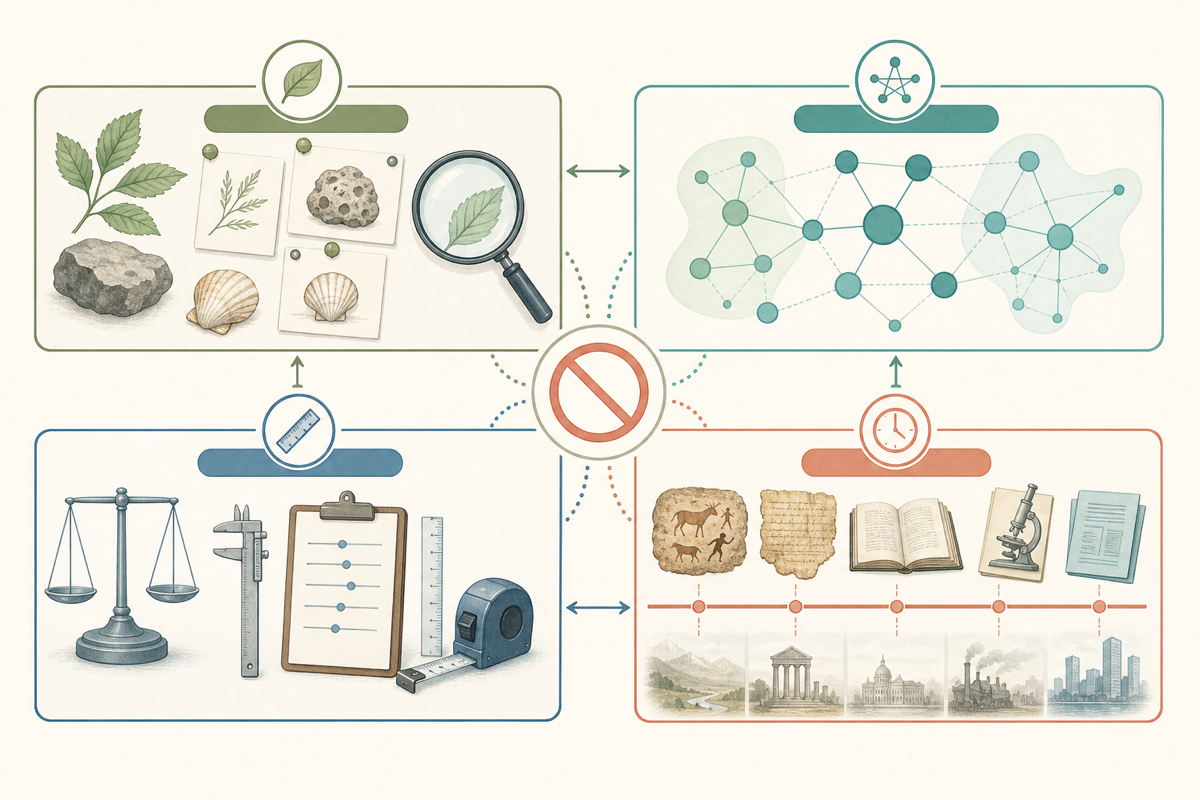
“Where did the Big Five come from?” sounds like a question about a year, but it contains at least three levels of inquiry.
The first concerns material: where do researchers obtain words describing personality differences? The second concerns structure: what patterns of shared variation do those words show in data from particular samples? The third concerns tools: how do researchers arrange broad dimensions into items, facets, and scoring rules?
These levels are related, but cannot substitute for one another. Words are not personality itself; a set of words that vary together is not a causal law governing a life; and a questionnaire is a measurement design developed by particular researchers for particular purposes. Compressing the entire process into “someone discovered five kinds of personality” makes it memorable, but erases the distinctions between material, methods, and tools.
When you encounter different “birth years” for the Big Five, you do not need to choose a side immediately. First ask whether the author means lexical work, a particular structural study, the gradual stabilization of five names, or a particular inventory version. A year without that distinction is at most a brief historical cue, not an account of the whole research history.
Everyday language offers an entry point that can be examined when researching personality differences. People describe one another with words such as “talkative,” “careful,” “willing to try things,” “prone to worry,” and “cooperative.” Organizing these words does not declare everyday language inherently correct or put people into a dictionary. It turns existing descriptive material into questions that can be tested further.
Goldberg’s (1990) paper is an important milestone along this research path. Its abstract describes research using English trait adjectives, examining a five-factor structure across multiple samples and factor-analytic procedures, and reporting that factors beyond the fifth did not generalize across samples. That scope must remain explicit: it is a report about its English vocabulary, samples, and analytic procedures, not proof that “five dimensions exhaust all of personality.”
A lexical starting point also helps prevent a common leap. A colleague calling someone “quiet” might mean that the person speaks little in unfamiliar meetings, prepares for a long time before speaking, or simply did not get a turn that day. A word can prompt observation; it does not automatically reveal someone’s inner essence or the causes of their behavior.
After collecting many descriptive words, researchers ask which words tend to occur together, and which are relatively independent, in a group’s self-ratings or ratings by others. Factor analysis is a family of statistical methods for finding patterns of shared variation among variables. It derives structure from data instead of forcing each person into a fixed category.
Think of organizing a box of mixed cards. The cards contain descriptive words, not someone’s “true identity.” If “organized,” “finishes on time,” and “thorough” tend to appear in similar ways in particular data, researchers might provisionally name that pattern as a broader dimension. Naming it is not the end: they still need to examine whether the pattern broadly recurs with other samples, ways of organizing words, or analytic procedures.
This structure is primarily descriptive, not a causal chain. Even if some words frequently occur together in research, that does not establish that “this person was born this way,” let alone whether they suit a particular career, can manage a relationship, or will achieve a particular outcome. Specific behavior also involves circumstances, roles, learning experiences, current stress, opportunities, and conditions that were not measured. The model’s history does not authorize us to skip those conditions.
Digman (1990) reviewed the topic under the title “Personality Structure: Emergence of the Five-Factor Model.” This review is used as a bibliographic milestone; its title alone does not establish a complete history. Read alongside Goldberg’s abstract describing earlier work over many years by several investigators, “emergence” provides a useful perspective on an accumulating research process rather than a single act of invention.
Readers do not have to memorize every name and year. This is more of a reading reminder: different research teams, sources of material, and analytic choices can become milestones in an account. Later research may restate, test, criticize, or refine earlier claims. Two articles emphasizing different years are not necessarily contradictory; they may simply treat different stages as the “beginning.”
When you see phrases such as “first proposed,” “formally established,” or “finally proved,” pause and ask whether they refer to a word list, statistical findings, a review milestone, or a particular inventory. Do they describe one study’s limited scope, or expand that scope into a universal conclusion? These questions are not a higher barrier to reading. They make historical accounts less dependent on heroic myths and more explicit about distinctions that can be checked.
There is no automatic leap from “research can identify a descriptive framework of five broad dimensions” to “a questionnaire measures it.” Item wording, the time frame respondents are asked about, and the inclusion of more specific facets are design choices for a particular tool. Structural language in research history does not automatically endorse any questionnaire.
Soto and John’s (2017) BFI-2 research provides a clear example. Its abstract describes a hierarchical model with fifteen facets nested within five broad dimensions, and the development of an initial item pool for that particular inventory. It shows how later measurement research can organize a broad framework into an explicit hierarchy belonging to a particular tool.
But “having facets” is not a more precise verdict on a person. It describes how this BFI-2 study defines and measures its constructs. It does not establish that all Big Five tools have the same hierarchy, or that everyone shows the same pattern in every setting. In particular, the existence of an inventory-development study cannot be transferred into validation of any website or product whose measurement details are undisclosed.
Xiao Zhou does not first need to find one uniquely correct timeline. The next time he reads an origin story, he can break it down with the four-part checklist below. This table is an editorial reading aid, not a validated rating scale; it asks each “origin” claim to explain what it is talking about.
| Claim you encounter | Its level | Understanding you can retain | What it does not directly establish |
|---|---|---|---|
| “Researchers began with personality words” | Research material | Everyday descriptive words can be a testable starting point | Words are people’s true essence, or every language produces the same result |
| “The analysis yielded five factors” | Statistical structure within samples | Shared variation among the study’s variables can be summarized as broad dimensions | Five dimensions explain everything or predict an individual’s future |
| “An inventory has dimensions and facets” | Design of a particular tool | That inventory organizes measurement according to a particular structure | All tools, versions, and language adaptations are identical |
| “The Big Five was born in a particular year” | Historical summary | The author may mean a particular research milestone | There is one inventor, or the history will never be revised |
For example, if you read “extraversion means being talkative,” put it in the first box initially: it may compress several descriptive words into an everyday expression. Then ask which people, materials, and methods produced a structure from those words, and whether the tool in front of you actually measures the same content. Only then examine whether the sentence has been expanded into “I dislike speaking, so I belong to a fixed kind of person.”
This checklist does not require you to accept or reject a label immediately. You can treat it provisionally as a description to observe, retaining examples that do not fit. Someone being silent at an unfamiliar gathering but actively leading discussions in a familiar team does not require an explanation that the model “works” or “does not work.” It simply reminds us that broad descriptions cannot override context.
Dimension names can easily become noun-like identities: “I am an extravert,” or “I am low in agreeableness.” A more careful statement is that a research framework tries to organize some reportable and observable differences using broad dimensions. It does not require a person to fit a word forever, and cannot reduce complex experiences to a single cause.
“I list risks first in conflict situations” is a description that can be observed further. “I am inherently difficult, so I will never be able to cooperate” has crossed into a fixed identity and a judgment about the future. The former allows examples, limits, and counterexamples to be sought in different situations; the latter removes circumstances, skills, relationships, and room for choice. The history of the Big Five’s emergence does not support that leap.
Likewise, encountering a dimension name cannot answer “Why am I this way?” Causal explanations need to be proposed and tested against a specific question, timeline, and evidence. A related descriptive word cannot replace that work. If difficulties substantially affect daily life, safety, or important relationships, online personality content cannot replace appropriate professional support.
This article discusses general research history and a limited example from the particular BFI-2 measurement study. It is not a technical description of FermatMind’s product. Check specific product information against the public technical explanation for the current version. Disclosure of scoring rules or norm status does not itself establish reliability, validity, cross-language equivalence, or predictive ability; these conclusions require evidence tied to the particular instrument, version, sample, and use. This article infers no product-validation result from general research history.
Goldberg’s lexical and structural research, Digman’s review bibliography, and the BFI-2 inventory-development research therefore cannot be transferred into validation of FermatMind. They cannot establish that product scores are accurate or comparable, predict careers, or define a person. Where a page does not disclose particular product information, the careful response is still to retain Unknown, rather than fill the gap with the general history of the Big Five.
The next time you see “the Big Five was born in a particular year,” add a question beside it: does that mean lexical material, statistical structure, a research review, or a particular inventory? Distinguishing that level already brings you closer to the actual research path than searching for a concise origin myth.
Sources checked: 2026-10-01.