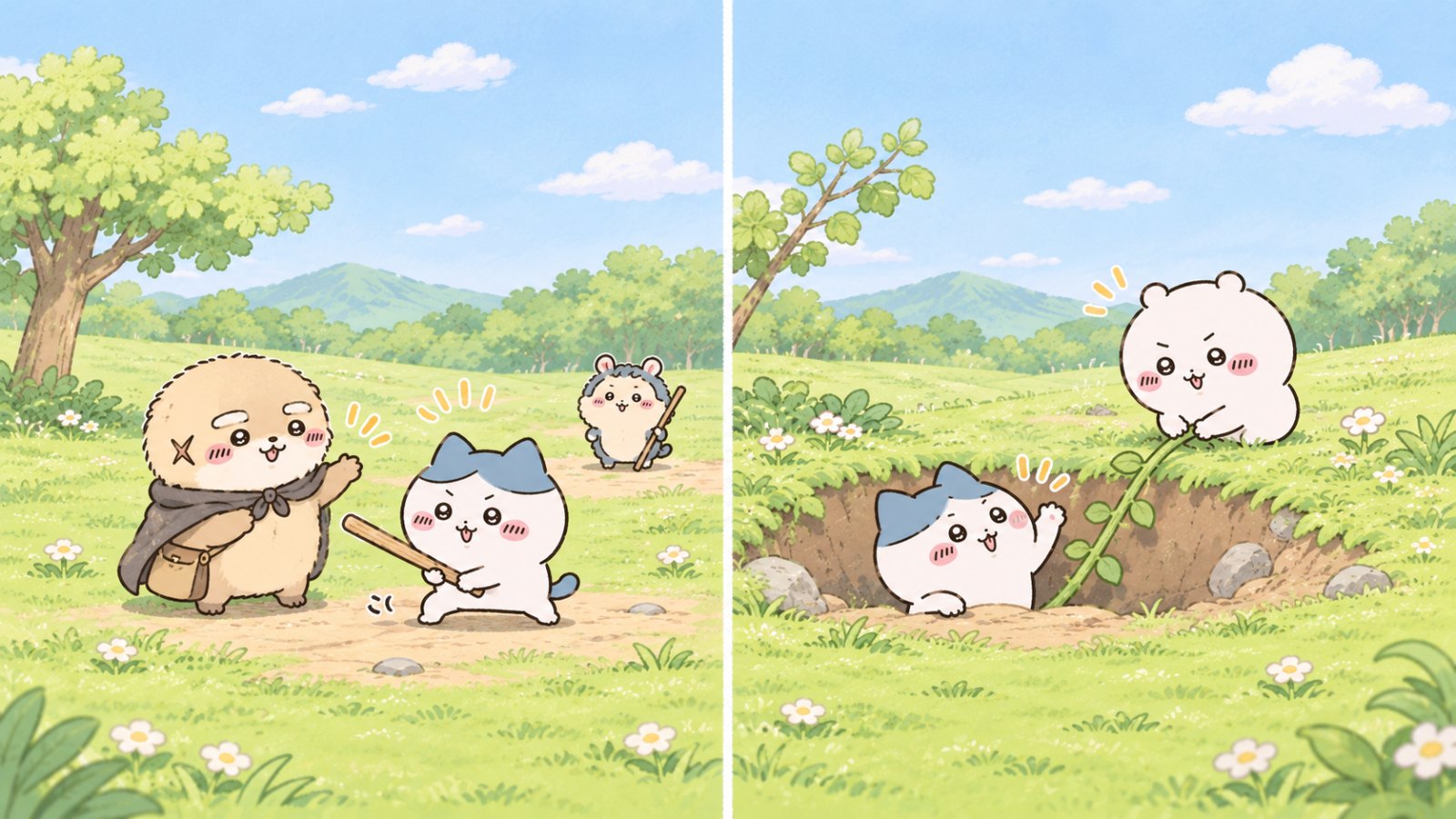
On a hunt in Chiikawa, Rakko leaves the finishing blow to a nervous Hachiware. In the pitfall story, Hachiware is the one in trouble, yet still calls out to stop Chiikawa jumping in. Both scenes capture the relief of having someone beside you who makes the next step feel possible. Spoilers follow for two stories in the Japanese TV anime.
Try a character scenario. When a friend says they’re scared, do you show them how to start or stay with them while they figure out what feels hard? Take the Chiikawa character quiz to explore how you might help in that little group of friends.
Quick take
- Rakko gives Hachiware a turn. Rakko makes one part of the job manageable and treats Hachiware’s contribution as real.
- Hachiware thinks alongside Chiikawa. Even from the pit, Hachiware helps a frightened friend pause and find another way.
- Two ways to help. You can make a task easier by demonstrating one step or make a hard moment easier by listening.
How does Rakko help Hachiware find courage in Chiikawa?
Rakko brings Hachiware along on the hunt and lets Hachiware land the final blow once the others have set it up. Hachiware gets to make a real contribution without having to handle the whole hunt.
Rakko sets out with another companion. Hachiware hangs back nervously at first, then steps forward for the last hit. It’s a small kind of courage: someone steadies things long enough for you to get your bearings, then hands you a step you can do.
Afterward, Hachiware is hesitant about accepting a share of the reward. When others have done so much, it can be hard to recognize that your part counted. Some of the confidence Rakko gives Hachiware comes from taking that contribution seriously.
The scene shows what it can look like to make a hard task accessible. The more experienced characters handle most of the coordination, while Hachiware gets a manageable action. The kindness is in how they divide up the work. Hachiware has room to learn at a different pace and still gets to participate.
A third companion is there too, so the result belongs to the group. Describing the hunt as a solo victory would erase the other characters’ work. Giving Hachiware no credit would erase the part Hachiware actually accomplished. A small contribution can still deserve recognition.
Hachiware goes from following at the back to having something to do in person. There is no sudden transformation into a veteran like Rakko. With someone alongside, Hachiware simply manages one more step than before. That modest progress is part of what makes the scene so comforting.
Why does Hachiware help Chiikawa feel less alone, even while scared?
In the pitfall story, Hachiware is stuck but stops Chiikawa from jumping down. The warning gives them time to find another option and lets a frightened friend know they’re still working together.
Chiikawa is ready to follow Hachiware into the pit. Hachiware calls out and Chiikawa turns back to find a vine. There is a later beat involving retrieving a weapon, but the most touching part of their cooperation is already there. Hachiware can warn a friend from inside the pit, and Chiikawa can keep helping after being told to stop.
Hachiware can’t search for the vine in Chiikawa’s place. What Hachiware can do is stay engaged while they consider the next move. Someone answers the friend who’s panicking, and the person in trouble still has a way to contribute. Both are involved in getting through the moment.
| Moment | Rakko on the hunt (ep. 343) | Hachiware at the pit (eps. 31–32) |
|---|---|---|
| What’s hard | Rakko and the other companion have experience; Hachiware is nervous | Hachiware is trapped; Chiikawa is about to jump in |
| What helps | Gives Hachiware a manageable part of the hunt | Warns Chiikawa about the danger, so Chiikawa looks for a vine |
| What it resembles | Show the hard part, then let a friend try | Hear the concern, then look for another option together |
What would you do? Rakko lets Hachiware land the finishing blow. From the pit, Hachiware helps with a warning. Do you tend to show someone what to do or stay with them while they think it through? Try the Chiikawa character quiz →
Being stopped doesn’t mean Chiikawa’s offer to help has been rejected. It gives those good intentions another route. Chiikawa pauses and scans the surroundings for something useful. The later attempt to retrieve the weapon changes the situation again. Hachiware isn’t pushing a friend away by naming the danger. It’s a way to keep thinking through the problem together.
Questions are useful when someone needs to think out loud. If they already understand the constraints and just need a demonstration, more questions can make them feel rushed. Giving them a task they never agreed to can be intrusive too. It helps to find out whether a friend wants ideas or would rather be heard first.
Hachiware’s position changes between the two scenes. In episode 343, experienced characters bring Hachiware into a hunt. In episode 32, Hachiware notices a danger someone else has missed, despite being the one in trouble. Having experience or a different vantage point can change who is able to help. That shift tells us more about their friendship than a blanket label such as “the optimistic one.”
For a quick rewatch, look for the three-person setup in the Japanese episode titled “先生と討伐①.” Then find the moment in the pitfall story when Hachiware stops Chiikawa. One scene follows whoever demonstrates and whoever gets a turn. The other follows the change from jumping in to finding something useful nearby.
Do you help like Rakko or stay with a friend like Hachiware?
Rakko gives Hachiware confidence by making it possible to try. Hachiware tells Chiikawa what’s worrying in the moment. With a friend, start by asking what kind of support would help.
Both scenes invite a simple question: whose next step is it? Rakko leaves part of the task to Hachiware, and Hachiware makes the risk clear while leaving Chiikawa free to try another idea. You can see Hachiware respond to a different kind of setback in how Hachiware comforts Chiikawa after the weeding exam.
The authors’ BFI-2 materials place compassion and consideration under agreeableness and put worry in a different domain. The Big Five guide to agreeableness can help you reflect on what you tend to do. The same person can feel for a friend, offer an idea, and still leave them space to decide.
- Ask where they’re stuck. If they want a demonstration, show them that step and give them a turn to try it.
- Say what each of you can see. When you’re thinking together, share the constraints and what you have available before choosing the next step.
Frequently asked questions
What’s the difference between how Rakko and Hachiware help?
Rakko guides by letting someone try; Hachiware helps a friend think things through. Rakko gives Hachiware a turn on the hunt, while Hachiware warns Chiikawa against jumping into the pit. The hunt is episode 343 in the Japanese numbering.
Who helps whom in the Chiikawa pitfall story?
They each help with a different step. In episodes 31–32, Hachiware stops Chiikawa from jumping down, and Chiikawa finds a vine. Neither action alone describes the full escape.
Why does Hachiware make Chiikawa feel safe?
Hachiware stays involved and leaves Chiikawa room to act. In the pitfall story, the warning gives Chiikawa a chance to pause and find the vine. They arrive at another option together.
Explore the characters and your own choices
- Try a fictional scenario. See how you would respond in an original, unofficial Chiikawa fan quiz. Start the Chiikawa character quiz →
- Reflect on how you help. Think about when you show consideration and when you give someone space. Explore your Big Five agreeableness →
- Read another Chiikawa scene. See how Hachiware responds when a friend is disappointed. Read how Hachiware comforts Chiikawa →
Story sources
Mezamashi Media episode overview · Chiikawa Park episode recap · ABEMA’s report on the pitfall story.

