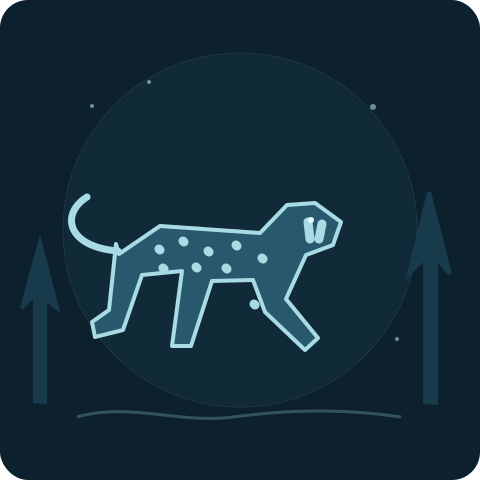
Commit energy to one direction once the moment is right.
Scale both this round’s counts and each fixed portrait coordinate by the corresponding dimension maximum, then sum the six squared differences: distance = Σ((round count − portrait coordinate) / dimension maximum)². Every equally smallest distance is retained, without list-order tiebreaks. Coordinates and mappings are original narrative design, not a research scale, resemblance probability, population percentile or magical ability.
The guardian image in this edition
Commit energy to one direction once the moment is right.
An original journey scene
You are not always running; when target and distance are clear, effort concentrates into one brief stretch.
A strength and a possible tradeoff
Commit energy to one direction once the moment is right. Speed needs deliberate recovery afterward.
Compare a nearby portrait
Compared with Kingfisher: Cheetah emphasizes focused execution over a short stretch; Kingfisher acts after longer observation.
One small thing to try
Set a short, clear action window and rest afterward.
Fixed reachable example: not your answers
This fixed 20-screen demonstration has six counts equal to this portrait’s coordinates, so its distance is zero and it reaches this portrait. It demonstrates reachability, not a real participant, a typical distribution or your experiences. Other answer patterns can also reach the same image.
Courage
9 / 17
Care
6 / 17
Observation
7 / 17
Patience
6 / 17
Playfulness
8 / 14
Independence
9 / 14
Expand all 20 demonstration choices
1. Which strengths would you lean on during this magical journey? Click all six from least to most relied on. You can undo and reorder.
2. A call for help comes from an unfamiliar corridor. What would you do first?
Respond first once basic safety is secured.
3. Someone is falling behind on a journey. What would you do?
Agree on a new pace and share a task they want help with.
4. An old map shows an unfamiliar symbol. What would you do?
Compare several clues and test an explanation with a safe small step.
5. A magical exercise shows little progress. What would you do?
Track small changes and continue at a sustainable pace.
6. At a night camp, which support would you offer? Choose any, including none.
Explicit none (0 items)
7. Rain keeps everyone at an inn. How would you spend the wait?
Turn ordinary objects into a little adventure people can join freely.
8. The group’s preferred route differs from your needs. What would you do?
State my boundary and take responsibility for my chosen route.
9. A shared decision needs someone to own the consequences. What would you do?
Volunteer for a key portion after clarifying risks and support.
10. A friend does not want to discuss what happened today. What would you do?
Ask whether quiet company or practical help would suit.
11. An explanation sounds compelling. How would you decide whether to trust it?
Ask which observable clues support it.
12. A companion needs more time to decide. What would you do?
Ask them to give an answer soon.
13. After an adventure goes badly, which approaches could help you recover? Choose any, including none.
Explicit none (0 items)
14. A first little experiment does not work. How would you try again?
Change one small detail and try again.
15. Someone has planned every step of your practice. What would you do?
Keep most of it and adjust one detail.
16. An important plan is publicly challenged. How would you state your position?
State my position clearly despite nerves, including what would change my mind.
17. Someone struggles with a shared task. How would you arrange your help?
Complete my own part first to keep things moving.
18. Two travellers describe the same event differently. What would you do?
Use the account of the person I know better.
19. A distant goal needs small repeated steps each day. How would you begin?
Wait for a chance to focus on it all at once.
20. Imagine your guardian appearing. What would you want it to remind you of? Choose any, including none.
Explicit none (0 items)
Scope and reading notes for this guide
This guide explains an original guardian image, six counts and normalized distance, with a fixed reachable example. It contains no private answer pattern and is not an official assignment, resemblance probability or psychometric result.
No. FermatMind independently authored this fan entertainment question set and animal portraits. It does not use the official algorithm or claim an official assignment within the story.
How is my result calculated?
Ranking positions,selected multiple-choice items and scenario answers add to six narrative-style scores. After scaling by each dimension’s maximum, the answer pattern is compared with 40 fixed portraits. All equally closest portraits remain in the result. Full rules and a reachable example for every result are public.
May I leave a multiple-selection question empty?
Yes. Each multiple-selection question offers an explicit continue-with-none action. Empty selection adds no points. Ranking requires all six items; each single-choice question requires one answer.